Erin O'Riordan writes smart, whimsical erotica. Her erotic romance novel trilogy, Pagan Spirits, is now available. With her husband, she also writes crime novels. Visit her home page at ko-fi.com.
David Aaronovitch is a British journalist. The central theme of his book is that conspiracy theories often come about when a large group of people has suffered an emotional loss. The conspiracy theory provides a narrative that makes the loss more palatable, more understandable.
While Aaronovitch sympathizes with the psychological aspects of conspiracy theorizing, he also emphasizes the real-life consequences when large groups believe things that are factually inaccurate. The chapters of his book provide several historical examples of this. The most dramatic may be how the demonstrable fraud of the Protocols of the Elders of Zion influenced a century of virulent anti-Semitism, including the Holocaust. When conspiracy theory is linked with scapegoating, there's a good possibility that people will die as a result.
Please note that Aaronovitch's analysis of conspiracy theories has neither a liberal nor a conservative bias. In his historical survey, what he sees is that neither side of the political spectrum is more prone than the other to believing in dark forces at work behind the scenes. What matters more is not the political bent of the theorizer but whether they feel disempowered and at a loss at the historical moment of the theorizing.
For example, the liberal/progressive side of the United States felt it was under attack and at a loss with the assassination of John Kennedy in 1963. As of the writing of this book, approximately half of Americans believed in some kind of conspiracy theory regarding the president's assassination. Aaronovitch brought up a historical fact rarely mentioned in Kennedy conspiracy circles: That Lee Harvey Oswald had tried to assassinate another politician previously, although his shot missed and no one was hurt. The note Oswald wrote to his wife Marina confessing this deed, in case he didn't return home, is still extant. Since this fact is inconvenient to "Oswald was framed" theories, it's rarely brought up in conspiracy circles.
Omitting inconvenient facts is a common characteristic of conspiracy theories, Aaronovitch argues. He mentions the glaring inconsistencies and outright untruths in the popular documentary Loose Change, which alleges U.S. government conspiracy in the September 11, 2001 terrorist attacks.
Another popular conspiracy theory in which popular narratives bend and twist the facts to fit the narrative is the suicide of Clinton White House aide Vincent Foster. Conspiracists, Aaronovitch demonstrates, take off-hand, non-professional, and uninformed statements made by those loosely attached to the incident, such as statements made by first responders, as if they were gospel truth.
This is called the Historian's Fallacy: The tendency to believe that a witness, having experienced an event that later turned out to have historical significance, must experience the event in the way that a historian would describe it. In reality, by definition, the witness can only know what they experienced at the time. They can't have foreknowledge of facts that will only become widely known after the event has been studied and investigations conducted. To expect a witness's offhand statement to be 100% accurate at the moment the witness is involved in an ongoing event is to fight the nature of reality itself.
And yet we see this all the time on YouTube. A tragic event such as a mass shooting (unfortunately common in the U.S.) happens and a witness, who may be a first responder, a child, or a person with no formal training in law enforcement, ballistics, etc. makes an offhand remark about the number of shooters, the number of gunshots, etc., and the conspiracy-minded YouTube video creator takes this statement as if it must be accurate. This is then conflated into the theory that there must be a cover-up of the "real" version of events that "they" don't want you to know.
If you've spent any time on YouTube at all, you probably know how common, and often disturbing, this is. It has led to lawsuits, in fact. Grieving relatives don't like being called liars or having non-experts with no connection to the event claiming that their dead relative is, in fact, a "crisis actor" who only pretended to be murdered so that Group X could try to get Law Z passed.
The fact is, for human societies to operate properly, there has to be a certain amount of agreement on what does and what does not constitute reality. Facts must be properly vetted and opinions must be grounded in facts that can withstand rigorous scrutiny. Otherwise we each live in our own fantasy worlds and none of those fantasies are compatible with each other.
This book was published in 2008, but even though it's a decade old, a thoughtful reader could easily apply what Aaronovitch lays out in his book to the U.S. election of 2016. In fact, he addresses the loss of power experienced by white American males as they perceive their world being threatened by advances made by women and by men of color. An antidote to the harmful scapegoating effect, Aaronovitch suggests, is for these men to gain the emotional literacy they would need to deal with their feelings as feelings, rather than externalizing them in a way that can have devastating consequences for the lives of the groups they see as the enemy.
I purchased a used copy of this book from Better World Books with my own funds and was not, in any way, obliged to review it.
The Anonymous Girl by Holy Ghost Writer (HGW) is the sequel to That Girl Started Her Own Country (review here). The first novel in this series is The Sultan of Monte Cristo, a contemporary follow-up to Alexandre Dumas' 19th-century masterpiece. Sultan followed the further adventures of Edmond Dantes, Mercedes, and Haydee; That Girl switched the scenery to the 21st century, following the adventures of a descendant of Dantes and his mistress Raymee.
At least one other volume of the series - The Sovereign of Monte Cristo, which I have read - takes place in the 19th century on an American plantation. Quite frankly, I'm not entirely sure what order the entire series is meant to be read in, but Sultan definitely comes first.
The protagonist of The Anonymous Girl is Zaydee, and she's still in the process of starting her own country. She doesn't know she's a descendant of Edmond Dantes and Raymee, but she seems to be edging closer to the truth about her heritage. She's also connected somehow to a secret society called the Sovereign Order of Monte Cristo. Like the previous book, this one hints at conspiracy theories, but very little is revealed. I keep hoping the next installation will tie things together in a neat package.
Within this fictional world, Zaydee may be the true identity of the fictional character Lisbeth Salander. Steig Larsson, in this fictional world, is a pen name of U.S. journalist named Steve Larson, and Steve is a former lover of Zaydee's. This volume introduces a new wrinkle to the story, though: Zaydee has an identical twin sister named Liz. Steve didn't realize they were two different people even though he had relationships with both of them - so, chances are, Lisbeth Salander is based on some characteristics of both sisters.
This time around, Liz is extremely concerned for Steve's safety, but Zaydee seems convinced he's safe but has been taken into some kind of custody for his own protection. This is the first time the sisters have spoken in several years.
Speaking of custody, Zaydee is still residing in a federal prison in Florida. She's getting increasingly fed up with the criminal justice system, and she uses her superior hacking skills to get some sweet revenge on a couple of FBI bozos. These scenes are typical of the wicked humor throughout these stories, some of what makes them so fun and enjoyable.
Zaydee has really grown on me as a character, partly because she's so smart and competent, and partly because in some ways she resembles her famous ancestor The Count. She plays fast and loose with the American legal system, but you can't help but root for her dream of starting her own micro-nation with mostly women in all the important positions of state.
A new character in this volume is Remey, the heir of a biotech company whose father is working on a transhumanist project involving manipulating the human genetic code and furthering evolution at a greatly sped-up rate. Zaydee throws a spanner in the company's works, much to the chagrin of Remey's father. Remey takes Zaydee's side, turning his back on his family and his connections to a second secret society, Skull and Bones. Remey's character is well-written because when he comes into Zaydee's life on one of her excursions outside prison walls, it's unclear whether he's going to be an asset or a liability to her. By the end of the novel he seems to be trustworthy, but there's a bit of mystery to his character.
This fast-paced series continues to draw me in, and I look forward to reaching the end and having some answers to the questions raised by the secret societies and the exact nature of the link between the present day and the Count of Monte Cristo's time. I tended to take the series a little too seriously at first. You have to have fun with it. It's like a fun, breezy Dan Brown thriller.
"Holy Ghost Writer" is the pen name of an undisclosed author. The person who discovers his or her true identity has the opportunity to win a $1,000 prize. To enter, one has to e-mail a guess to prize AT sultanofmontecristo DOT com.
I purchased this book with my own funds from Barnes and Noble.
This is an affiliate link:
Erinyes by George Saoulidis. $4.99 from Smashwords.com When a sheltered teenager starts noticing a hazy face following her in her photographs, she begins to investigate an urban legend. But will she uncover the truth when she gets in trouble with a technology corporation, when an enigmatic hacker starts telling her conspiracy theories and when the hazy face becomes all too real and starts chasing her non-stop?
In January, when I read The Sultan of Monte Cristo by Holy Ghost Writer*, I didn't quite know what to make of the modern sequel to Alexandre Dumas' classic The Count of Monte Cristo (which I also read in January of this year). Recently, when the author approached me on Goodreads about reading the sequel, That Girl Started Her Own Country, I didn't know what to expect.
I was pleasantly surprised by That Girl Started Her Own Country; I really enjoyed it. It appears to be only loosely linked to Sultan - the main character, Zaydee, is the great-granddaughter of Raymee, an original Holy Ghost Writer (HGW) character introduced in Sultan. Early in That Girl, Zaydee is arrested and taken in federal custody in the United States. She won't reveal her real name, and lets the authorities believe she's royalty from another country (a very Count of Monte Cristo thing to do). She intends to become just that - the sovereign of her own micronation, which will be largely a gynecocracy.
It's strongly suggested that Zaydee is the real-life inspiration for Lisbeth Salander in Stieg Larsson's Millennium trilogy that starts with The Girl With the Dragon Tattoo. HGW makes mention of time Zaydee has spent in psychiatric institutions; since this is the reader's first introduction to Zaydee, it appears that HGW assumes the reader is familiar with Lisbeth's story (which includes psychiatric hospitalization) and can make the connection. Zaydee also uses the nickname "Pippi Longstocking," which is likely another reference to Lisbeth, who is sometimes thought to be an adult version of the beloved children's book character. I am a bit of a disadvantage here as a reader, since I haven't read any of Larsson's novels. (I did read the summary of The Girl With the Dragon Tattoo on Wikipedia, though.)
Larsson himself becomes a character in the novel; he's Zaydee's former boyfriend, a journalist who wrote the Millennium books under a Swedish pseudonym, but who is actually an American named Steve Larson. In this novel, he's investigating the Bilderberg Group (a favorite topic of conspiracy theorists, or individuals we might categorize by the less-pejorative term "proponents of non-mainstream theories"), and Zaydee is giving him false leads so that his real investigation does not endanger his life and his work.
Granted, this novella suffers from some of the same faults as its predecessor: HGW gives us tantalizing bits of information, but those hints don't necessarily get fully explained by the end of the novel. The narrative doesn't always flow very smoothly, jumping from place to place and introducing new characters without much transition. That said, all of the various theories and characters who pop up in these books may very well be explained and unified by the time this series is concluded. I'm more confident in the author's ability to pull off an overarching storyline than I was when I'd only read Sultan.
I also happen to know from conversing with the author and glimpsing a later volume that the Sultan (the former Edmond Dantes), Haydee and Raymee make an appearance in a later volume.
The next book in the series is The Boy Who Played With Dark Matter.
Disclosure: The author provided a paperback copy of this book to me at no cost. The opinions presented here are entirely my own. I am an Amazon.com affiliate; if you make a purchase from Amazon after clicking through a link on my site, I'll earn a commission of a few cents.
*HGW sponsors an ongoing contest; whoever can guess his true identity wins $1,000!
This is an affiliate link:
Erinyesby George Saoulidis. $4.99 from Smashwords.com When a sheltered teenager starts noticing a hazy face following her in her photographs, she begins to investigate an urban legend. But will she uncover the truth when she gets in trouble with a technology corporation, when an enigmatic hacker starts telling her conspiracy theories and when the hazy face becomes all too real and starts chasing her non-stop?
Content Warning (CW) for discussion of child abuse. The Bourne Identity
YouTube recommended this video to me the other day.
This video is a bit silly. Mario is essentially just reading an article he found on the (unaffiliated with him) website The Vigilant Citizen. The article is from June 2012, and it includes photos of Twilight stars Robert Pattinson and Kristen Stewart - separately - in photo shoots from glossy fashion magazines. The article makes reference to MK Ultra, a favorite among conspiracy theorists a.k.a. alternative media sources. (No judgment - remember, I like to examine so-called conspiracy theories through the lens of modern folklore and urban legends.)
Here's how the theory basically goes, according to my understanding:
- During/after the Korean War, the U.S. government saw the American prisoners of war were being manipulated by their North Korean captors to say anti-American things. (This part seems to be factual.)
- As a defense strategy, the U.S. began researching ways in which the human mind can be controlled. The "MK" part stands for "Mind Kontrol." Part of the U.S. government experiments under this program involved giving doses of hallucinogenic drugs, including LSD, to people without their knowledge or consent. (This part is factual and documented.)
- Although the program was alleged to have ended in the 1970s, it continues today. Actors, musicians, and other popular culture figures undergo mind control experimentation that makes them into Jason Bourne-type "puppets" who can be triggered by their handlers into performing whichever action their handlers want them to take. The process involves taking these people into a secret place where they are abused and tortured until their minds split like people with dissociative disorder. They come out with alternate personalities that don't know what the other personalities are doing. Common triggers include Disney movies, Alice in Wonderland symbolism, and Wizard of Ozsymbolism (This part is speculative.)
Mario is an interesting vlogger. I don't see eye to eye with him on many, many issues. He's anti-feminist, for example, and he doesn't believe in the theory of evolution. I'll never quite understand why a certain segment of the Christian population has to reject the scientific method, but hey, that's just me (and people who believe in a rational universe). But I think he's basically coming from a well-intentioned place, even if his "facts" are intellectually questionable. I say this so you know my intention is not to mock or disrespect him. On a person-to-person level, I kinda like the guy. Like me, he was raised as a Roman Catholic. He's a French Canadian who learned English as a second language.
Ellie Goulding's "Lights"
At this point, I have been exposed to enough YouTube and blog material by The Vigilant Citizen, Mario the Vigilant Christian, and others to be able to "talk the talk" of MK Ultra, as you'll see below. If I were going to pick out a song to use as an example of mind control talk in popular media, that song would be "Lights" by Ellie Goulding.
I know you can interpret the lyrics of just about any song to mean whatever you want them to mean. In college I once wrote a paper about how the lyrics of Hole's song "Violet" could be interpreted as a warning about the dangers of alcohol abuse and another paper on how the Beatles song "I Am the Walrus" was John Lennon's plea for American authors, but especially Edgar Allan Poe, to be taken as seriously by the literary world as classical British authors. I knew those things weren't intended by the songwriters, but at the time I thought it was humorous to tortuously over-interpret things for allegedly comical effect.
So, please take this with a large grain of salt and, perhaps, a rocks margarita.
I hear "Lights" quite often on the station Tit Elingtin and I listen to on our day job as remodeling contractors. We listen to an "easy listening" station, while essentially means Top 40 radio without the rap songs. I liked the way the song sounded before I even listened to all the lyrics. I started to like Ellie Goulding even more when I heard her song "High For This (The Weekend Cover)." Then, of course, she contributed the song "Beating Heart" to the Divergentfilm soundtrack. It was one of my favorite songs for a while.
BUT I can't stand her song "Burn." I just find the very high-pitched section of this song incredibly annoying. Sorry. Even the best musical artists have an occasional fail. Now back to "Lights."
According to SongMeanings.com, which lets anyone add their comments on what they think the song means, the simplest explanation of this song is that it's about Goulding's childhood fear of the dark. She was afraid of the dark, so she had to sleep with a light on in order to feel safe.
Other theories think the song refers to:
- A battle with depression or another mental illness, such as schizophrenia
- Childhood sexual abuse
- An encounter with an extraterrestrial spacecraft and/or Goulding herself being from another planet.
Lyrics
Let's look at the lyrics of "Lights."
I had a way then losing it all on my own I had a heart then but the queen has been overthrown And I'm not sleeping now, the dark is too hard to beat And I'm not keeping now the strength I need to push me You show the lights that stop me turn to stone You shine it when I'm alone And so I tell myself that I'll be strong And dreaming when they're gone 'Cause they're calling, calling, calling me home Calling, calling, calling home You show the lights that stop me turn to stone You shine it when I'm alone home Voices I play within my head Touch my own skin and hope that I'm still breathing. And I think back to when my brother of my sister slept In an unknown place the only time I feel safe You show the lights that stop me turn to stone You shine it when I'm alone And so I tell myself that I'll be strong And dreaming when they're gone 'Cause they're calling, calling, calling me home Calling, calling, calling home You show the lights that stop me turn to stone You shine it when I'm alone home Light, lights, lights, lights Light, lights, lights, lights (Home, home) Light, lights, lights, lights Light, lights You show the lights that stop me turn to stone You shine it when I'm alone And so I tell myself that I'll be strong And dreaming when they're gone 'Cause they're calling, calling, calling me home Calling, calling, calling home You show the lights that stop me turn to stone You shine it when I'm alone home Home, home Light, lights, lights, lights Light, lights, lights, lights... Writers: Ash Frances Howes, Lorin Ashton, Ellie Goulding, Richard StannardCopyright: Sony/ATV Music Publishing (Uk) Limited, Major 3rd Music Limited, Amorphous Music, Global Talent Publishing Interpretation The first line could refer to a childhood fear of the dark: "I had a way then (when I was a child) of losing it (losing my fear of the dark) all on my own (I simply turned on my night light)."
Creative Commons image by Marple Bridge Photography
The second line, though, seems a little strange in that context. The queen has been overthrown? That fits more with the mental illness theory - the "queen," or rational part of her mind, has been "overthrown" or overwhelmed by the illness. It also makes sense according to the childhood sexual abuse theory: she had a heart then (as a child, before she was abused) but then she learned to shut off her feelings after "the queen was overthrown," which could refer to an adult authority figure, such as her mother, being unable to keep her safe from the abuse. Of course, both mental illness and sexual abuse could be considered part of MK Ultra-type conditioning - a child who is being groomed to be a pop star is abused until her mind splits, and that way she'll be easily controllable.
The chorus starts off with, "You show the lights that stop me turn to stone/You shine it when I'm alone/And so I tell myself that I'll be strong/And dreaming when they're gone." Now this seems to be saying the opposite of what we might expect. The lights were supposed to protect her from fear of the dark, right? So why is saying that the lights "stop me?" This speaks to the alien theory, I suppose: the lights that stop her are the sudden lights from a spacecraft that appear. She is either stopped simply by curiosity, or paralyzed with fear of them, or the extraterrestrial beings have stopped her somehow.
Some theorists, depending on their point of view, would go so far as to claim that aliens are synonymous with demons. They say that when people think they are abducted by aliens, they are really being tormented by fallen angels. If we are going with the MK Ultra theory, then we'd probably say that the handlers who perform the abusive experiments disguise themselves as aliens--or that they're somehow in league with actual aliens, who may or may not be fallen angels.
Creative Commons image by Mingle Media TV
The "I tell myself that I'll be strong" could refer to being strong in the dark when there are no lights - a simple enough explanation, although it doesn't seem to match up with "lights that stop me, turn to stone" line. What does turning to stone mean, anyway? Shutting off one's emotions so that one is as imperturbable as stone, perhaps, which fits with the abuse theory.
"Dreaming when they're gone" seems to fit this theory as well; the child cannot sleep until her abusers are gone. What would "they're" refer to in the context of fear of the dark? Nightmares, perhaps. Maybe she simply means that sleeping in the dark makes her prone to nightmares.
The "calling me home" of the chorus is why some people interpret this song to mean that Goulding herself has come from the star people. The lights call her home? Why, that's her fellow extraterrestrials coming back to claim her. Alternatively, we might say that the lights calling her home are some kind of signal or trigger that her handlers use when it's time for her to "come home" to be reprogrammed. The "reprogramming" process is painful and frightening, and that's why the singer seems to be so scared and depressed.
In the second verse, "Touch my own skin and hope that I'm still breathing" sounds a bit ominous, but fear - including simple childhood fear of the dark - could do that to a person. But then she sings something rather strange: "And I think back to when my brother of my sister slept/In an unknown place(,) the only time I feel safe." The only time she feels safe is when her brother and sister slept in an unknown place - now that seems odd. If a child were simply scared of the dark, wouldn't we expect her to say that she only felt safe when her brother and sister slept in her room with her, or when they were in the house with her - sort of a "safety in numbers" feeling? What is the "unknown place?" Is she saying that she wants her brother and sister to sleep away from where she is, because wherever she is is unsafe, and she wants to keep them safe? That line really makes it seem as if something other than mere darkness frightened her when she was a child.
In short, although this song is supposed to be about using light to ward off fear of the dark, the lyrics actually seem to be suggesting exactly the opposite - that the lights are failing to ward off the fearful thing that the dark brings, whatever that thing may be. But only the songwriters know for sure what they were thinking.
The content warning is for those who don't like to look at possibly-scary pictures. If that's you, do not scroll down the page.
On Thursday, September 11 of this year, I decided to stop by Loren Coleman's blog Twilight Language to see if Coleman had added any interesting updates lately. As you know, I'm an amateur folklorist. For my own personal satisfaction, I enjoy looking at non-traditional media and what might be called "conspiracy theories" through the lens of modern folklore and urban legends. Coleman isn't a "conspiracy" blogger per se, but his explorations into predicting patterns of human behavior often touch on weird phenomena.
I read the post titled "Tridents, Pitchforks, and Satan in the News" dated September 10th. It mentions the terrorist group ISIS (Islamic State of Iraq and Syria). You may recall that I mentioned ISIS, or ISIL, in my review of Religio Duplex the other day. Coleman's post talks about the persecution of the Yazidi (also spelled Yezidi) minority group by ISIS/ISIL.
According to Wikipedia, the Yazidis live primarily in northern Iraq and mainly speak the Kurdish language, although they consider themselves - and are considered by the United Nations - as an ethnic group separate from the Kurdish people. The article describes the Yazidi religion as combining elements of pre-Zoroastrian Iranian religion, Christianity, Gnosticism, Islam, Judaism, and Zoroastrianism, as well as an ancient nature-worshiping religion.
Quoting the U.K. newspaper The Guardian, Coleman mentions that the Yazidi's object of worship is a figure known as Melek Tawwus. To the radical ISIS group members, this makes the Yazidi people "devil worshipers" and, thus, legitimate targets. The cultural confusion may stem from the fact that another name for Melek Tawwus is Shaytan, which is the name the Koran uses to refer to Satan/the devil. However, the Yazidi people themselves do not use the word "Shaytan" and do not associate Melek Tawwus with evil acts.
Creative Commons image by PHGCOM
Coleman identifies an image similar to this one with Melek Tawwus, but also with "the same region's Assyrian demon Pazuzu."
The name Pazuzu rang a bell in my mind. Where, I thought, had I heard that name before? Then it occurred to me: Futurama. Pazuzu is the name of the dragon-like beast in Professor Farnsworth's care. The animated creature is rather cute.
Coleman mentions that the ancient artifact above would be "familiar from the Exorcist movies." I've only seen the movie once, several years ago, but I do seem to recall that the early scenes involve an archaeological dig in which the demonic-looking (or angelic-looking, depending on your point of view) statue is found.
Apparently, the name of the demon that possesses the 12-year-old character Regan in The Exorcist is named Pazuzu. Although the creature's name is never used in the film, it's revealed in the sequels and also in William Peter Blatty's novel on which the film is based.
So, did Futurama name the Professor's living gargoyle after the demon in The Exorcist? Probably not. According to The Infosphere, Futurama is filled with references to the role-playing game Dungeons and Dragons. In D+D, Pazuzu is the name of a demon prince - based, of course, upon a reference to Assyrian and Babylonian mythology. The Paris setting of the end of the episode, says the Futurama wiki, alludes to a graphic novel called The Demon of the Eiffel Tower by Jacques Tardi.
"A winged demon, feared by the people of ancient Mesopotamia. It is a creature with a deformed head, the wings of an eagle, the sharp claws of a lion on its hands and feet, and the tail of a scorpion. This demon is the personification of the south-east storm wind, which brings diseases. The Mesopotamians believed that Pazuzu lived in the desert."
Wikipedia elaborates that the south-east wind is associated with bringing famine in the dry season and plagues of locusts in the rainy season. However, Pazuzu's name may be invoked on amulets used to protect human beings from harm, since Pazuzu wards off the evil goddess Lamashtu. (Lamashtu, a she-demon who menaces women in childbirth and kidnaps young children, treads some of the same folkloric ground as Lilith.)
And why might William Peter Blatty have been interested in Middle Eastern people's ancient folklore? Because the New York-born American writer has two Middle Eastern parents, both from Lebanon. His mother's uncle was a well-known Christian bishop in Lebanon, and Blatty went to a Jesuit school as a youth. So, he is both an Arab and a Roman Catholic.
Most Lebanese people identify as ethnically Arab, although they are technically a lovely melange of several related West Asian ethnicities that includes the Arab people. If you don't believe me that people of Lebanese descent are quite lovely, you need only look at Amal Ramzi Alamuddin, the British human rights lawyer who's engaged to George Clooney. The lady is of most exquisite beauty.
Now 86 years old, Blatty is still writing. His latest novel was published in 2011.
By the way, if you go to Tumblr and search for pictures of Professor Farnsworth's rather cute-looking gargoyle beast, prepare to have the excrement scared out of you. A search of the tag "Pazuzu" brings up this hideous-looking thing.
The rational part of the brain knows that's just the actress Eileen Dietz, who appeared on the soap opera General Hospital, in a bald cap, makeup, and false teeth. The irrational part of the brain says DEAR GOD PLEASE GET THAT HIDEOUS MONSTROSITY AWAY FROM ME!
Dietz served as a body double for Linda Blair, the young actress who played Regan, in The Exorcist. She did the difficult "projectile vomiting" scene, for example. Images of Dietz in demonic makeup were inserted in key points in the film to heighten the viewer's discomfort and fear on an almost-subliminal level. These shots flash by so quickly, one is not really sure what one has seen, but it has still provoked a visceral fear reaction.
This post suggests the disturbing makeup was inspired by a Japanese film called Onibaba. According to IMDB, Onibaba is about a mother-in-law and daughter-in-law in feudal Japan who kill passing samurai and sell their possessions. The daughter-in-law takes an awful-looking, demonic mask off one of her victims and begins to wear it, only to find that soon it will no longer come off.
Blatty claims he based his fictional novel The Exorcist on a real-life exorcism that took place while he was a college student at Georgetown in 1949. (He says so in this opinion essay.) However, this does not mean that there was an actual documented case of demonic possession. The events that took place surrounding the 14-year-old boy who was believed to be "possessed" have been explained by psychology and possible trickery on the part of the adolescent in question. (He's referred to by the pseudonyms Roland Doe and Robbie Mannheim.)
Now, a personal note:
The Exorcist came out in 1973. My dad took my mom on a date to see it at a movie theater in downtown South Bend, Indiana. (The building is still there, but it's no longer a movie theater. It was most recently a venue for live music.) My mom, also raised as a Roman Catholic, was so terrified she hid her face in my dad's jacket for almost the entire thing. To this day, if she's flipping TV channels and happens to hear a bit of the theme music, she runs from the room.
Since you, dear reader, know that I'm a huge Marvel nerd, you may not be surprised to read that I've been watching WandaVision and, more recently, The Falcon and the Winter Soldier.
One character from the Marvel Cinematic Universe (MCU) who reappears in TFATWS is Baron Helmut Zemo. You may remember him from The Avengers: Civil War, in which he killed T'Chaka, king of Wakanda and father of its current king, T'Challa. He pinned the bombing murder on the Winter Soldier in hopes of tearing the Avengers apart from within.
I don't forgive Zemo for killing King T'Chaka. I do understand that part of his motivation for doing so was that the Avengers unleashed Ultron on the world. Ultron not only killed Wanda Maximoff's twin Pietro but also killed Helmut's father, wife, and son Carl. The Zemos, like the Maximoffs, are from the fictional country of Sokovia.
Baron Helmut Zemo is a complicated bad guy, less sympathetic than Black Panther's Erik Killmonger, but still with some sad widower Frank Castle vibes.
Zemo is played by Daniel Brühl, a Catalonian actor born in Barcelona to a Spanish mom and a German dad. Only yesterday I remembered that I'd seen him speaking German (one of his several native languages) in a movie once before: Quentin Tarantino's Inglourious Basterds (sic). I even wrote an unsolicited-by-anyone article about it, "Brad Pitt Is Not the Hottest Guy in Quentin Tarantino's Latest," written in 2010. It also singles out Michael Fassbender (before I knew he was an accused domestic violence offender - canceled) and Eli Roth.
Brühl's character in Inglourious Basterds is a Nazi. Tarantino, for all his flaws (accused of sexual harassment on several occasions and poor on-set treatment of his muse/ex-girlfriend Uma Thurman, whom I adore), at least clearly hates Nazis. Brühl's character, on the other hand, is cute but not sympathetic, giving off strong "Ralph Fiennes in Schindler's List" vibes. As I say far too often in these Nazi-infested modern times, where is the Bear Jew when I need him?
Zemo on TFATWS is more sympathetic, although I'm torn. Like Billy Russo/Jigsaw on The Punisher, he's a bit queer-coded. Billy Russo, a character who was known to have been sexually abused by a male predator as a young teen, embodied that problematic trope that queer people are queer because of their sexual trauma. Not only is this not supported by clinical evidence, but it also reinforces the mistaken notion that heterosexuality is the default for human sexuality and everything else is some kind of mutation or deviation from the norm.
It's my opinion that Billy Russo is queer-coded even though his two sexual relationships in the series are with women. He appears to be flirting with every other character he encounters, including Frank Castle. Your mileage may vary.
On the other hand, it's harder to argue that Daniel Brühl isn't playing Helmut Zemo as bisexual, especially after Episode 5. Zemo appears to be sexually attracted to Bucky Barnes (the Winter Soldier), lovingly caressing his face at one point.
Bisexual-coding your villains skirts dangerously close to the Depraved Bisexual trope, the notion that people without a clear gender preference are, in the words of TVTropes.org, "cold-blooded sociopaths." As a person without a clear gender preference and a non-sociopath, I take personal offence. Representation matters, and although I always want to see more bisexual and pansexual characters in the media, I want to see positive representation as well as regicidal criminals.
Daniel Brühl is totally adorable, though. Add him to my Fictional Harem, along with basically everyone else from the MCU.
I have an opening in my Fictional Harem, by the way. I had to kick Jim Caviezel out for being, unfortunately, an advocate of the impossible, nonsensical, illogical right-wing QAnon conspiracy theory. I'm fascinated with conspiracy theories as a species of contemporary folklore, but I cannot abide folk who take part in counterfactual disinformation campaigns that borrow tropes from anti-Semitism. As a person with an Irish-American dad and a Polish-Jewish-American mom, I won't allow my human rights as a Jewish person to be eroded in the service of white supremacist fears.
On Saturday I went to the discount bookstore, as I may have mentioned. I picked up three books in Nalini Singh's Psy Changeling series, as well as a stack of magazines (they sell them for $1 each) and, for only $1.40, Breaking the Da Vinci Code by Darrell L. Bock, Ph.D.
This last one is a 2004 book about Dan Brown's book that was first published in 2001. I know this is a subject that was popular 100 years ago in pop culture time, but if you've been reading this blog very long, you know I love to read about books I've read. This isn't the first time I've read a book that supplements The Da Vinci Code. I already own Da Vinci Code Decoded by Martin Lunn (which I've read) and The Unauthorized Dan Brown Companion edited by John Helfers (2006 - I have skimmed it, but not read it the whole way through).
Now I've read Breaking the Da Vinci Code. I very much enjoyed it. Bock is a Protestant Biblical scholar, and his book looks at various ancient texts mentioned in Dan Brown's book to show systematically, using the original source material, that 1) the books of the Bible are as authentic a historical source as any other ancient text, and probably much more so, and 2) the ancient texts show very clearly that the relationship between Jesus and Mary Magdalene was understood by witnesses of their time to be teacher/student, not sexual or a marriage relationship.
One of the sources that Bock addresses is Against Heresies (Adversus Haereses in Latin), a second-century work by Irenaeus, considered one of the "church fathers" and a Catholic saint. Irenaeus, a bishop of what is now Lyons, France, but which was then part of the Roman Empire, wrote in part to combat the Gnostic writings of Valentinus, which were popular in Lyons at the time. Valentinus was a Hellenic Egyptian; he or his followers wrote The Gospel of Truth, which was rediscovered in modern times at Nag Hammadi in 1945.
Bock quotes Frederica Mathewes-Green, an Eastern Orthodox Biblical scholar, in her magazine article "What Heresy?" (Books and Culture, November-December 2003). Mathewes-Green wrote:
"The version attributed to Valentinus, the best-known Gnostic, is typical. Valentinus supposedly taught a hierarchy of spiritual beings called 'aeons.' One of the lowest aeons, Sophia, fell and gave birth to the Demiurge, the God of the Hebrew Scriptures. This evil Demiurge created the visible world, which was a bad thing, because now we pure spirits are all tangled up in fleshy bodies. Christ was an aeon who took possession of the body of the human Jesus, and came to free us from the prison of materiality.
"'Us,' by the way, didn't mean everybody. Not all people have a divine spark within, just intellectuals; 'gnosis,' by definition, concerns what you know. Some few who are able to grasp these insights could be initiated into deeper mysteries. Ordinary Christians, who lacked sufficient brainpower, could only obtain the Demiurge's middle realm. Everyone else was doomed. Under Gnosticism, there was no hope of salvation for most of the human race."
Bock explains that "demiurge" is simple a Greek word that means "maker" or "builder," referring to the making of the material world.
If the story of the cosmic spirit-being Sophia giving birth to evil sounds vaguely familiar, it may be that you, like me, are a fan of Lady Gaga. It's the bones of what Lady Gaga wrote in "The Manifesto of Mother Monster" in the full-length "Born This Way" video.
This is the text of the manifesto:
This is the manifesto of Mother Monster:On G.O.A.T, a Government Owned Alien Territory in space, a birth of magnificent and magical proportions took place. But the birth was not finite; it was infinite. As the wombs numbered, and the mitosis of the future began, it was perceived that this infamous moment in life is not temporal; it is eternal. And thus began the beginning of the new race: a race within the race of humanity, a race which bears no prejudice, no judgment, but boundless freedom. But on that same day, as the eternal mother hovered in the multiverse, another more terrifying birth took place: the birth of evil. And as she herself split into two, rotating in agony between two ultimate forces, the pendulum of choice began its dance. It seems easy, you imagine, to gravitate instantly and unwaveringly towards good. But she wondered, “How can I protect something so perfect without evil?”
That the text represents Gnosticism is not my idea, but rather something I read at MKCulture (which you may remember from last year's conspiracy theory post), an inactive blog that is, as of this writing, still able to be accessed. The blogger doesn't elaborate much in the blog post "Descendants of Sophia," but writes, "In my last post I explored the ever-present theme of the Goddess archetype within the context of pop culture. That inquiry ended with 'Born This Way,' the latest [as of April 2011] music video from pop star Lady Gaga. In the video Lady Gaga embodies Gnostic Goddess Sophia." The rest of the post veers off into Kate Bush's album, Elliot* Page's career, and then goddesses associated with the owl and the peacock.
The blogger has a YouTube account as well, on which this video can be found. It explains the Gaga-as-Sophia concept in a little bit of detail.
If you want the full "Illuminati" explanation of this same video, visit Vigilant Citizen's "Born This Way" post. I'm not much for Illuminati conspiracy theories. I don't doubt that a small group of people has far more power than it should in this world, and that they probably have some screwed-up ideas about how the world should run, but I also believe pop culture is run more by a quest for increased profit than by some sort of ideological (Masonic/Luciferian/Satanic - depends on who you ask) cabal. But it's there to read, if you want it.
Madonna may be the Material Girl, but Lady Gaga-as-Sophia gave birth to the creator of the material world. Maybe that's why "Born This Way" subtly samples Madonna's "Express Yourself," according to some listeners.
My trusty Woman's Encyclopedia of Myths and Secrets has more than two pages on Sophia, under the heading "Saint Sophia."
Barbara J. Walker describes Sophia (the name literally means "wisdom" in Greek) as "God's mother" but also the shakti, or female soul/power source, of God. Her symbol was the dove, as some of her incarnations include Aphrodite, Isis/Hathor, and "The Holy Ghost." She writes:
"Some said Jesus became Sophia's spouse and his glory depended on this sacred marriage; for he was only one of the Aeons, a minor spirit, the 'common fruit' of the Pleroma [the Gnostic "one true God," a transcendent being].
"Some said Sophia was also Jesus's mother, for she was the Virgin of Light whose spirit entered into the body of Mary to conceive him...Some said Sophia was to God as Metis was to Zeus, his 'mind.'"
Walker goes on to report that when the Church of Hagia Sophia was constructed in Constantinople in the 6th century, it was a shrine to Sophia the Goddess, but to cover up the appearance of goddess worship, Christians made up the "virgin martyr" Saint Sophia. Walker cites the 8th and 9th chapters of the Biblical book of Proverbs as having an ambivalent attitude toward Sophia, or wisdom.
In one passage, following Wisdom is to be praised, but in another, "she sitteth at the door of her house, on a seat in the high places of the city [her temple]," calling to passersby to turn toward her, but if anyone turns into her temple "he knoweth not that the dead are there; and that her guests are in the depths of hell." Walker sees this as two factions - one in favor of worshiping the Goddess Sophia and another that worships only the male God - having a debate.
If Sophia is thought of as the mother/spouse of Jesus, and she's associated with the "high places of the city" (the temple or watchtower, magdala in Hebrew), it's possibly Sophia is also associated with Mary Magdalene.
Perhaps this is another reason why Lady Gaga appears as a Mary Magdalene figure in her "Judas" video, which came out after "Born This Way."
(However, after having watched a little video about Kenneth Anger and Hollywood Babylon the other day, I learned about Anger's experimental film Scorpio Rising. In it, Anger intercut clips of a Biblical drama featuring Jesus with footage of a leather-clad biker, set to 1950s rock 'n roll. The "Judas" video may be an homage to Scorpio Rising. Now, Kenneth Anger - he was openly a Satanist, and would proudly have told you he followed the teachings of Aleister Crowley.)
Neo-Gnosticism is a favorite topic of a blogger I mentioned yesterday, Christopher Loring Knowles. He seems to genuinely believe there is a world of spiritual or energy beings, hidden from us most of the time in the material world, but which seems to break through at times and communicates with us in a language of symbols and coincidences (synchronicities).
VISUP will occasionally mention Gnosticism as well. In one post, VISUP mentions that some Gnostics referred to the Demiurge as Samael, which VISUP says means "blind idiot." Where have I read that name before? In Devil's In the Details, where Samael is the name of Satan's fiance. Synchronicity? Maybe. Dog days of summer weirdness? It's a little early for that, but perhaps.
December 2, 1984: Union Carbide’s pesticide plant in Bhopal, India, is so poorly maintained it causes the largest industrial disaster in history. The accidental release of methyl isocyanate causes the immediate suffocation deaths of more than 2,000 people, injuries in more than 50,000 people, and an additional gas-related death toll of perhaps another 8,000 people. Although the Indian government charged Union Carbide executives with homicide, the company claimed it was not under Indian jurisdiction and these officials did not appear in court to face these charges.
December 3, 1935: Linguist Milman Parry, 33, an assistant professor at Harvard University whose work introduced the serious study of oral storytelling tradition to academia, travels to Los Angeles with his wife Marian. Marian’s mother, who lived in California, had been the victim of some financial abuses. The Parrys came to help her; Milman packed a revolver in his suitcase, as he’d done on earlier trips to then-Yugoslavia, where he’d collected recordings of Bosnian oral poetry. This time, when the Parrys went to change for dinner in their room in the Palms Hotel, the revolver became entangled in a shirt inside Milman’s suitcase. Its safety catch was not engaged. As Milman reached into the suitcase, the revolver discharged, shooting him through the heart and killing him.
December 4, 1987: Children’s book author and illustrator Arnold Lobel dies of AIDS-related cardiac arrest. He is 54 years old.
December 5, 1931: Poet Vachel Lindsay dies by suicide after intentionally drinking a bottle of lye. His last words are reportedly, “They tried to get me; I got them first!”
December 5, 2016: A 28-year-old man from North Carolina arrives at Washington, D.C.’s Comet Ping Pong pizza restaurant armed with a rifle and two additional firearms. The man, who had been reading completely falsified conspiracy theories that the restaurant served as a front for child abuse by D.C. elites, threatened staff with the weapons and fired the rifle in the restaurant’s kitchen, apparently a “warning shot” not directed at anyone. He is arrested before anyone inside the pizza place is hurt. In March 2017, the man pleads guilty to federal weapons charges and judge Ketanji Brown Jackson (not yet an associate justice of the U.S. Supreme Court) sentences him to four years in prison. He is released from prison in 2020.
December 7, 1941: A surprise attack on U.S. territory by the Japanese military at 8 a.m. on this Sunday morning kills 2,403 Americans (2,335 military personnel and 68 civilians) and wounds 1,143. The attack on the U.S. naval base on the Hawaiian island of Oahu was intended to incapacitate the Pacific Fleet of the American Navy, even though the U.S. was officially neutral in World War II at this time.
Among the wounded was my paternal grandfather Bill, 17 years old at the time. He was blown off his ship (the USS West Virginia) and knocked, unconscious, into the water, awakening in the base hospital with a shoulder injury. He recovered and was reassigned from pharmacist’s assistant to EMT so he could help care for the more seriously wounded sailors.
December 7, 2010: Kim Tinkham, age 36, dies of what was most likely metastatic breast cancer. Tinkham had appeared on The Oprah Winfrey Show in 2008 to talk about the then-popular book The Secret. Tinkham claimed her Stage 3 breast cancer had been successfully treated with alternative medicine. The doctor who appeared with Tinkham on that show and backed up her claim, Robert Oldham Young, was arrested in 2014 and convicted in 2016 for theft and practicing medicine without a license.
Young’s claim was that cancers are caused by an imbalance of the body’s pH and that an “alkaline diet” can treat and prevent cancer. Little to no scientific research supports this claim.
December 8, 1980: John Lennon is murdered by handgun outside his apartment building in New York City.
December 9, 1977: In the NBA, the L.A. Lakers play the Houston Rockets. At the beginning of the second half of the game, Laker Kareem Abdul-Jabbar and Rocket Kevin Kunnert scuffle over a rebound. In the scuffle, Kunnert elbows Abdul-Jabbar’s teammate Kermit Washington. Washington punches Kunnert in the head.
Kunnert’s teammate Rudy Tomjanovich runs over, intending to help break up the fight. Washington takes a swing at Tomjanovich, striking him in just such a way that fractures his skull. Tomjanovich falls to the court, unconscious and bleeding, although he quickly recovers and, apparently due to a rush of adrenaline, walks around the court in a seemingly aggressive manner. Tomjanovich doesn’t know it yet, but in addition to a broken jaw and nose, he has a fracture near the base of his skull leaking cerebrospinal fluid. He has to be rushed to the emergency room and given emergency surgery, since this is a life-threatening skull fracture. Tomjanovich requires five months of physical recovery before he can play again.
December 9, 1995: American author Toni Cade Bambara dies of colorectal cancer at the age of 56.
December 10, 1816: The body of Harriet Westbrook Shelley, the estranged wife of Percy Shelley and the mother of his son and daughter, is discovered in the Serpentine River. She is pregnant and has apparently died by suicide. She is only 21 years old.
December 10, 1929: Poet, publisher, and World War I veteran Harry Crosby kills his mistress, Josephine Noyes Rotch, and himself inside a friend’s apartment. Crosby’s wife Caresse becomes worried about her husband’s whereabouts when he fails to show up for a dinner party with the poet Hart Crane. Crane will also die by suicide two years later.
December 11, 2021: Anne Rice dies at the age of 80 of complications from a stroke.
December 12, 1999: Satirical novelist Joseph Heller dies of a heart attack at the age of 76.
December 13, 2011: Gianluca Casseri, a far-right author, Germanic neo-Pagan, devotee of American fascist Ezra Pound, and historian of J.R.R. Tolkien goes on an anti-immigrant shooting spree in Piazza Dalmazia, Florence, Italy. He shoots five street vendors who are all immigrants from Senegal, wounding three and killing two. Casseri then kills himself.
December 14, 1920: George “The Gipper” Gipp, legendary Notre Dame football player, dies of strep throat and pneumonia in St. Joseph Hospital (then in South Bend, now located in Mishawaka). He is 25 years old.
George Gipp is buried in his native Michigan, but an often-told legend around the Notre Dame campus is that Gipp's ghost haunts the old theater building, Washington Hall. According to the legend, when Gipp missed curfew and got locked out of his dorm building, he would sleep outside Washington Hall.
December 14, 1944: Golden Age of Hollywood actress Lupe Vélez dies by suicide, taking 75 barbiturate pills with a glass of brandy. Her secretary found her body lying in Vélez’s bed and not, as urban legend has it, drowned in her toilet.
December 14, 1995: 28-year-old professional skydiver Rob Harris dies while filming a Mountain Dew commercial. The commercial, a James Bond spoof in which a Bond-like figure snowboards out of an exploding plane, is aired featuring previous takes, but none of the footage from Harris’s final jump, contrary to urban legend. Harris’s fatal fall is triggered by tangled lines and a backup chute that fails to deploy in time.
December 16, 1913: Ambrose Bierce writes to his literary secretary, “I am going to Mexico with a pretty definite purpose which is not at present discloseable. If you hear of my being stood up against a Mexican stone wall and shot to rags, please know that I think that’s a pretty good way to depart this life. It beats old age, disease, or falling down cellar stairs. To be a Gringo in Mexico–ah, that is euthanasia!” Neither Bierce’s literary secretary nor any of his other acquaintances ever hear from him again after this letter. He’s presumed to have died in Mexico, perhaps in an early example of “suicide by cop,” or in this case, suicide by revolutionary.
December 16, 1988: Disco singer Sylvester James dies at his home in San Francisco from AIDS-related illness. He’s 41 years old.
December 17, 2021: Visual artist, classic album cover designer, and novelist Eve Babitz dies at age 78 from Huntington’s disease, the same hereditary neurodegenerative disease that killed Woody Guthrie.
December 18, 1966: Tara Browne, the heir to the Guinness stout fortune, dies in the hospital one day after crashing his Lotus Elan sports car into a parked truck. Browne had been driving at over 100 miles per hour through London and sped through a red traffic light before crashing. Browne’s passenger, model Suki Potier, was not injured in the accident.
In popular cultural, Browne is remembered as the man who “blew his mind out in a car” in the Beatles song “A Day in the Life.” Browne and Paul McCartney and John Lennon were acquaintances.
December 18, 2015: A fire at Mzuzu University Library in Mzuzu, Malawi, destroys an estimated 45,000 pieces of media.
December 19, 1848: 30-year-old Emily Brontë dies of tuberculosis.
December 19, 1991: Musician Henry Rollins and roadie Dennis Cole return home from a Hole concert at the Whiskey a Go Go nightclub when they are held up by a pair of men with guns. The men demand money, and when they discover that Rollins and Cole only have $50 of cash between them, the men order Rollins to go inside the home (which Rollins and Cole share) to get more. Rollins escapes and calls the police. Cole is shot in the face by the robbers and dies. The assailants have never been identified or arrested.
December 20, 1882: Swiss Romantic poet Alice de Chambrier dies at age 21 from complications of diabetes.
December 21, 1940: Heavy-drinking author F. Scott Fitzgerald dies of a heart attack, leaving his novel The Last Tycoon unfinished.
December 22, 1940: The day after F. Scott Fitzgerald dies, author Nathanael West runs a stop sign while driving home to Los Angeles from a trip to Mexico. He and his wife Eileen McKenney are both killed.
December 22, 1995: Retired dancer and Gone With the Wind actor Butterfly McQueen, then 84 years old, dies at the hospital from burn wounds she suffers when she attempts to heat her home using a kerosene heater that malfunctions.
December 23, 1888: Vincent Van Gogh, suffering from a severe bout of depression, cuts off a piece of his own left ear with a razor.
December 24, 1851: A fire at the U.S. Library of Congress destroys 55,000 books, or approximately two-thirds of its collection at the time, including most of the books donated by Thomas Jefferson that made up the library’s original collection.
December 24, 1936: Stage and early silent film actress Irene Fenwick dies at age 49 due to complications of an eating disorder. Her husband Lionel Barrymore (great-uncle of Drew Barrymore), who famously plays Ebenezer Scrooge on the radio every Christmas, is forced to turn the role over his brother John (great-grandfather of Drew Barrymore).
December 26, 2002: Photographer Herb Ritts dies of AIDS-related pneumonia at the age of 50.
December 27, 1974: Ned Maddrell dies at the age of 97. He was the last fluent speaker of Manx, a Celtic language of the Isle of Man.
December 27, 2016: Actress and author Carrie Fisher dies during her fourth day in the intensive care unit of Ronald Reagan UCLA Medical Center. She has suffered from respiratory failure while aboard a flight on December 23rd. Her exact cause of death could not be determined, but artery disease, sleep apnea, and use of cocaine and opiates are all thought to be contributing factors. Fisher is 60 years old.
December 29, 1170: Knights loyal to King Henry II assassinate Thomas Becket, Archbishop of Canterbury, inside Becket’s cathedral.
December 29, 2003: Maria Sergina, the last fluent native speaker of the Akkala Sámi language, dies and the language goes extinct. Akkala Sámi was spoken by the indigenous Sámi people of the Kola Peninsula in Russia.
December 30, 1903: The Iroquois Theatre in Chicago hosts a performance of Mr. Blue Beard before an audience filled with women and children out making a day of after-Christmas shopping. A faulty arc light causes the background scenery to catch fire. A number of inadequate fire safety precautions, including too few exits, lead to a disastrous fire that kills more than 600 people.
December 30, 1999: Former Beatle George Harrison, his wife Olivia, and their son Dhani are asleep in their home, Friar Park, outside London at around 3 a.m. local time. George and Olivia hear glass breaking. George goes downstairs to investigate, only to find a 33-year-old man screaming. The stranger had broken into the home by breaking a window with a bit of lawn statuary. The man has a knife and stabs George repeatedly in the chest until Olivia comes down and hits the man with a fireplace poker. The intruder then tries to strangle Olivia with the cord of a lamp. Olivia manages to fight off the attacker.
George survives but has to have part of a lung removed. The attacker, who is experiencing serious mental illness, is found to be not criminally liable for his actions because of his mental state and is admitted to a secured mental health hospital, where he stays until after George’s death in 2001 from cancer.
Forget the conspiracy theories that have cropped up in the past 18 years. If you want to know what happened on September 11, 2001, stick to factual, journalistic reports like this one. Zuckoff cites extensive notes in his sources, including firsthand interviews with survivors, so this isn't just some person with a YouTube channel talking out of their...imagination.
This is a hard read. It was an awful, brutal, cruel act of terrorism, and this narrative pulls no punches when it comes to graphic descriptions. Content warning for descriptions of violence and bodily injury; sensitive readers may not be able to handle some of the more vivid chapters. (One of the really graphic ones relating to the Shanksville, Pennsylvania plane crash was mentioned in the Washington Post review of this book. If you could handle that review, you'll probably be okay.)
This book does two important things. One, it personalizes the unthinkable tragedy, bringing it back down to human scale. Two, it ends on a hopeful note, reminding us that survivors continue to survive and thrive despite their horrific losses and injuries.
I don't know why I'm drawn to reading such sad things. I guess it's a "hope for the best but prepare for the worst" thing. But I do know that an American is more likely to be killed by a bee sting than by a terrorist. The reality is that we're actually safer than we've ever been. So read this history, but don't get depressed.
I borrowed this audio book from my local library using the Libby app. I wasn't obligated to review it in any way.
You know me and conspiracy theories: I find them fascinating as a kind of contemporary folklore. Although, I have to admit, they used to be a lot more fun before they were weaponized in U.S. politics, and before antiSemites like Kanye West felt emboldened to spew their hate in public.
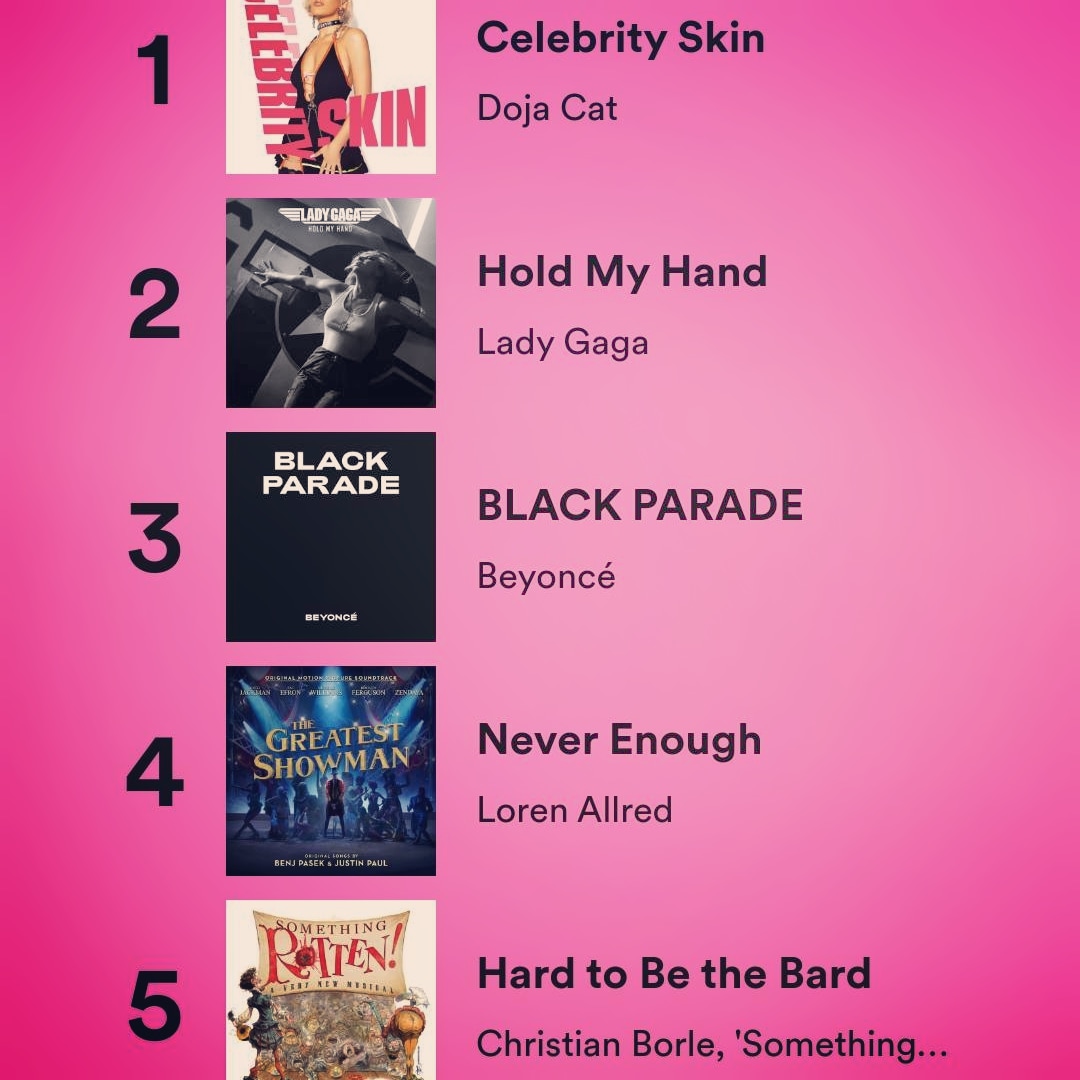
I made a conscious effort to branch out and listen to a variety of new artists in 2022, yet somehow I still ended up listening to more minutes of Lady Gaga than anyone else.
In the comments, share what surprised you the most about your 2022 listening habits!


 Erinyes


.jpg)