Erin O'Riordan writes smart, whimsical erotica. Her erotic romance novel trilogy, Pagan Spirits, is now available. With her husband, she also writes crime novels. Visit her home page at ko-fi.com.
I know, I know, I know - the women in Disney cartoons, except possibly Mulan, are losers. They're passive damsels in distress who get by mostly on their sex appeal. The case against Disney princesses as role models for your daughters is laid out by Erik Wecks in Great Geek Debates: Disney Princesses vs. Hayao Miyazaki.
Guffaw if you must, but like Twilight, the Disney cartoons deliver on the classic romance novel formula. Walk with me for a moment on the cartoon characters who, in a fictional Disnified world, would be my baby daddies. CCILFs, you could call them.
5. Eric in The Little Mermaid. The prince in the 1989 adaptation of Hans Christian Andersen's beloved fairy tale is a feminist nightmare - his ideal woman is one with, literally, no voice at all. On a symbolic level, that's awful, although in real life, a woman with mutism would learn sign language and get on with her life.
But with Eric, you get this, among the most romantic of Disney tunes:
4. Aladdin. A thief and a liar, Aladdin was perfectly willing to live his life as the fraudulent Prince Ali if it would get him Princess Jasmine. He's a scoundrel. Yet we still root for him to get together with Jasmine.
The story of Aladdin comes from the Arabian Nights, but it doesn't seem to have been added to the book until circa 1709, when a French author included it. (Disney makes no reference to any of the translators or compilers of The Arabian Nights in the film's credits.) In the original folk tale, Aladdin is Chinese. Later storytellers located his home in Baghdad (the capital of modern Iran, but historically part of a number of different empires, including Genghis Khan's Mongol empire and the Ottoman Turkish empire), which Disney transformed into the fictional city of Agraba, but Aladdin and Jasmine are most likely Arabic or Persian. There are plenty of hot Persian dudes; just ask Bodazey Magazine.
3. Prince Naveen of The Princess and the Frog. Voiced by hunky Brazilian Bruce Campos, Naveen is prince of an undetermined country. (His name is from India.) A misbehaving brat, he gets turned into a frog and takes hard-working, would-be restauranteur Tiana down into the swamp with him. Only true love saves them from a lifetime of amphibian-ness. Once you get past Eric, do you sense a theme? Disney princesses love them some bad boys.
Of course, in the Brothers Grimm version, the princess refuses to kiss the nasty, slimy frog and turns him into a prince by slamming him into the wall of her bejeweled bedroom when the persistent little critter insists on sleeping in her bed.
2. Flinn Rider, a.k.a. Eugene Fitzherbert, of Tangled. I just watched this the other day, which is what inspired this blog post. I like to think that Flinn, voiced by Zachary Levi (who also played Chuck on Chuck), is the first Jewish Disney prince. Sure, his name is super Anglo, but there is that running joke about the wanted posters making his nose look so big. I feel like this is a nod and a wink to the audience. Jewish on his mother's side, Anglo-Saxon on his father's, I say. Of course, the actor who voiced Aladdin, Scott Weinger, is also Jewish, but Aladdin himself seems to be Persian or Arab.
The Brothers Grimm, terrible with names, gave names to neither the prince in "Rapunzel" nor the princess in "The Princess and the Frog." Flinn is only a prince by marrying Rapunzel anyway; taking a page out of Aladdin's book, he begins as an orphan and a thief. Depending on the rules of Rapunzel's fictional kingdom, he may be considered a consort rather than an actual prince, since he's a commoner.
(As of this writing, the above Brothers Grimm e-book is free!)
1. Thomas from Pocahontas. Right now you're probably thinking, "Who?" Thomas is the young redhead who falls off the ship early in the cartoon. Later, his overzealous use of firearms nearly causes a war between the English and Pocahontas' tribe, the Algonquian people. But he's careless and naive, not intentionally bad. Most importantly, though, he's voiced by Christian Bale. He's no Wizard Howl, but for a Disney dude, Thomas is all right.
Note that I don't particularly enjoy this film. Not only does it have Mel Gibson cooties, but (hopefully embarrassed for the racist portrayal of American First Nations people in Peter Pan), the script goes way overboard on Pocahontas' tree-hugging nobility - and I say this with a healthy respect both for Mother Earth and for indigenous spirituality. Plus, it plays very fast and loose with a real, historical woman's life story. For one thing, she was approximately 12 years old the first time she met John Smith.
This is a naughty artist's rendition of the ginger Thomas, not the blond John Smith.
If you want to see the whole gallery of 20 sexy Disney dudes, visit the source: AcidCow.com.
If you're any kind of a Disney fan, I highly recommend you go see Maleficent, starring Elle Fanning and Angelina Jolie. I took my 8- and 10-year-old nieces on Wednesday, and they loved it.
Disney's Sleeping Beauty Castle, Anaheim, CA. Public domain image
I loved it, too. Although Maleficent is the villainous fairy who tries to kill the princess with a spell in the Disney cartoon Sleeping Beauty, she's the heroine of this live-action version (also from Disney). Sleeping Beauty/Aurora herself is...also a heroine! This movie doesn't pit them against each other, it makes them friends.
The villain is Aurora's awful father Stephon. Human Stephon and fairy Maleficent met as children. He showed goodwill at their first meeting when he threw away his iron ring - fairies can't bear the touch of iron. As they grew into teens, they fell in love, but Stephon didn't have an honest or loyal bone in his entire body. Maleficent grew nicely into her role as protector of the moors, while Stephon went off to court and secretly aspired to be king. She was innocent, open, and honest, while he was worldly, greedy, and duplicitous.
The presiding king tried to conquer the moors; Maleficent and her fairies repelled them. The king was wounded and promised that whoever killed Maleficent would be his successor. Slimy Stephon paid his "true love" a visit on the pretense of warning her, but instead drugged her and brutally cut off her wings. He brought the wings to the king as "proof" she was dead.
Stephon, subsequently made king, married and had a daughter, but slowly descended into madness. Maleficent got her bit of revenge by cursing the newborn Aurora to fall into a deep sleep on her 16th birthday when she touched a spinning wheel. (We know this part from the cartoon.) We can't really blame Maleficent for this, because STEPHON CUT OFF HER MAGNIFICENT FRICKING WINGS.
"Sleeping Beauty" by Louis Sussman. Public domain photo by Mutter Erde
Stephon sent baby Aurora off to a cottage in the woods to be raised by three fairies (one of them was played by Imelda Staunton, best known to U.S. audiences as Dolores Umbridge in the Harry Potter movies). These fairies are well-meaning but rather dim-witted. Maleficent looks out for Aurora, and gradually the two women become friends. Inevitably, Aurora finds out about the curse and forsakes the moors for her father's castle. Of course, the curse comes true, although Maleficent regrets it and tried unsuccessfully to lift it. Aurora falls into her enchanted sleep.
Maleficent comes to the rescue, though. Aurora's prince friend is ineffective at lifting the curse, but because Maleficent friendship-love for Aurora is true, Maleficent kisses her friend and breaks the spell.
Then the really happy ending: fairy and wings are reunited, Stephon gets his comeuppance, and the violent old patriarchy is replaced with a peaceful matriarchy under Queen Aurora.
This movie is visually beautiful and well-written. Angelina Jolie's acting in the title role is perfection.
According to Wikipedia, the earliest published account of Sleeping Beauty is Charles Perrault's 1697 version. That article (linked above) doesn't say much about the European folklore that may have inspired it, except that the sleeping princess motif may have been inspired by "tribulations of saintly female martyrs in early Christian hagiography conventions" and the Germanic folk tale of Brynhild. Also called Brunnehilde, Brynhild was placed by Odin in a magical circle of fire, where she slept. The hero Siegfried rescued her and awakened her by removing her Valkyrie armor.
"Hagiography" is simply a fancy Greek loan word that means "holy writing." For an example of a female martyr story, see this post on the feast day of St. Lucia.
"Wotan's Farewell to Brunhilde" by Emilie Kip Baker. Public domain within the U.S.
So, why a spindle or spinning wheel, of all things, as the center of the curse? If we read SparkNotes' Themes, Motifs, and Symbols page for Sleeping Beauty (the Disney film), we see that the spinning wheel might represent "the unstoppable revolutions of the years," signifying how time inevitably changes things. Clearly one of things time is changing is Aurora - on her 16th birthday, she's transforming from a girl into a woman. This is certainly another example of the Dangerous 16th Birthday trope.
I've read elsewhere - and unfortunately I can't remember where - that the spindle on which Aurora pricks her finger may be a stand-in for another type of "prick." In other words, the thing the king and queen wish to keep her away from is her own awakening sexuality.
If you'll recall from the Mother Night post, the Germanic mother-goddess known variously as Frigga, Frigg, and Freya has a spinning wheel, which was known as the Wheel of Fate. Fate or Fortune seems to be an underlying theme of the Sleeping Beauty legend. Wikipedia will tell you that in some versions, the princess doesn't fall under a curse at all, but falls into an enchanted sleep simply because it's her fate to do so. The three fairies who raise her represent the Fates, who in Germanic mythology are called the Norns.
Public domain image of the three Norns. 1895
The Norns are also collectively called the Weird Sisters (cf. Macbeth, and also Harry Potter and the Goblet of Fire), the Women Who Write (because they wrote the Book of Destiny), and the Three Mysterious Beings. Their names were Fate, Being, and Necessity; or Become, Becoming, and Shall-Be; or Urth (Mother Earth), Verthandi, and Skuld. Skuld lends her name to "skullduggery," the doings of witches. As depicted above, they lived in a cave containing the root of the world-tree Yggdrasil and the source of the Fountain of Life. (If you're a fan of Marvel movies, you'll be somewhat familiar with Yggdrasil. The image of the tree first shows up in Captain America, I believe.)
It's probably not a coincidence that when a bitter, vengeful Maleficent decides to make herself queen of the moors, her throne is located in a grotto with a waterfall, and a tree grows out of it.
The Fates are also the Triple Goddess: maiden, mother, and crone. This is clearly depicted in Maleficent. The eldest of the three, played by Staunton, wears pink and represents the crone. (Imelda Staunton isn't actually very grandmotherly, in my opinion. She's younger than 60 and rather young-looking for a Caucasian woman of her age. She has good skin.) The fairy in blue who wishes happiness on Aurora is the mother figure, and the green nature-fairy with wild blonde hair is the childlike maiden.
The ancient Greeks pictured the fates as weavers, weaving the thread of life and cutting it at the time of death. What do you make with a spinning wheel? Thread. You spin thread from flax. The Greeks also envisioned the Fates as standing over the cradle of newborns, determining the child's destiny, according to Barbara G. Walker's The Woman's Encyclopedia of Myths and Secrets.
Clearly, the fairy tale of Sleeping Beauty has some roots in very old Indo-European mythology, some of which was common to the ancient Greeks and the Vikings. How cool that we're still adapting and telling this ancient bit of goddess-mythology. How cool that Angelina Jolie makes such a cool goddess figure.
This is an affiliate link:
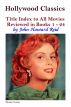
Hollywood Classics Title Index to All Movies Reviewed in Books 1 - 24 by John Howard Reid. $0.99 from Smashwords.com
Another essential book for a film buff's library, this one is packed with information and reviews. Some of the entries are quite extensive. JHR provides all the information you need, including complete cast and production staff. I find JHR's information invaluable. I like to read not only who acted in a movie, but who made it, both top-billed and lesser mortals. -- Ross Adams in DRESS CIRCLE mag.
Yesterday we talked about Mabon; today I'll focus on a Northern European goddess strongly associated with the grain harvest, an ideal archetypal figure for a fall holiday of thanksgiving. We can learn a little about this Norse goddess, often simply referred to as "the wife of Thor" (typical patriarchy! to honor a goddess only as far as her relationship to a male divinity), from a beautiful old book I rescued from a library book sale.
My cover looks different. This image is from Amazon.co.uk, and is by this person*
This book, first published in 1957, is called The Lost Gods of England by Brian Branston (not to be confused with Breaking Bad actor Bryan Cranston!). It's all about the religious-mythological system of the British Isles during the Anglo-Saxon period, which it appears was something of a mash-up between traditional Norse mythology and Celtic mythology. The two cultures had some similarities anyway, because all Indo-European pantheons can be traced back to the very ancient religion of the Indian subcontinent.
I just made a really cool thing sound incredibly boring. Norse myth is cool, really. Otherwise, Marvel wouldn't have co-opted it for comic books, and an increasingly successful movie franchise. More on the comic book Sif later.
Sif's brief article at Encyclopedia Mythica will tell you the story of how Loki sneaked into Sif's bedroom and cut off all her golden hair. The crime was investigated by Veronica Mars - no, I'm just kidding. Thor threatened to pull an Incredible Hulk on Loki unless Loki found a way to replace the hair. The ever-resourceful trickster god went to some dwarves, who spun gold into replacement locks, which Loki then magically attached to Sif.
Lost Gods is slightly more instructive. Slightly. Sif comes up four times. The first time is on page 117 of my edition, which teaches us that the Anglo-Saxon counterpart of Thor, called Thunor, is associated with agriculture, which "make[s] for a fertility element to his cult...He is married to the golden-haired goddess Sif, the northern Ceres, another manifestation of Mother Earth." Ceres, of course, is the Roman equivalent of the Greek grain-goddess Demeter, the mother of Persephone.
She comes up again on page 123, in the myth of how Thor once fought a stone giant named Hrungnir and ended up with a piece of stone embedded in his skull. The original source for this tale is the famous Icelandic poet and politician Snorri Sturluson, who lived in the 12th and 13th centuries. Christianity came to Iceland around the year 1000, and by Snorri's time, the Norse religion was no longer the dominant one. But I digress - this myth says only that Hrungnir threatened to abduct both Sif and Freya.
As seen in this Creative Commons image, another famous Icelandic person is Bjork.
The third reference, on page 128, is similarly brief; Branston merely asserts that Freya and Sif are the same goddess, and so is Frig.
The final reference, on page 145, takes the tale of how Sif lost her hair as a metaphor - our old favorite, the agricultural metaphor of the Annually Dying and Returning God and his mother/lover who is Mother Earth. The loss of hair is the loss of the lover ("death" of the harvested crops), and its return is the lover's return (springtime growth of new crops from seeds planted in autumn). Branston cites another version of this myth from the Norse canon. In it, Loki steals the Brisingamen (a really fancy piece of jewelry) from Freya.
Heimdall, the guardian of the godly realm of Asgard who controls the rainbow bridge, Bifrost, transforms himself into a seal selkie-style and swims out to the rock on which Loki has stashed it, and after a battle with Loki, retrieves it for the beautiful goddess of sex and death.
If you read Eternally Bad: Goddesses With Attitude by Trina Robbins, as I did many years ago, you'll read a slightly different twist on the story of Freya and the Brisingamen. In it, Freya offers her sexual services to the dwarves, whose craftsmanship produced the shining jewel (a necklace, in Robbins' telling). From this bawdy Norse myth descends the Western European folk tale of Snow White. Oddly enough, by the 20th century this was regarded as such an innocent children's tale, Walt Disney turned it into the first full-length animated Disney movie.
Public domain image, a screen capture from the trailer for the 1937 Disney film, from Wikimedia Commons
Did you wonder why the seven dwarves worked in a diamond mine?
Trina Robbins also wrote The Great Women Superheroes, which my brother bought me one Winter Holidays. It doesn't mention the Marvel Comics version of Sif. (It does, however, mention The Valkyrie, briefly a member of the Marvel "superteam" The Defenders in the 1970s.) But if you saw the 2011 movie Thor, you may remember that Sif was a character - played by a distinctly brunette actress (Jaimie Alexander). If you were a fan of that movie, you've probably already seen this.
Thor: The Dark World is scheduled for a November 2013 release. The Marvel comic book character Sif, according to the Marvel Universe wiki, first appeared in 1964. In this version of the loss of Sif's golden hair, Loki was overeager to get the replacement hair to the goddess, and over time it darkened from shining gold to jet black. The first Thor film ends with the god's mortal beloved, scientist Jane Foster (played by Natalie Portman), waiting on earth for Thor while he remained in Asgard. In the comics, Thor and Jane have a fairly brief relationship, Odin has long approved of Sif as a mate for Thor, and Thor and Sif get engaged (although they've never been married in the Marvel Universe}. Jane and Sif never come up in the next Marvel film to feature Thor and Loki, The Avengers (2012), but it's possible there may be a bit of a love triangle in The Dark World. Loki has a wife, Sigyn, both in Norse mythology and in Marvel Comics, but she isn't in the film franchise. That's because the filmmakers want Loki to be a single guy, because they know he is attractive to women. Like me. I love Tom Hiddleston as Loki, and I think Idris Elba is absolutely gorgeous with the golden eyes he has when playing Heimdall. Of course, Idris Elba is absolutely gorgeous reading the phone book, or sitting in traffic, or naked on the roof of the Empire State Building eating an Eskimo Pie. (Yeah, I reached way back into the '90s for that reference.)
Did I have a point here? Ah, yes - Mabon. The mythological Sif is a great goddess to celebrate at the harvest time because she's a fertility goddess whose golden hair represents the golden sheaves of wheat, or corn, or whatever grain you have that's ripened to a golden brown in the autumn. The sexual pairing of Sif and Thor assures the fertility of the crops. We can also think of Thor and Loki - the fair-haired brother and the dark-haired brother - as archetypes of the Oak King (Thor) and the Holly King (Loki). At Mabon, Loki's powers are starting to decline. At the Winter Solstice - Yule - Loki has his final fling as Lord of Misrule and then becomes the yearly sacrifice of a warrior that Hel (underworld goddess - Loki's daughter, incidentally) demands. Thor will rule until the Summer Solstice, when they'll once again switch places. Eternally. Or at least until Ragnarok, when Loki's monstrous child the Midgard Serpent and Thor kill one another.
I made this myself at QuickMeme.
*This person is Mr. Ian Johnston of Bon Bon Books, Cottenham, Cambridgeshire, U.K. Bon Bon is one of the two bookshop dogs, both Cairn terriers. The other is named Robbie. I only mention it because it makes a charming footnote. Compare Selected Works and its bookshop cat.
This is an affiliate link: League of Super Heroes: Rise of the Villain (#1) (Party Game Society Hit Party Game) by Celeste Ayers. $2.99 from Smashwords.com The League of Super Heroes HQ is under attack! A Super Hero went missing last night. Looks like someone is out for blood… someone is killing heroes… but who? Who amongst you has turned from Super Hero to Super Villain? It’s time to suit up and take control of this evil once and for all. The fate of the world is at stake. Will the good guys be victorious in sniffing out the tyrants?
The Wind In The Willows by Kenneth Grahame, adapted by Nicole Vittiglio
My rating: 4 of 5 stars
The Wind in the Willows by Kenneth Grahame was my dad's favorite book when he was a kid in the 1950s. I didn't read it until I was an adult, and it was a bit hard for me to place it in its proper context without looking up a little background on it. It was originally published in 1908, and I suppose the anthropomorphized animal tale can be thought of as a descendant of Alice's Adventures in Wonderland (first published 1865) and an ancestor of Winnie-the-Pooh (1926). In fact, Winnie-the-Pooh author A.A. Milne adapted parts of The Wind in the Willows into a stage play called Toad of Toad Hall in 1929.
Willows is really a set of two interconnected stories. One is a set of vignettes about the friendship between Mole and Rat. Wikipedia says Rat is actually a water vole, which I suppose is a European animal somewhat similar to an animal I see outside my house all the time, the muskrat. The setting of 'Willows' is the area surrounding the Thames River in England.
Kenneth Grahame was a banker by trade, and he worked for the Bank of England for most of his career. He had a secondary career as a writer, though, and he wrote these stories particularly for the amusement of his own son Alistair - similar to the way Peter S. Beagle wrote The Last Unicorn.
The other vein of stories running through 'Willows' is about Toad, an impulsive and vainglorious animal with a habit of taking up hobbies and then abandoning them. He does have an ongoing obsession with motorcars, though, which gets him into trouble with the law. (Keep in mind that in 1908, motorcars were very new and still had to share the roads with horses and carriages.) He ends up imprisoned, but escapes with the help of the jailer's daughter. He spends much of the book disguised as, and mistaken for, a human washerwoman. He considers this a great insult to his pride.
The age and setting of the story make it a bit exotic to me. Grahame contributes to this impression by creating an idealized, pastoral setting, a version of Merry England. You can read more about Merry England or Merrie Olde England in the "pseudohistory" category on Wikipedia. The writer(s) define it as "an English autostereotype, a utopian conception of English society and culture based on an idyllic pastoral way of life that was allegedly prevalent at some time between the Middle Ages and the onset of the Industrial Revolution. More broadly, it connotes a putative essential Englishness with nostalgic overtones, incorporating such cultural symbols as the thatched cottage, the country inn, the cup of tea and the Sunday roast. Children's storybooks and fairy tales written in the Victorian period often used this as a setting as it is seen as a mythical utopia. They often contain nature-loving mythological creatures such as elves and fairies, as well as Robin Hood. It may be treated both as a product of the sentimental nostalgic imagination and as an ideological or political construct, often underwriting various sorts of conservative world-views."
I don't think Willows is political, but it is nostalgic and idealized. Although Grahame was born in Edinburgh, Scotland, his father moved him and his three siblings to the Oxford area (Berkshire, which is just south of Oxforshire) when Grahame was five years old. He grew up boating on the Thames with his uncle in settings that inspired Willows (and probably would have seemed familiar to Lyra Belacqua in The Golden Compass).
While fairies and elves fail to show up in the Willows stories, the god Pan makes an appearance, although he is described rather than specifically named. When Otter's little son Portly goes missing, Rat and Mole find him sleeping peacefully between the cloven hooves of Pan, who is playing the pan-flute. After Mole and Rat depart with Portly, Pan wipes the memories of the animals clean of every having met him, presumably because the old gods are somewhat terrifying to mortals.
There are just a few fantasy elements in the story; they pop up and then they quickly dissipate, as when the Wayfarer - a wandering sea rat - seems to put some kind of spell over Rat that makes him want to leave home and take to the sea. He shakes off the spell with the help of Mole.
It took me a little while to get into this book, because at first it seems to be a collection of loosely-related talking animal stories with very little plot. Once the Toad stories take prominence, there's a bit more of a plot, and it does have a recognizable climax and denouement, even if the ending does seem a bit rushed. I wouldn't go so far as to say it's become a new favorite of mine, but I do appreciate some of its charms. I think Rat was my favorite character. Who wouldn't want to do little else in life besides hanging out with friends and messing about in boats?
The Disney film The Adventures of Ichabod and Mr. Toad dates
from 1949. As best as I can remember, I have only watched the Ichabod part of
the cartoon, which is the animation of Washington Irving's 1820 longish short
story "The Legend of Sleepy Hollow." 88 years older and American, the
story of the Headless Horseman is an odd juxtaposition with a thoroughly
English, early 20th century book. I'm not sure what Walt Disney was thinking
with that one. You can still ride Mr. Toad's Wild Ride at Disneyland in
California, but its equivalent at the Magic Kingdom in Florida closed in 1998.
Grahame also wrote a short story called "The Reluctant
Dragon," which was also made into a Disney cartoon.
I purchased this book with my own funds (at Goodwill, and then donated it to a local tutoring program after I read it). I was not obligated to review it in any way.
If your local (U.S.) library subscribes to Hoopla, you can read the e-book free there.
Public domain. This photo depicts the handprints of Leonard Nimoy in front of The Great Movie Ride at Walt Disney World's Disney's Hollywood Studios theme park.
Tony Goldwyn is the grandson of Samuel Goldwyn of Metro-Goldwyn-Mayer (MGM) fame, but the family named itself after the studio, not the other way around. I read this story in Bill Bryson's Made in America (a book you will find fascinating if you're any kind of amateur or professional etymologist).
Bryson writes, "Some understandable confusion exists concerning Samuel Goldwyn and Metro-Goldwyn-Mayer. Though his name accounts for the middle initial in MGM, Goldwyn was never part of the company. In 1924, he sold out to the Metro studios and Louis B. Mayer, and was astonished to discover that they took his name with them. But then that was no more than Goldwyn himself had done. The Goldwyn Picture Company was not in fact named for Goldwyn, but rather he for it. His real name was Schmuel [also sometimes spelled Szmuel] Gelbfisz, though for his first thirty years in America he had called himself - perhaps a little unwisely - Samuel Goldfish. Goldwyn was a portmanteau of the names of the studio's two founders: Samuel Goldfish and Edgar Selwyn. It wasn't until 1918, tired of being the butt of endless fishbowl jokes, that he named himself after his corporation. After the MGM takeover, he had to go to court to win permission to continue making movies under the Goldwyn name."
public domain image
Apparently, he won. I can proudly say that the Gelbfisz family came from Warsaw. Poland, the same place as my ancestors, the Templin family. My grandmother's grandmother was named Antonia Templin.
At one time, I knew Tony Gelbfisz/Goldfish/Goldwyn primarily as the villain in the Patrick Swayze-Demi Moore romance Ghost. Now he's playing the U.S. president on Scandal...
...but perhaps (since I don't watch that show) I'd like him even better as Andrew Prior in the film version of Veronica Roth's Divergent.
I'm sorry, Tris Prior, but your dad is a complete DILF.
This is what Tony Goldwyn looks like dressed casually.
This is what he looks like dressed formally.
This is what he looks like with no shirt on.
He's not technically a Jewish Disney prince, but he did provide the voice of Tarzan in the Disney cartoon.
Having a happy Hanukkah so far? Good. There's one more night to go.
Public domain. This photo depicts the handprints of Leonard Nimoy in front of The Great Movie Ride at Walt Disney World's Disney's Hollywood Studios theme park.
March 30, 1967: The Beatles photograph the album cover photo of Sgt. Pepper’s Lonely Hearts Club Band. Artists Jann Haworth and Peter Blake have designed the image, which portrays the group in colorful pseudo-military uniforms, surrounded by wax sculptures of themselves and numerous cardboard cutouts of famous people. Among those depicted by the cutouts are Lenny Bruce, William S. Burroughs, Lewis Carroll, Stephen Crane, Bob Dylan, Aldous Huxley, James Joyce, Carl Jung, Marilyn Monroe, Edgar Allan Poe, Dylan Thomas, H.G. Wells, Mae West, and Oscar Wilde.
March 30, 1968: Former Disney child actor Bobby Driscoll, who appeared in Song of the South and Treasure Island, is found dead in an abandoned apartment in the East Village of New York City. He is 31 years old. He has died of heart failure related to his use of heroin.
March 30, 1981: In an assassination attempt, U.S. President Ronald Reagan is shot by an assailant who also wounds Press Secretary James Brady, a Secret Service agent, and a Washington, D.C. police officer in the attack. Brady is severely injured, and when he dies in 2014, his death is classed as a homicide since it is directly related to his injuries. Police officer Thomas Delahanty suffers nerve damage that ends his career. Secret Service agent Timothy McCarthy, shot in the liver, diaphragm, and lung, makes a full recovery.
Reagan’s extremely low blood pressure when he reaches the hospital indicates he almost certainly would have died, had he not been rushed into emergency surgery so promptly. Special Agent Jerry Parr most likely saved Reagan’s life by ordering Reagan’s driver to take the president to George Washington University Hospital.
Through April 1st, 2026, get 15% off any book on this Bookshop.org list with code BSO15.
Content Warning (CW) for discussion of child abuse. The Bourne Identity
YouTube recommended this video to me the other day.
This video is a bit silly. Mario is essentially just reading an article he found on the (unaffiliated with him) website The Vigilant Citizen. The article is from June 2012, and it includes photos of Twilight stars Robert Pattinson and Kristen Stewart - separately - in photo shoots from glossy fashion magazines. The article makes reference to MK Ultra, a favorite among conspiracy theorists a.k.a. alternative media sources. (No judgment - remember, I like to examine so-called conspiracy theories through the lens of modern folklore and urban legends.)
Here's how the theory basically goes, according to my understanding:
- During/after the Korean War, the U.S. government saw the American prisoners of war were being manipulated by their North Korean captors to say anti-American things. (This part seems to be factual.)
- As a defense strategy, the U.S. began researching ways in which the human mind can be controlled. The "MK" part stands for "Mind Kontrol." Part of the U.S. government experiments under this program involved giving doses of hallucinogenic drugs, including LSD, to people without their knowledge or consent. (This part is factual and documented.)
- Although the program was alleged to have ended in the 1970s, it continues today. Actors, musicians, and other popular culture figures undergo mind control experimentation that makes them into Jason Bourne-type "puppets" who can be triggered by their handlers into performing whichever action their handlers want them to take. The process involves taking these people into a secret place where they are abused and tortured until their minds split like people with dissociative disorder. They come out with alternate personalities that don't know what the other personalities are doing. Common triggers include Disney movies, Alice in Wonderland symbolism, and Wizard of Ozsymbolism (This part is speculative.)
Mario is an interesting vlogger. I don't see eye to eye with him on many, many issues. He's anti-feminist, for example, and he doesn't believe in the theory of evolution. I'll never quite understand why a certain segment of the Christian population has to reject the scientific method, but hey, that's just me (and people who believe in a rational universe). But I think he's basically coming from a well-intentioned place, even if his "facts" are intellectually questionable. I say this so you know my intention is not to mock or disrespect him. On a person-to-person level, I kinda like the guy. Like me, he was raised as a Roman Catholic. He's a French Canadian who learned English as a second language.
Ellie Goulding's "Lights"
At this point, I have been exposed to enough YouTube and blog material by The Vigilant Citizen, Mario the Vigilant Christian, and others to be able to "talk the talk" of MK Ultra, as you'll see below. If I were going to pick out a song to use as an example of mind control talk in popular media, that song would be "Lights" by Ellie Goulding.
I know you can interpret the lyrics of just about any song to mean whatever you want them to mean. In college I once wrote a paper about how the lyrics of Hole's song "Violet" could be interpreted as a warning about the dangers of alcohol abuse and another paper on how the Beatles song "I Am the Walrus" was John Lennon's plea for American authors, but especially Edgar Allan Poe, to be taken as seriously by the literary world as classical British authors. I knew those things weren't intended by the songwriters, but at the time I thought it was humorous to tortuously over-interpret things for allegedly comical effect.
So, please take this with a large grain of salt and, perhaps, a rocks margarita.
I hear "Lights" quite often on the station Tit Elingtin and I listen to on our day job as remodeling contractors. We listen to an "easy listening" station, while essentially means Top 40 radio without the rap songs. I liked the way the song sounded before I even listened to all the lyrics. I started to like Ellie Goulding even more when I heard her song "High For This (The Weekend Cover)." Then, of course, she contributed the song "Beating Heart" to the Divergentfilm soundtrack. It was one of my favorite songs for a while.
BUT I can't stand her song "Burn." I just find the very high-pitched section of this song incredibly annoying. Sorry. Even the best musical artists have an occasional fail. Now back to "Lights."
According to SongMeanings.com, which lets anyone add their comments on what they think the song means, the simplest explanation of this song is that it's about Goulding's childhood fear of the dark. She was afraid of the dark, so she had to sleep with a light on in order to feel safe.
Other theories think the song refers to:
- A battle with depression or another mental illness, such as schizophrenia
- Childhood sexual abuse
- An encounter with an extraterrestrial spacecraft and/or Goulding herself being from another planet.
Lyrics
Let's look at the lyrics of "Lights."
I had a way then losing it all on my own I had a heart then but the queen has been overthrown And I'm not sleeping now, the dark is too hard to beat And I'm not keeping now the strength I need to push me You show the lights that stop me turn to stone You shine it when I'm alone And so I tell myself that I'll be strong And dreaming when they're gone 'Cause they're calling, calling, calling me home Calling, calling, calling home You show the lights that stop me turn to stone You shine it when I'm alone home Voices I play within my head Touch my own skin and hope that I'm still breathing. And I think back to when my brother of my sister slept In an unknown place the only time I feel safe You show the lights that stop me turn to stone You shine it when I'm alone And so I tell myself that I'll be strong And dreaming when they're gone 'Cause they're calling, calling, calling me home Calling, calling, calling home You show the lights that stop me turn to stone You shine it when I'm alone home Light, lights, lights, lights Light, lights, lights, lights (Home, home) Light, lights, lights, lights Light, lights You show the lights that stop me turn to stone You shine it when I'm alone And so I tell myself that I'll be strong And dreaming when they're gone 'Cause they're calling, calling, calling me home Calling, calling, calling home You show the lights that stop me turn to stone You shine it when I'm alone home Home, home Light, lights, lights, lights Light, lights, lights, lights... Writers: Ash Frances Howes, Lorin Ashton, Ellie Goulding, Richard StannardCopyright: Sony/ATV Music Publishing (Uk) Limited, Major 3rd Music Limited, Amorphous Music, Global Talent Publishing Interpretation The first line could refer to a childhood fear of the dark: "I had a way then (when I was a child) of losing it (losing my fear of the dark) all on my own (I simply turned on my night light)."
Creative Commons image by Marple Bridge Photography
The second line, though, seems a little strange in that context. The queen has been overthrown? That fits more with the mental illness theory - the "queen," or rational part of her mind, has been "overthrown" or overwhelmed by the illness. It also makes sense according to the childhood sexual abuse theory: she had a heart then (as a child, before she was abused) but then she learned to shut off her feelings after "the queen was overthrown," which could refer to an adult authority figure, such as her mother, being unable to keep her safe from the abuse. Of course, both mental illness and sexual abuse could be considered part of MK Ultra-type conditioning - a child who is being groomed to be a pop star is abused until her mind splits, and that way she'll be easily controllable.
The chorus starts off with, "You show the lights that stop me turn to stone/You shine it when I'm alone/And so I tell myself that I'll be strong/And dreaming when they're gone." Now this seems to be saying the opposite of what we might expect. The lights were supposed to protect her from fear of the dark, right? So why is saying that the lights "stop me?" This speaks to the alien theory, I suppose: the lights that stop her are the sudden lights from a spacecraft that appear. She is either stopped simply by curiosity, or paralyzed with fear of them, or the extraterrestrial beings have stopped her somehow.
Some theorists, depending on their point of view, would go so far as to claim that aliens are synonymous with demons. They say that when people think they are abducted by aliens, they are really being tormented by fallen angels. If we are going with the MK Ultra theory, then we'd probably say that the handlers who perform the abusive experiments disguise themselves as aliens--or that they're somehow in league with actual aliens, who may or may not be fallen angels.
Creative Commons image by Mingle Media TV
The "I tell myself that I'll be strong" could refer to being strong in the dark when there are no lights - a simple enough explanation, although it doesn't seem to match up with "lights that stop me, turn to stone" line. What does turning to stone mean, anyway? Shutting off one's emotions so that one is as imperturbable as stone, perhaps, which fits with the abuse theory.
"Dreaming when they're gone" seems to fit this theory as well; the child cannot sleep until her abusers are gone. What would "they're" refer to in the context of fear of the dark? Nightmares, perhaps. Maybe she simply means that sleeping in the dark makes her prone to nightmares.
The "calling me home" of the chorus is why some people interpret this song to mean that Goulding herself has come from the star people. The lights call her home? Why, that's her fellow extraterrestrials coming back to claim her. Alternatively, we might say that the lights calling her home are some kind of signal or trigger that her handlers use when it's time for her to "come home" to be reprogrammed. The "reprogramming" process is painful and frightening, and that's why the singer seems to be so scared and depressed.
In the second verse, "Touch my own skin and hope that I'm still breathing" sounds a bit ominous, but fear - including simple childhood fear of the dark - could do that to a person. But then she sings something rather strange: "And I think back to when my brother of my sister slept/In an unknown place(,) the only time I feel safe." The only time she feels safe is when her brother and sister slept in an unknown place - now that seems odd. If a child were simply scared of the dark, wouldn't we expect her to say that she only felt safe when her brother and sister slept in her room with her, or when they were in the house with her - sort of a "safety in numbers" feeling? What is the "unknown place?" Is she saying that she wants her brother and sister to sleep away from where she is, because wherever she is is unsafe, and she wants to keep them safe? That line really makes it seem as if something other than mere darkness frightened her when she was a child.
In short, although this song is supposed to be about using light to ward off fear of the dark, the lyrics actually seem to be suggesting exactly the opposite - that the lights are failing to ward off the fearful thing that the dark brings, whatever that thing may be. But only the songwriters know for sure what they were thinking.
Glory of the '90s – A Decade-Long Odyssey in 10 Songs
At the start of 1990, I was 12 years old and waiting to
begin the second semester of the 7th grade. When I think of “Close
to You” by Maxi Priest, I think of my 13-year-old self that summer before I
started the 8th grade. My daytime hours were occupied mainly by
peddling my bicycle around the neighborhood, listening to my Walkman. (I bought
it with my own money at the Osco drug store where my dad occasionally worked as
a security guard when he wasn’t on duty with the police dept.) What I can’t
remember was whether I’d taped this song off the radio – I still used cassette
tape back in those days, since I wouldn’t acquire a CD player until 1993 – or
if I heard it repeatedly on the radio, which I could also listen to on my
Walkman.
1991 brought
us “Sensitivity” by Ralph Tresvant. This song reminds me of a night spent with
my middle school classmates – including best friends Therese and Jamie – at the
YMCA, an overnight class trip chaperoned by our teachers. I had a tremendous amount
of fun, and very little sleep, at these overnighters, which I did twice –
perhaps once in 1990 and again in 1991, in 7th and 8th
grades.
My friend
Dennis – the one on whose recommendation we rooted for the Detroit Pistons (the“Bad Boys” at the time) in the NBA playoffs that year – remarked during the
sleepover that Ralph Tresvant’s breakout single meant that all the members of
New Edition were now bona fide solo artists. This was true – Bobby Brown was
still known more for his music than for a propensity to use illegal substances,
Bell Biv Devoe had already released “Poison,” and the previous year had Johnny
Gill offering to rub the world the right way. I knew this even though my
personal radio tastes were much more American Top 40 than the R&B station.
1992 gave us
“Smells Like Teen Spirit,” the first hit for Nirvana. I did not get the grunge
aesthetic straight out of the gate. After all, people were wearing t-shirts
under flannels that DID NOT MATCH WITH THEIR T-SHIRTS. If I’d tried such a
thing in grade school, my mother wouldn’t have let me out of the house. A pink
t-shirt could only be worn with a PINK flannel.
(I did own a
pink flannel at one point – if memory serves, it was purchased at The Gap. This
was after grunge went commercial, obviously.)
We saw the
unenthusiastic-cheerleaders-bored-pep-rally video many a time on MTV, which we
still watched religiously at that age. My brother bought the Nirvana album,
Nevermind, at Tracks. (Back then, Tracks was a record store. I found myself
bemused by the lyrics of “Smells Like Teen Spirit,” which seemed to mock those
who thought “self-assured” was a dirty hyphenated word but otherwise didn’t
make any literal sense. The snarky, rebellious esprit de corps that bonded ‘90s
alterna-teens dawned on me slowly, beginning my childhood neighbor/friend/high
school classmate Kristen introduced me to “Siva” by the Smashing Pumpkins.
Then in 1993
– when I was 15, then 16, and my junior year of high school started - Siamese
Dream came out. Every hit single was a
revelation – but the song that really characterizes 1993 for me is “A Whole New
World” by Peabo Bryson and Regina Belle. It came from the soundtrack of the
Disney film Aladdin, which I saw in the theater twice. The first time I went
with my best friend Therese and her mom, to a special double feature that also
included Homeward Bound: The Incredible Journey. The second time was after I’d
spent the night at the farm house belonging to the parents of my school best
friend Sharon. Her mom baked us homemade bread and made us toast for breakfast,
then took us to a matinee. I was in love with the movie and owned the
soundtrack on tape, listening to it many more times than, I’m sure, my parents
would have preferred.
When I was a
freshman, the girl I most desperately wanted to be friends with was named Kirstin.
She was a sophomore. We had AP Biology together. (That I had AP Biology with
older, wiser, more disgusting sophomores is the source of several…interesting
memories for me.) One highlight of my freshman year was a Bio trip to the
cranberry bog and then the sand dunes. I didn’t think Kirstin came on the trip,
but then we stopped at Burger King for lunch and she was there. My mood was
lifted greatly, and when I climbed to the top of the sand dune (never minding
the sophomore having his cigarette break up there. Was his name Cody?), I had a
Transcendental-like moment of appreciation for the majesty of nature.
But I
digress. Kirstin and her boyfriend who went to a different school experienced
an unintended pregnancy. Kirstin went to live with her aunt and uncle in
Maryland for the duration of her pregnancy before giving her son up for
adoption. I wondered if I’d ever see her again – but I did, in 1994, working at
a Target store in a mall that no longer exists. That was the year of “Linger” by
The Cranberries, which Kirstin sung to herself as she rang up my mom’s
purchases. I hadn’t liked the song much until I heard it from her.
Perhaps my
initial dislike of the Irish band The Cranberries was subliminally influenced
by the fact that some plant in the cranberry bog gave me a rash all over my
hands and forearms.
In 1995, I
graduated from high school and went to St. Mary’s College of Notre Dame,
Indiana. My first work-study job was working in the dining hall. Whenever I
hear “Waterfalls” by TLC, I’m instantly reminded of my sweaty, smelly job
sorting the clean silverware into baskets in the bowels of the dining hall.
(All that steam was from the high-temperature, sanitary commercial dishwasher.
And the room always smelled like old food.) My colleagues, most of whom were
not students themselves, listened to the R&B station I’d been rather
indifferent to as a middle schooler.
In 1996, when
I started my sophomore year in college, I moved my dorm room from one half of
H-shaped Regina Hall to the other. I had the second room from the end of the
hall. The first room belonged to a junior named Blake, a girl who, at any hour
of the day or night, was probably listening to “I Love You Always Forever” by Donna
Lewis. I never have taken much of a liking to that song, and Blake is 82% the
reason why.
1997, the
year I turned 20, gave us “Something About the Way You Look Tonight/Candle in
the Wind 1997” by Elton John. I thought “Something…” was a very romantic song,
and I remember singing along with it on the radio on my way home from Meijer.
But “Candle in the Wind” was the ubiquitous tribute to Princess Diana of Wales
after her death. I was coming home – to my parents’ house – from a visit with
Irish Granny when I heard the news on the radio that the Princess had been in a
car accident. I didn’t imagine she’d been seriously injured, or at least I
hoped she wasn’t. When I got home I found my mom on her bed, watching the news
on her small TV. She was an admirer of the Princess and was quite upset,
especially upon learning that she’d died. I tried to be optimistic. “Sometimes
they’re wrong and they report that someone’s died when they’re injured but
alive,” I said. Sadly, I was wrong.
I hope the
daughter-in-law the Princess never got to meet, Katherine Duchess of Cambridge,
is genuinely happy. I’d hate for her to suffer even a small portion of the
misery Princess Diana was put through. I wish the Duke and Duchess and their two
precious children long, happy lives together.
“Too Close” by
Next transports me instantly back to the summer of 1998. In that year, the
Indiana Pacers faced off against the Chicago Bulls in the men’s NBA Eastern
Conference playoffs. This was Reggie Miller’s last year before retirement.
Miller and the Pacers were cut off from their shot at the whole enchilada by a
young Bulls forward named Toni Kukoc, but I still had fun watching MichaelJordan’s Bulls go up against Karl Malone’s Utah Jazz in the finals. Having
turned 21, I was now allowed in sports bars. My friends Jamie and Therese got
dragged along with me to watch Bulls games, when we weren’t playing putt-putt
or arcade games. Every time we were in the car that summer, “Too Close” would
inevitably be playing in the background.
In 1999 I
completed my final semester of college and earned my bachelor’s degree. While
still in school, I lived in the dorm next to the athletic center, and I enjoyed
using the indoor jogging track. During one of my indoor race-walks, I heard “…Baby
One More Time” by Britney Spears for the first time. I had mixed feelings about
the song at first. Of course I knew that “hit me” was a contemporary slang term
for call me/go out with me, but I still had some trouble adjusting to the sound
of it. The video helped me warm up to the song, however, and I started to like
Spears’ up-tempo songs. I never did care much for “From the Bottom of My Broken
Heart” or anything else that was slow/sad. That’s just me.


 Hollywood Classics Title Index to All Movies Reviewed in Books 1 - 24


.jpg)



.jpg)


.jpg)


.jpg)