Pages

Showing posts sorted by relevance for query Alice in Wonderland. Sort by date Show all posts

Saturday, May 3, 2014

Review (Nonfiction) of 'The Girls: Sappho Goes to Hollywood'

The Girls: Sappho Goes to Hollywood by Diana McLellan:


How was I supposed to resist a title like that?

This is the allegedly true, research-based story of Hollywood's two most famous LGBTQIA actresses of the 1930s, Ms. Greta Garbo and Ms. Marlene Dietrich. Neither woman self-identified as lesbian, bisexual, or pansexual during her lifetime, so I have to state for the record that it's a bit unfair to label them after their deaths, when they lived in a very different world than we do now. However, there is ample evidence to support that both women had ongoing romantic relationships with women and men. Dietrich's affairs seem to fit the bi/pan label more closely - she didn't seem to have much of a preference either way - while Garbo seems to have had a preference for women over men.

And yes, it does appear that at one point, they had a romantic relationship with each other.

Both are name-checked in Madonna's iconic hit "Vogue," but what did I really know about Dietrich and Garbo, whose best films were made in the 1930s, when my grandmothers were little girls? I'd read a little about Dietrich's sexy, androgynous, ice-blonde persona in film studies and media studies books and articles over the years. I don't think I've ever seen one of her movies.

Dietrich in 1933. Creative Commons image from the German Federal Archives
Dietrich, who was born in Germany, is perhaps best remembered for the movie The Blue Angel. In it, she plays a character named Lola Lola who seduces a professor. In the English-language version, she performs a song called "Falling in Love Again," which became her signature song. Her first name is a contraction of the first name she was given at birth, Marie Magdalene. She died in 1992.

Garbo in 1924. Public domain image. 
I know I've seen at least one Greta Garbo movie on the big screen - Anna Karenina (not the silent version, but the talkie), when I was a student at St. Mary's. I enjoyed it. Greta Garbo was born in Sweden. In addition to playing the title role in Anna Karenina, she is also known for her film Camille, based on the play by Alexandre Dumas fils. In her personal life, she was known for the great deal of secrecy around her, to the point that she was somewhat reclusive in her later years in New York City. She died in 1990.

According to The American Women's Almanac, Louise Brooks said about Garbo, "She made a pass at me." About Brooks, the silent film star who popularized the "bob" hairstyle for women, Wikipedia says she made friends with lesbian and bisexual women, and experimented sexually with them - including Garbo - but did not consider herself to be lesbian or bisexual.

Louise Brooks. U.S. Library of Congress, George Grantham Bain Collection. No known restrictions on image usage rights
Some of the other fascinating characters in Garbo and Dietrich's "sewing circle," according to this book, include:

Emma Goldman: Goldman can perhaps be considered the founder of the "sewing circle" of lesbian and bisexual women in the U.S. theater and film communities. She was an ethnic Jewish woman born in what is now part of Lithuania, but which at the time was part of the Russian Empire.

Goldman in 1886. Public domain image
Moving to the U.S., she was an editor and orator whose causes included anarchy, reproductive rights, and gay and lesbian rights. She was said to have inspired the man who assassinated U.S. President William McKinley, although it was not her intention to do so. Goldman was strong critic of marriage and advocate of free love, and among her many lovers was, allegedly, Alla Nazimova.

Alla Nazimova: Born Miriam Leventon in Yalta, Crimea - the province that only a few weeks ago was taken over by Russia, although legally speaking it is part of Ukraine - the Jewish woman emigrated to the United States, where she became a theatrical and film actress. She is alleged to have had sexual relationships with a number of women, including Goldman, Eva La Galliene, Mercedes de Acosta, and Oscar Wilde's niece Dolly.

Nazimova, photographed by Maurice Goldberg in 1922. Public domain
She appeared in the silent-film version of Camille opposite Rudolph Valentino and possibly carried on affairs with both Valentino's first wife and his second wife, Natacha Rambova. Nazimova was married to two men, resulting in two divorces. Toward the end of her life, her domestic partner was a woman named Glesca Marshall.

Nazimova was also known for generously helping other women launch their acting careers. Among the women she helped to get started in film was Anna May Wong. Nazimova continued working throughout her life. She appeared with a young Montgomery Clift - they played mother and son - in a stage play titled The Mother.

Natacha Rambova: Despite her Russian name, which she gave herself during her years as a ballerina, Rambova was an American of Irish descent. She worked on the set of Camille as a set and costume designer. She served as art director on a number of Hollywood productions, and later had some success as a fashion designer. She may or may not have been bisexual - Valentino was almost certainly bisexual or, perhaps, preferred men to women and was actually gay. Being a gay male was considered more taboo than being a lesbian or bisexual women, even in the relatively forgiving climate of the Hollywood Gilded Age.

Valentino and Rambova. Thought to be in the public domain; photographer unknown
What can be said with certainty about Rambova is that she was a spiritualist. McLellan's research indicated to her that later in her life, Greta Garbo sought out Rambova for seances. Garbo had remained friendly with Ramon Novarro, the Mexican-American actor who'd starred with her in Mata Hari. Novarro was friends with Rambova, and Garbo asked Novarro to arrange for her to meet Rambova for a seance. Novarro invited a crowd, though, which spooked Garbo, and she ran off without ever meeting Rambova.

Novarro, photographed by Carl Van Vechten. The Library of Congress believes this image is in the public domain
That Novarro and Valentino were lovers is a bit of an old Hollywood legend. The legend goes that Valentino, famously well-endowed, gave Novarro a sex toy modeled after Valentino's own privates. Sadly, Novarro lost his life in 1968. He let two men into his home for the purpose of having sex with them, but they mistakenly believed he was hiding a large sum of money in the home. They beat and tortured him for hours trying to get him to say where the money was hidden, but he had none. They left him for dead, taking only $20 with them. He choked to death on his own blood as a result of the beating, probably unconscious. A Hollywood urban legend held that Novarro had choked to death as a result of Valentino's gift being forced down his throat, but this has no basis in fact.

Fun Rambova fact: In the Ken Russell film Valentino, she was played by Michelle Phillips of The Mamas and The Papas.

Eva La Galliene: Unlike the women mentioned above, La Galliene was never "in the closet." She lived openly as a lesbian during her own lifetime. La Galliene was an English theatrical actress whose mother was a Danish journalist. Her father was a French poet. La Galliene is said to have carried on a 5-year affair with Mercedes de Acosta.

La Galliene's acting credits include playing the White Queen in the 1955 TV-movie version of Alice in Wonderland.

Mercedes de Acosta: de Acosta was an American poet, playwright, and novelist of Spanish and Cuban descent. She was one of Garbo's closest friends and, according to McLellan, carried on romantic relationships with both Garbo and Dietrich. Her lovers were said to include the dancer Isadora Duncan (who died tragically at age 50 when her long, flowing scarf became entangled in the spokes and rear axle of the car in which she was a passenger), Nazimova, La Galliene, Ona Munson (best known for playing the madame Belle Watling in Gone With the Wind), and possibly Alice B. Toklas.

Mercedes de Acosta. Public domain image
Among de Acosta's works for the stage included Jehanne de Arc (Joan of Arc). Eva La Galliene played the heroine onstage, but de Acosta hoped a filmed version would be a vehicle for Garbo. The film never materialized, however. She fell severely out of Garbo's favor, in part due to the behind-the-scenes manipulations of Salka Viertel and in part due to publishing a memoir that talked about Garbo. The memoir never explicitly referred to lesbian relationships, but Garbo was so protective of her privacy, even a veiled memoir was too much of a violation.

Salka Viertel: A Jewish woman born in what is now Ukraine, which was then part of the Austro-Hungarian Empire, Viertel was the screenwriter who co-wrote Garbo's films Queen Christina and Anna Karenina. She was a close friend of Garbo's and, according to McLellan, schemed to keep Garbo and de Acosta apart as much as possible. One of her sons married Deborah Kerr, the star of From Here to Eternity.

Tallulah Bankhead: The daughter of a respectable Southern politician who eventually served as the U.S. Speaker of the House, Tallulah never used the word "bisexual," but she did describe herself as "ambisextrous." She started modeling at age 15. Her theatrical career began on London's West End, and then she made the jump to the U.S. stage. She originated the role of Sabina in Thornton Wilder's The Skin of Our Teeth (another play that featured the young Monty Clift).

Bankhead, photographed by Carl Van Vechten
Bankhead's lovers were said to have included Garbo, Dietrich, de Acosta, Nazimova, and La Galliene, as well as Billie Holiday and Hattie McDaniel (who played Mammy in Gone With the Wind and was the first African-American actress to win an Academy Award, for that role).

Hattie McDaniel, studio publicity photo. Photographer unknown. Public domain
Reportedly, Bankhead was David O. Selznik's first choice to play Scarlett O'Hara, but she was considered too old to play the character at the age of 36. The flamboyant, smoky-voiced Bankhead played a character called Black Widow in a 1967 episode of Batman, and Cruella de Ville is said to have been based on a caricature of her. After her stage and film career wound down, she became widely known as a radio show host.

As you can probably tell, I found this book absolutely fascinating. You'll probably enjoy it if you're interested in Old Hollywood history, women's history, and/or LGBTQIA history. Some of McLellan's sources are a bit dubious, but that's the nature of the beast when you're trying to uncover the history of something that was deliberately kept hidden. As the World War II era gave way to the 1950s, people in Hollywood had to worry about being associated with Communism. That gave them another reason to obscure and hide some of their past relationships, as well as the cultural swing that was becoming even more repressive of gay, lesbian, and bisexual sexuality. The 1950s were the golden age of the closet.

I bought this book with my own funds from Barnes and Noble and read it on my Nook. I was not obligated in any way to review this book. Here is the link: http://www.barnesandnoble.com/w/girls-diana-mclellan/1114477109

I'm not a Barnes and Noble affiliate. If you shop there, I don't get anything but the satisfaction of supporting a brick-and-mortar bookshop.

This is an affiliate link:
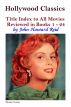
Hollywood Classics Title Index to All Movies Reviewed in Books 1 - 24 by John Howard Reid. $0.99 from Smashwords.com
Another essential book for a film buff's library, this one is packed with information and reviews. Some of the entries are quite extensive. JHR provides all the information you need, including complete cast and production staff. I find JHR's information invaluable. I like to read not only who acted in a movie, but who made it, both top-billed and lesser mortals. -- Ross Adams in DRESS CIRCLE mag.

Friday, August 10, 2012

Several Hours I Spent Reading Conspiracy Theory Blogs

Once upon a time, I used to host a link on this blog to Nibiru Planet X, a conspiracy theory blog. Its author, Ray Austin, contacted me and asked me if I wanted to host a link on my blog in exchange for a link on Nibiru. I put up his link, but I don't think he ever put up mine. But anyway...

Nibiru Planet X maintains a post about Illuminati symbolism in Kanye West's "Heartless" video.

Creative Commons
What caught my eye about the post mentioned in the link was that it was about Lady Gaga. I'm a fan. Why, only yesterday I was moved to express my support for Mother Monster on Mandy Nicole's blog Pretty Little Endeavors, when Mandy expressed the opinion that she much preferred Madonna to Gaga. But anyway...

I ended up spending a great deal of time reading over MK Culture. Its main premise seems to be that much of pop culture is directly related to, and influenced by, something called Project MKUltra, which a Wikipedia entry defines as "a covert, illegal human research program into behavior modification run by the Central Intelligence Agency's (CIA) Office of Scientific Intelligence. The program began in the early 1950s, was officially sanctioned in 1953, was reduced in scope in 1964, further curtailed in 1967 and finally halted in 1973." Yeshua contends, however, that it still goes on, and that young pop stars all show signs of having been indoctrinated into a specific mind control program.

Creative Commons

Yeshua has a large number of posts related to Lady Gaga, dating back to 2009. One titled "Just Dance" also makes reference to Madonna, Beyonce, Rihanna, Ciara, Britney Spears, and Janet Jackson, among other pop cultural phenomena. Across several blog posts, Yeshua contends that the on-stage or on-record alternate personalities represented by pop stars (Beyonce's Sasha Fierce, Janet Jackson's Damita Jo, Madonna's Dita) actually represent alternate personalities caused by intentional personality-splitting through ritualistic abuse.

Public domain
It was an odd thing to read - and, like a supermarket tabloid, it was far too odd, disturbing and intriguing to stop reading. Here are a few highlights of the blog, in chronological order:

Creative Commons

I notice a lot of these female pop stars are people whose names are already listed in my tags, women I've already blogged about. What does this say about me? 

Branching off from Yeshua's blog, I read this intriguing post about the symbolism in The Prestige (the movie that caused me to fall in love with Christian Bale). Then I explored the blog Invoking Mother Spirit (now defunct). Some interesting stuff there, too, such as: Whitney Houston, Michael Jackson, and Amy Winehouse all died on the eve of major awards shows. To my chagrin, it didn't actually have much to do with mother spirit. I love my goddess symbolism, not because I belong to the Illuminati (or want to) but because I'm a witch. That's my spirituality. 

I'm not saying I agree or disagree with any of the theories presented in the posts I read. They were just something that caught my interest today.

Sunday, October 30, 2016

Book Haul-o-Ween

My husband and I were in Chicago on October 27th-29th. Before we left, I wanted to pay another visit to Selected Works, the used bookstore in The Fine Arts Building on Michigan Avenue. You may remember Selected Works from this 2012 blog post:

That Time I Tried Out for Jeopardy!

In 2012, I lugged the ponderous tome The Dictionary of Cultural Literacy on the train, and was stuck carrying it for the rest of the trip. This time, I brought two books which, even taken together, were still smaller: Mycroft Holmes by Kareem Abdul-Jabbar and Anna Waterhouse, and The Last Days of Magic, the Doctor Strange graphic novel. And we shipped our dirty laundry et al, home in a U.P.S. box so we didn't have to schlep it everywhere.

Today I learned the bookstore cat's name. It is Hodge. This is Hodge examining one of the books I intended to purchase.


I said in 2012 that I thought he was a Russian blue, but now I don't think he is. I think he's just gray, like my dad's cat Bucky.

In 2012, I found a neat old paperback about the film adaptations of Ernest Hemingway's short stories. I tried to find more Hemingway nonfiction, but I didn't see anything that interested me. Instead, I found these four things.


I'm already familiar with "The Wasp in a Wig" thanks to Martin Gardner's Annotated Alice books (I own two different editions). I still like to own as many Lewis Carroll volumes as possible.

(Also, I may have ordered myself a pair of Alice in Wonderland socks while I was buying my mother's birthday present from Out of Print Clothing today.)


As we learned from the Willie Lynch Speech incident, there are a good deal of quotes out there in circulation that were never actually uttered. Often, the authors contend, these false quotes have polemic purposes. Some of these false quotes drive the conspiracy culture of today. This book was published in 1989, but (perhaps unsurprisingly) many of these fake quotes are still being quoted today by people who have no idea they were wrongly attributed, taken far out of context, or made up of pure bullshittery. It's rather fascinating.

I apologize for the low-res picture. It's from Goodreads.
I may have caught Pericles: Prince of Tyre, The Tempest, and Richard III this year, but there is still Shakespeare out there for me to conquer. I'll never reach Jillian Keenan's level, but this should be a good basic reference book.


It may seem that I indulged myself quite a bit in the bookshop. I did. We did a lot of indulging when we weren't visiting the organ transplant team at Northwestern University hospital, though. We saw Blue Man Group and went to the AMC Dine-In Theatre, where we got to eat a full meal, including cocktails, while watching the film version of Dan Brown's Inferno. We didn't get to see the ending of Inferno, unfortunately, because of a very rude lady, but that will have to be a story for another day.

Wednesday, December 4, 2024

My Spotify Wrapped 2024

Happy Spotify Wrapped release day 2024! What was your top song of the year? Mine was "Joyride" by Kesha, surprising no one, since I already wrote a blog post about my obsession with this fun pop song.

Is 128 times a lot of times to stream one song? My top song last year was one that I listened to 49 times. 

Kesha wasn't my top artist, though. 

My #1 artist was The Smashing Pumpkins. 


Rounding out my other top songs are tracks from ZZ Ward, New Found Glory, and Taylor Swift. But I'm not just a music girlie: I'm also a podcast girlie. These were my Top 5, including of course Disaster Area. 


Now let's dive into my Top 100, which I'll divide into several posts over the next few days for easier readability. 

100. "Headless Horseman" Kid Kasino, Shea - an electroswing version of the Bing Crosby-Disney tune with a female vocalist; Halloween playlist

Of course, I was in Sleepy Hollow, New York in October. Here's my photo of the Headless Horseman Bridge.


99. "Talking Body" Tove Lo - on the Daniel Brühl playlist

98. "Piano Mashup: Moonlight Sonata/L'Interludio Ambivalent/Ain't Misbehavin'" Alicia Keyes - on the Reading playlist

97. "Siva" The Smashing Pumpkins - the 1st SP song I ever heard and still one of my favorites

96. "Cruel Summer - triple j Like A Version" G Flip - Sapphic cover of the T. Swift hit

95. "Unspoken Word - Intro" The Soil - wordless vocalizing, on the Reading playlist

94. "Oysters In the Pits" Hans Zimmer - Rush soundtrack/Daniel Brühl playlist

Does the mention of oysters make you think of Alice's Adventures in Wonderland, specifically "The Walrus and the Carpenter?" Coincidentally, the next-most listened song is...

93. "The Lobster Quadrille" Franz Ferdinand. Not the Franz Ferdinand you're thinking of. This is from the soundtrack of theTim Burton movie Alice in Wonderland (2010).

92. "Lover Please" Melissa Etheridge - my go-to karaoke song

91. "Captain Speaking" Ghettobillies - short spoken word track that I don't remember how I stumbled across 

Tune in tomorrow for 90-81. What was YOUR top track of 2024?

Friday, August 21, 2015

Discovering 'The Wind in the Willows' as an Adult

The Wind In The Willows (Treasury of Illustrated Classics)The Wind In The Willows by Kenneth Grahame, adapted by Nicole Vittiglio

My rating: 4 of 5 stars

The Wind in the Willows by Kenneth Grahame was my dad's favorite book when he was a kid in the 1950s. I didn't read it until I was an adult, and it was a bit hard for me to place it in its proper context without looking up a little background on it. It was originally published in 1908, and I suppose the anthropomorphized animal tale can be thought of as a descendant of Alice's Adventures in Wonderland (first published 1865) and an ancestor of Winnie-the-Pooh (1926). In fact, Winnie-the-Pooh author A.A. Milne adapted parts of The Wind in the Willows into a stage play called Toad of Toad Hall in 1929.


Willows is really a set of two interconnected stories. One is a set of vignettes about the friendship between Mole and Rat. Wikipedia says Rat is actually a water vole, which I suppose is a European animal somewhat similar to an animal I see outside my house all the time, the muskrat. The setting of 'Willows' is the area surrounding the Thames River in England.

Kenneth Grahame was a banker by trade, and he worked for the Bank of England for most of his career. He had a secondary career as a writer, though, and he wrote these stories particularly for the amusement of his own son Alistair - similar to the way Peter S. Beagle wrote The Last Unicorn.

The other vein of stories running through 'Willows' is about Toad, an impulsive and vainglorious animal with a habit of taking up hobbies and then abandoning them. He does have an ongoing obsession with motorcars, though, which gets him into trouble with the law. (Keep in mind that in 1908, motorcars were very new and still had to share the roads with horses and carriages.) He ends up imprisoned, but escapes with the help of the jailer's daughter. He spends much of the book disguised as, and mistaken for, a human washerwoman. He considers this a great insult to his pride.


The age and setting of the story make it a bit exotic to me. Grahame contributes to this impression by creating an idealized, pastoral setting, a version of Merry England. You can read more about Merry England or Merrie Olde England in the "pseudohistory" category on Wikipedia. The writer(s) define it as "an English autostereotype, a utopian conception of English society and culture based on an idyllic pastoral way of life that was allegedly prevalent at some time between the Middle Ages and the onset of the Industrial Revolution. More broadly, it connotes a putative essential Englishness with nostalgic overtones, incorporating such cultural symbols as the thatched cottage, the country inn, the cup of tea and the Sunday roast. Children's storybooks and fairy tales written in the Victorian period often used this as a setting as it is seen as a mythical utopia. They often contain nature-loving mythological creatures such as elves and fairies, as well as Robin Hood. It may be treated both as a product of the sentimental nostalgic imagination and as an ideological or political construct, often underwriting various sorts of conservative world-views."


I don't think Willows is political, but it is nostalgic and idealized. Although Grahame was born in Edinburgh, Scotland, his father moved him and his three siblings to the Oxford area (Berkshire, which is just south of Oxforshire) when Grahame was five years old. He grew up boating on the Thames with his uncle in settings that inspired Willows (and probably would have seemed familiar to Lyra Belacqua in The Golden Compass).

While fairies and elves fail to show up in the Willows stories, the god Pan makes an appearance, although he is described rather than specifically named. When Otter's little son Portly goes missing, Rat and Mole find him sleeping peacefully between the cloven hooves of Pan, who is playing the pan-flute. After Mole and Rat depart with Portly, Pan wipes the memories of the animals clean of every having met him, presumably because the old gods are somewhat terrifying to mortals.


There are just a few fantasy elements in the story; they pop up and then they quickly dissipate, as when the Wayfarer - a wandering sea rat - seems to put some kind of spell over Rat that makes him want to leave home and take to the sea. He shakes off the spell with the help of Mole.

It took me a little while to get into this book, because at first it seems to be a collection of loosely-related talking animal stories with very little plot. Once the Toad stories take prominence, there's a bit more of a plot, and it does have a recognizable climax and denouement, even if the ending does seem a bit rushed. I wouldn't go so far as to say it's become a new favorite of mine, but I do appreciate some of its charms. I think Rat was my favorite character. Who wouldn't want to do little else in life besides hanging out with friends and messing about in boats?

The Disney film The Adventures of Ichabod and Mr. Toad dates from 1949. As best as I can remember, I have only watched the Ichabod part of the cartoon, which is the animation of Washington Irving's 1820 longish short story "The Legend of Sleepy Hollow." 88 years older and American, the story of the Headless Horseman is an odd juxtaposition with a thoroughly English, early 20th century book. I'm not sure what Walt Disney was thinking with that one. You can still ride Mr. Toad's Wild Ride at Disneyland in California, but its equivalent at the Magic Kingdom in Florida closed in 1998.


Grahame also wrote a short story called "The Reluctant Dragon," which was also made into a Disney cartoon.


I purchased this book with my own funds (at Goodwill, and then donated it to a local tutoring program after I read it). I was not obligated to review it in any way.

If your local (U.S.) library subscribes to Hoopla, you can read the e-book free there.

Sunday, September 27, 2015

Banned Books Week: Is ‘The Catcher in the Rye’ Morally Destructive?

On August 17, 2012, I wrote the following two paragraphs:

“From Here to Eternity is on page 131. I'm pretty sure I read this section before, but I didn't mean as much to me before I finished FHTE…I also learned that the book FHTE beat out when it won the National Book Award was The Catcher in the Rye.

“Catcher in the Rye is a favorite subject of the conspiracy theory bloggers, by the way. See this post at MK Culture, for example, or this post at Pseudo-Occult Media implicating the cartoon ‘Family Guy’ (a cartoon I personally dislike, for the record). The Wikipedia entry on the book mentions that it's been linked to John Hinckley Jr.'s attempted assassination of Ronald Reagan, Mark David Chapman's shooting of John Lennon, and Robert John Bardo's shooting of Rebecca Shaeffer.”


The Wikipedia article doesn’t go into any great detail, and for these past three years I haven’t really strongly understood the connection between the book I read as a teen and real-life incidents of violence. Then I stumbled across this video:

https://www.youtube.com/watch?v=TI93pmWGWNc

…and then, subsequently:

https://www.youtube.com/watch?v=sUHvCaSFeOg

In these videos, Joseph Atwill discusses a blog post he’s written about Holden’s relationship with his younger sister and other post called "The Freemason in the Rye." In the articles and subsequently in the video, he attempts to explain how he interprets some of the more cryptic passages in J.D. Salinger’s text.

Who is Joseph Atwill? If you search for Joseph Atwill within Wikipedia, you’ll find two relevant results. One is the entry for “Christ myth theory,” and the other is the entry for Emilia Lanier. Atwill’s 2013 book Caesar’s Messiah is cited as a source for the former. In the latter, he is credited along with John Hudson as having discovered that Emilie Lanier, the first English woman to publish a book of poetry, was possibly the identity of the “Dark Lady” to whom William Shakespeare’s poems were addressed. The citation there is Atwill’s 2014 self-published book Shakespeare’s Secret Messiah.


According to Goodreads, Atwill also wrote The Roman Origins of Christianity in 2003. His Goodreads author page links to Atwill’s blog, http://caesarsmessiah.com/blog/.

In the videos, Atwill summarizes his interpretation of The Catcher in the Rye, basically, as follows:

• In the novel, Holden Caulfield (Salinger’s protagonist) mentions being in a secret fraternity.
• Atwill connects that fraternity to the Freemasons because Holden mentions studying the Egyptians (for a test) for 28 days, elements of Freemasonic initiation rituals.
• Holden lying down on Eli’s bed is mentioned three times, which Atwill takes to be a Freemasonic signal.
• The most obvious reason why CITR is connected with various assassinations is that Holden calls his deer-hunting hat a people-shooting hat. Atwill connects the hat with the traditional hoodwink of Freemasonic initiation.
• The titular allusion of CITR is a mishearing of the Robert Burns poem “Comin’ Thro’ the Rye.” Atwill says a different word ("fuck") is used in the original Robert Burns poem in place of “meet” a body coming through the rye. Thus, it has an explicit sexual connotation. Wikipedia agrees that there is an explicit version:

https://en.wikipedia.org/wiki/Comin%27_Thro%27_the_Rye

• Atwill contends passages where the 10-year-old sister, Phoebe, is described as being in states of undress are intended to imply an inappropriate relationship between brother and sister. I suppose it makes sense, then, that Holden was studying the Egyptians, since among ancient Egyptian royalty, brother-sister marriages were common.
• He says the last paragraph of the book is the warning that anyone who tells the secret will be killed. He says Mark Twain put the same warning into the end of Tom Sawyer.


• Boys are supposed to identify with Holden and girls are supposed to identify with Phoebe. Thus, boys are being conditioned to be violent abusers and girls are being conditioned to be victims.
• Atwill’s call to action in this interview is the request for people who have children in the school systems to bring up these issues with the school boards, ultimately to get books that serve as “weaponized anthropology” out of the schools.

Atwill did not invent the term “weaponized anthropology” to describe cultural artifacts intended to have psychological effects upon those who consume them. He refers to a book by David H. Price called Weaponizing Anthropology published in 2011. Price is an anthropology professor whose scholarly works examine the history of the intersection between military intelligence and ethnography/anthropology. Atwill contends that J.D. Salinger worked on military intelligence during World War II.


(There is another university professor/author named David H. Price who is a historian, but they are not the same person.)

If you want to read further into the connection between military intelligence and Mark David Chapman, you can do so with our old friend Visup. (You may remember him from the Buddy Holly human sacrifice conspiracy post.) Atwill’s Freemason article also provides the following link:

http://morcanbooksandfilms.com/2014/04/25/the-catcher-in-the-rye-enigma/

But basically, Atwill is saying that CITR is a military experiment explicitly written by Salinger to be morally destructive to U.S. culture.

On a slightly different subject, in one of the videos Atwill calls Lewis Carroll a “Freemasonic monster” and refers to an analysis of “The Walrus and the Carpenter.” Along with Lewis Carroll’s nonsense poem, the article discusses the Beatles song “I Am the Walrus.” Atwill contends the poem is about the Biblical book of Revelation (Lewis Carroll was a clergyman, after all) and that Lennon’s song lyrics are about genocide.

So, are the critics right when they want to ban CITR? Should we ban Alice’s Adventures in Wonderland/Through the Looking Glass from schools also?


Saturday, December 10, 2011

Blessed Yule! and Welcome, Witches Yuletide Ballers

Rather than a Yule tree, I like to put up a large wreath, wrapped in lights and garlands, then suspended from the ceiling. I have a theme to many of my Yule ornaments. Many of them have to do with my favorite children's books.

First, there's Hedwig. She was a gift from the aunt and uncle who got me started on Harry Potter in the first place.


Did you know that J.K. Rowling chose the name Hedwig for the beautiful white owl because St. Hedwig is the Catholic patron saint of orphans?

Here are a few of my many Alice in Wonderland collectibles. I have many different editions of this book, one of my all-time favorites. I even brought back Alicia en el Pais de las Maravillas from Madrid.


A couple of my ornaments are from Dr. Seuss stories. The little bell has The Grinch and his dog Max on it, and the silver one is either Thing One or Thing Two from The Cat in the Hat. I've also included the adorable Pat the Bunny ornament - this was quite possibly my first favorite book.


I actually don't have a lot of my childhood Dr. Seuss books anymore - I donated them to a school where I used to work. I do have I Can Lick 30 Tigers Today, which wasn't originally mine, but which resided at my grandparents' house, in a book box on the enclosed front porch, for years. I have many pleasant memories of Christmas Eves at that house.

Next, we have Rainbow Brite. Okay, she's really more of a cartoon character than a book character, but as you'll see, I also have a Rainbow Brite book. (The read-along cassette went missing years ago.)


What girl doesn't want a horse with a rainbow mane and tail?

My newest acquisition (thanks, Mom!) is Hallmark's Twilight Eclipse ornament, depicting Bella Swan, Edward Cullen and Jacob Black.


If I could have an ornament from any kids' book in the world, I'd like to have one from Dianna Wynne Jones' Howl's Moving Castle. They could be the anime versions of Howl and Sophie from the Studio Ghibli film, but preferably it would be right after Sophie cleaned up in Howl's bathroom, he tried to dye his hair blonde and it came out slightly pink. He's so vain about his hair!

But Howl and Sophie are the cutest fictional wizard-witch couple this side of Ron and Hermione. I want her power to make things happen to inanimate objects by talking to them. And he saw her once (on May Day) and fell in love with her - so romantic. Cheesy fan video? I think so.


My Yule wreath will look stylish and well-read this year. Thank you to the gracious hosts of the Witches Yuletide Ball!

http://witchofhowlingcreek.wordpress.com/
http://onthebroomstick.blogspot.com/

Wednesday, April 25, 2012

WIP Wednesday, in which Erin further explores fanfic

Authors needed - all genres! Are you an author who'd like to share a 100- to 200-word blurb about a current work in progress on a future WIP Wednesday? If so, please send an e-mail to Erin O'Riordan (erinoriordan AT sbcglobal DOT net).

This is the second half of a piece of fan fiction I wrote in between editing "Sheep Shifter" and my next project. I thought about it, and I realized "Sheep Shifter," which features a fully-grown Alice of Wonderland fame is also, in a way, fan fiction. I didn't invent those characters, either. It's similar to the stories collected in Fantastic Alice:New Stories of Wonderland, edited by Margaret Weis.

Snicker on, but E.L. James' 50 Shades of Grey trilogy, currently at the top of the bestseller list, also started out as fanfic. Twilight fanfic.

This is raw, unedited, the first and only draft. WIP Wednesday seems like as a good a place to post this as any. Last week's fic (catch up HERE) was a bit of a tease, the lead-up to the should-be relationship that's consummated in this part.

____

As he sat on the edge of the bed, she came around to his side. “You’re a beautiful woman, Joss.” She watched the way he bit his lower lip and almost leaned in to kiss him, but thought better of it. In her moment’s hesitation, he reached up for her and pulled her into his lap. It felt oddly familiar, as if she belonged here, and turned her on more than she’d dared to fantasize about.

He lay back, pulling her down with him, gently maneuvering her so her breasts were in his face. He sucked one while his fingers played lightly with the other. She drove her hips into him, crazy with wanting. “John – condom.”

“Not yet,” he said into her chest. She sighed in frustration. Before she knew what was happening, he had her flat on her back. She expected to feel his weight on top of her, but instead he spread her legs and knelt between them. She decided not to be offended at the way he liked to take control.

It was impossible to be offended at the way he slowly kissed and sucked his way up the inside of her thigh. His hot breath felt good, and the way one hand lightly brushed the inside of her other thigh gave her shivers. She caught herself moaning as if the pleasure were some terrible pain.

“Don’t stop,” she begged, sounding more desperate than she’d intended. He sounded pleased with himself as she reached down to run her fingers through his hair – and subtly nudge him closer to her very needy clit.

He seemed to get the message, slipping two fingers inside her as he circled her clit with his tongue. She spread her legs wider, welcoming him in further. Those fingers felt so good…and it had been so long since anyone had touched her like this…

The pressure steadily increased, and Carter’s hips swung wildly. Struggling not to scream, she came hard. John’s mouth never left her, but when Carter caught her breath and looked up, their eyes met. She sat up, threw her arms around him and took his mouth with hers. No feelings, she told herself. She only wanted the sensation.

Pressed against him, exploring her taste with her tongue inside his mouth, with his rock-hard erection against her belly, Carter felt as though she would burn if she didn’t have him inside her. She broke away. “Condom. Now.”

He nodded and located the wrapper near her foot. He ripped the package open, and she helped him roll it on. He wrapped his arms around her and started to lay her back down, but she stopped him with a hand on his chest. “There’s something you need to know - I don’t like to be held down.”

“I won’t.” He lay on his side, head on the pillow, and she lay beside him, looking into his eyes. He pulled her tight against him, holding her hips. The heat between their bodies was incredible; she felt the sweat pool between her breasts. “Joss, I need to-“

“Oh, god, John, do it.” She closed her eyes and put her leg over his to let him in. They both sighed – this felt natural, but also thrilling. He held her hips tightly, but mostly lay still while she moved against him. She wanted this. After all her nights of dreaming of this moment, she finally had him inside her, filling her, and it felt much better than she’d imagined. His obvious sounds of pleasure only turned her on more, and within minutes she came again. Harder. Longer. She bit her lip to keep from screaming, but was still surprised at the desperate sounds she made.

Laughing softly, he brought his mouth close to her ear. “If I promise not to hold you down, will you let me take over?”

She’d barely managed to get out a “yes” before he pulled away from her, only to pick her up, stand up and set her ass on the headboard. The bed squeaked in protest as she wrapped her legs around him. Both the headboard and her back slammed against the wall, but Carter didn’t mind. She knew what John was capable of when something drew his anger, but tonight his aggression only served her pleasure.

Her pleasure heightened when she opened her eyes, peeked around his shoulder and saw their reflection in the mirror behind the TV. All this time, those dark suits had been hiding that beautiful ass. She watched him grinding into her, legs wrapped around him, feeling each stroke as she watched its reflection.

If only the room had a mirror on the ceiling. She would have loved to watch him kneeling between her thighs, her fingers twisting in his hair while he ate her. Just the thought pushed Carter to the edge again, but as she listened to John’s hard breathing, she wondered if she could make him lose it with her. What would be sweeter than watching Mr. Control Freak lose his mind?

She dug her nails deeper into his back. If only he wasn’t so…oh god…too late. He rode her hard while she came again. She bit her lip so hard, she tasted blood, but still couldn’t keep herself completely quiet.

Her muted screams only seemed to have one effect on John, though. He brought his lips closer to her ear and whispered, “Again, Joss? You really needed it bad, huh?”

“Don’t you?”

“Yeah.”

“Your turn next.”

Her words did something to him; he groaned loudly and slammed his hand into the wall. A moment later, he pulled them back down to the mattress – leaving her on top, as he promised. She kept her eyes locked onto his as she sat up straight and tried her best to give as good as she got.

She knew his was close from the way he panted and clutched her hips. They were both covered in sweat by now, and his hair was wild. She wanted to savor this accomplishment, but even more, she wanted to watch him come inside her.

He turned his head, but Carter said sternly, “John, look at me.” He turned to her, his eyes wide. She felt his muscles tense underneath her, but wasn’t expecting the raw scream she tore from his throat. She never stopped swinging her hips, never broke eye contact, but broke out in a satisfied, joyful laugh. John’s holler tapered off into a deep laugh, and if Carter wasn’t mistaken, he sounded pretty satisfied, too.

Separating felt unnatural, but she had to let him take the condom off. Carter got under the covers. She wanted to get home to her son, but she had to rest first. As she turned toward the pillow, exhausted, he moved her hair aside and kissed the back of her neck. “No complications,” she reminded him. She must have fallen asleep quickly. When she woke up, he was simply gone.
___

In case you're wondering what, I imagine, happens next, I refer you to the post titled "...in which the term 13-inch is thrown about shamelessly." I actually wrote a little bit more after that, which I will share...eventually, I'm sure. As I'm sure you realize, this could not possibly end happily-ever-after. How could a woman ever have a real relationship with an emotionally damaged, essentially soulless CIA killing machine? This is all sex and angst, not romance.

BTW, my Homicide/Scooby Doo crossover doesn't sound so - um, whimsical - when you consider THIS, in which Harold Finch is a young wizard at Hogwarts, being sorted by the sorting hat. Spoiler alert! - Ravenclaw. (I'm a Ravenclaw, too.) I wonder if the hat puts Reese in Slytherin? Dude capped so many people, he could make, like, 1,000 horcruxes and never die. But you know the expression:


Follow on Bloglovin

Monday, December 18, 2023

Four Vignettes

I don't know what this is. Maybe it was inspired by my Spotify Wrapped? I'm still not sure I'm using the word "pastiche" correctly. I pulled at a few different threads and I wove this, whatever it is.


I.

Robert Sheehan is outside my window again. Lucky for me, I'm on the 2nd floor, in my writer's studio above the corner bodega and he's standing on the sidewalk.

The window is open.

"Eileen!" he shouts up. "Come on, Eileen."

I leave my chair, push aside the pink-and-gray buffalo check curtain and peer down at him. 

Putting his Irish accent on thick, he sings, "Believe me, if all those enduring young charms..."

"I'm dreaming," I say, interrupting his croon. "This is because I said you should play Kevin Rowland in a movie about Dexys Midnight Runners."

"Not a dream," he half-says, half-sings. "Don't you want to come down and go for a walk with me, just around the neighborhood?"

"No." The smell of hot tortilla chips warming in the bodega below makes my nostrils flare. I imagine the salt crystals on their flat surfaces. Craving the warmth and salt, I feel a hunger pang.

"Why not?"

"I've got things to do."

"Like what?"

I gesture at my laptop. "I have to write things. Legitimate things, fresh things, not just this Joyce Carol Oates pastiche."

"Eileen, you ain't telling the truth."

"Not my name," I remind him.

"Eileen, Erin, whatever. This is your day set aside for going for a walk with me and you know it."

I feel threatened. I close the window and go back to my laptop.


II.

I walk into the little Historic Downtown Irvington shop on Washington Street that used to be the ice cream shop that sold bubble tea. I see the new owner has rebranded it as a 1950s-themed nostalgia diner. The bubble tea options and anime keepsakes are gone, but the ice cream counter remains, as do about a dozen shiny, chrome milkshake blenders.

The brightly lit Wurlitzer jukebox in the corner plays “Drugstore Rock'N'Roll” by Janis Martin. The cheerful song paints the perfect picture of midcentury innocence.*

At one high table sits Edgar Allan Poe. His dark brown suit fits him well, although the foot that dangles from the long-legged chair has an untied shoelace. Catching me in his blue-eyed gaze, he says, “This was her favorite place.”

I’m confused. He died in the 1840s, over a century before the trope of the ‘50s malt shop emerged.

“I’m sorry?” I say. “ 'She’ is –?”

“Was,” he corrects me. “She was my Annabel Lee.”

I shake my head as I take the seat across from him. He offers me a sip of his milkshake, turning the straw toward me. I know I shouldn’t, but I indulge myself in a sweet sip of Poe’s chocolate malt.

I then continue, “This couldn’t have been her favorite place; that’s a line from that MC Lars song, 'Annabel Lee R.I.P.’”

He shrugs. Poe looks sad and beautiful but not morose. Despite his Gothic reputation, there’s nothing gloomy or goth about him. He’s every bit the Southern gentleman, gracious and effortlessly charming. I want to touch his dark hair where it starts to curl, just behind his ear.

I excuse myself to use the restroom. In the mirror, my eyes are less green and much more hazel than usual. Am I Christian Bale? No, I’m Augustus Landor. My clothes are careworn and I want to go back to my cottage.

Well, perhaps one more sip of Poe’s chocolate malt first.

*The song is about a drugstore. The former drugstore with the soda fountain, the one robbed by John Dillinger, is up the block a bit and on the other side of the street, across from the present-day library.


III.

John Legend, wearing a fashionable off-white suit, sits at his white piano, playing me a Christmas song in front of a roaring fire. Actually, he’s singing me “The Christmas Song.”

“Chestnuts roasting on an open fire…”

“Happy birthday,” I blurt out.

“My birthday isn’t until the 28th. I’m an after-Christmas baby.”

I say, “You’re the Christmas baby; you’re Jesus Christ Superstar.”

He laughs, and I can’t tell whether he’s more surprised or amused.

Presently the fireplace-warmed air grew hotter. This was no winter wonderland. Were we in Jerusalem? Beyond John I spot a man with copious sandy-blond hair wearing black eyeliner and a keffiyeh.

“Judas,” I say upon the appearance of Tim Minchin.

“Jesus Christ,” he says, approaching John, seemingly moving in to kiss him. They lock eyes and I feel I’m witnessing something I’m not meant to see.

“…Superstar,” I mutter to myself as I turn away to give them their privacy. I muse aloud, “I can appreciate casting Alice Cooper as King Herod; I appreciate his showmanship. You know else might have made an interesting casting choice? Murray Head, the original album-Judas Superstar, coming back to play King Herod.”

We stand before his throne now: King Murray Head.

Blame W. Somerset Maugham. He had a birthday (January 25), I remembered that his Oriental Hotel suite is name-checked in “One Night in Bangkok,” and soon I’m detecting something wistful in Murray Head ballads that speaks to me as something other than merely an ‘80s kid.

“Now see what you’ve done?” Jesus Christ Superstar admonishes me. “You chose to lean fully into your 1980s nostalgia and now I’m going to be crucified.”

Is Tim Minchin Judas wearing lip gloss? And is it a bit smudged now?

“I’m not interested in matters of Jewish law tonight,” King Murray Head says in the crispest English accent you’ve heard since Ralph Fiennes. Offering me a doubtful smile, he adds, “My dear, would you care to join me in the Somerset Maugham Suite?”

“I thought you got your kicks above the waistline, sunshine,” the saucy Aussie chimes in.

King Murray Head shrugs. “I’m only human. We can’t all be Jesus Christ Superstar.”

I’m sexualizing that old man. I desire him carnally. But will he love me tomorrow? I'm guessing no, but that's ok. Nothing lasts forever.


IV.

I’m tucked snugly, quite comfortably into my 4-post bed, the curtains drawn around me, blissfully asleep in the warm and the dark. The sound of my name awakens me.

“Who’s there?” I ask. It had better not be Robert Sheehan.

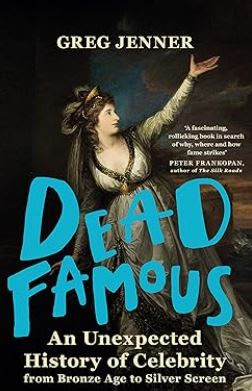
“Charles Dickens,” comes the reply. This is what I get for reading Greg Jenner’s Dead Famous before bed.

But I know that distinctive voice. I part the bed curtains. “Dan Stevens?!” I ask incredulously, laying eyes on the extremely handsome English actor in the early morning light.

“It’s Charles Dickens,” Dan Stevens insists. He’s brought a friend.

“And John Forster,” adds Justin Edwards-in-Victorian-costume.

Accepting that these British thespians are in character as their The Man Who Invented Christmas counterparts, I ask, “Are you the Ghosts of Christmas Past? Am I dreaming?

“Neither,” says John/Justin, pulling a pie sprinkled with sugar seemingly out of nowhere.

That explained nothing. I thought back to Robert Sheehan telling me his creepy Oatesian visit wasn’t a dream. I then grew distracted by the state of my bedroom, suddenly filled with evergreen trees and boughs decorated with silver baubles, iridescent glass bubbles, and magical flickering candles. I smelled cinnamon and cloves; was someone mulling red wine in my bedroom?

It was beginning to look a lot like Victorian Christmas and smell like it too. My chamber suddenly possessed a long dining table on which there lay a roasted turkey, an enormous figgy pudding, and a rapidly-multiplying host of 19th-century holiday delicacies that would have made Ichabod Crane’s head explode.

“And you’re saying you two are not the Ghosts of Christmas Past?” I asked my guests for clarification.

Seating themselves at the table, they denied being ghosts a second time as they helped themselves to a portion of the mouth-watering feast.

“Tuck in,” said Charles/Dan.

I serve myself, but soon notice how the actors favor each other’s company, eat from each other’s plates, and feed one another. They’d constructed an elaborate ritual that allowed them to touch one another without social judgment.

“What is this?” I wonder out loud.

“You could think of it as recursion,” Charles/Dan says. “Each Christmas harks back to every other Christmas. This Christmas reminds you of childhood Christmases, which in turn retains elements of Victorian Christmas past, which in turn bears marks of earlier traditions, and so on.

“One might say,” remarks John/Justin, “that, in a sense, there has only ever been one Christmas and we return to it every year. We practice the myth of eternal return when we practice Christmas.” His thumb traces a line of cream that Charles/ Dan has smeared on his cheek, then eats the errant cream.

“I still don’t understand why I’m here,” I say. “Why was it necessary for me to be the Scrooge in this drama?”

“It isn’t,” Charles/Dan says flatly. “We merely need your bed.”

With that they abandon their feast and retire to my comfy bed, drawing the curtains behind them. I politely ignore their pleasured sighs as I slice into a steaming plum pie, but internally I wish they’d gotten a different room. I knew the Somerset Maugham Suite at the Oriental Hotel in Bangkok had recently been vacated.


* * *


Author’s Note: Oliver Sacks wrote that Charles Dickens had a haunted mind, but didn’t explain that statement and then very sadly passed away. I began to understand it when I read about the railway accident he was involved in. I now believe that perhaps Dr. Sacks also meant that Dickens was haunted by his childhood poverty. This is depicted in The Man Who Invented Christmas and discussed in Dead Famous.

But then in this podcast, Helena Kelly spilled the absolute tea on Dickens and found out that he might have been lying about working in a boot blacking factory?! And he probably had syphilis, which he gave to Kate and the children - some of them may have died from it! - and maybe her sister too?! I don’t want to slut shame Charles Dickens, but I do think I understand what Dr. Sacks meant a lot more deeply now.

This is an affiliate link: https://amzn.to/3RdXQwk

But I wouldn’t be sad if the ghost of Dr. Oliver Sacks wanted to visit me and talk about it.