Pages

Showing posts with label Emily Bronte. Show all posts

Saturday, December 27, 2014

'Wuthering Bites' - Emily Bronte's Classic With a Twist #MashUp


Wuthering Bites by Sarah Gray

My rating: 3 of 5 stars

If you've read this blog for a while now, you may recall that near the top of my all-time favorite classic novels list is Emily Bronte's Wuthering Heights. I read or watch it or its many spinoffs and adaptations at least once every couple of years.

In October 2014, I saw it as a stage play. With Halloween being right around the corner from that night, I decided to give the vampire version a chance.

The thing that gave me tremendous pleasure about reading this novel was re-discovering all the brilliant bits that made me fall in love with Wuthering Heights in the first place. I have my favorite lines, and it's always a small thrill whenever they come up in a new version. There are also some deft bits of humor woven in.

Overall, I didn't enjoy this mash-up as much I liked Jane Slayre: The Literary Classic with a Blood-Sucking Twist, which I also recently read. In general, I'm fan of monster mash-ups, beginning with Pride and Prejudice and Zombies. Wuthering Bites was a fun read, but the vampire elements could have been incorporated in a more thorough way. Some of them, especially toward the end, felt very tacked-on. In a really good mash-up, we don't see the seams.

For example, for the vast majority of this version, we don't know what Heathcliff is. We know he's most likely the son of a Roma vampire slayer and that he has some power to control the vampires around Wuthering Heights. They listen to him when he tells them certain people are off-limits as food sources. But why does he have this power? We also know he's not a vampire himself. At almost the very end, we learn Heathcliff is a dhampir - half vampire, half human. Why this had to be a surprise kept until the very end, I just can't figure out. It seems like being a dhampir would go a long way to explain and perhaps even excuse some of Heathcliff's more disturbing behavior. Didn't Bronte intend for us to feel sympathy for Heathcliff, after the way Hindley treated him? He's more sympathetic if, through no fault of his own, he's caught between two opposing worlds.

The elder Catherine's fate is treated in a similarly mysterious way. Her ultimately-fatal illness, explained in the original book as being self-induced out of sheer cussedness, is explained in this mash-up by a vampire bite - not enough to turn her into a vampire, but enough to eventually kill her. We're told throughout the second half of the novel that Catherine's grave always looks fresh, and at the very end we find out it's because Catherine isn't quite dead and roams the moors in a zombie-like vampiric state. (Sounds like a job for Andrew Lincoln as a combination of Edgar Linton and Rick Grimes, no?) It would have been interesting for the other characters to come across her in this state, rather than just having Mr. Lockwood learn about her at the last possible moment.

One addition I did rather enjoy was the younger Catherine's ambition to become a vampire slayer. In the end, not only is she redeemed by her love for Hareton, but also by her new-found freedom to pursue her dream. I love a heroine with an ambition, even if her ambition is beheading bloodsucking fiends.

I love Wuthering Heights. I love vampires. This should have been the perfect book for me, but I thought it fell somewhat flat.

I purchased this book with my own funds and was not obligated in any way to review it. According to the sticker on the back, I bought it for $15 at Borders. It was published in 2010, so this was apparently one of the last things I ever bought at Borders.

This is an affiliate link:

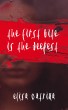
The First Bite Is the Deepest by Elisa Catrina. $2.99 from Smashwords.com
“Funny and clever and emotionally hard-hitting” "A perfectly creepy read." Elisa Catrina's debut novel begins as a quirky send-up of vampire romance, but quickly turns sinister. High schooler Stella Ortiz starts dating the mysterious new guy, but her friends are convinced he's bad news: Sebastian misses tons of school, he day-drinks something that smells like pennies, and oh yeah, he's a vampire.

Wednesday, October 22, 2014

Wuthering Heights (Stage Production) Review


I watched the performance of Wuthering Heights by the Aquila Theatre on October 13, 2014. This adaptation of Emily Bronte’s novel was written by Desiree Sanchez, who also directed the production. This was a touring cast, which I caught at my alma mater of St. Mary’s College of Notre Dame, Indiana. The Aquila Theatre’s permanent home is at New York University.

Film and video recording were prohibited at the performance, so these photos are borrowed from Aquila Theatre’s website, for informational purposes.

The cast consisted of six actors. There are more than six characters in the adaptation, so this required some of the actors to play multiple characters. I’d recently watched a performance of William Shakespeare’s Much Ado About Nothing by the Actors From the London Stage at the University of Notre Dame in which all the roles were played by five actors. I was familiar with this type of production, but I can’t say it’s one of my favorites.

Nor did I understand the framework of the adaptation. As the play opened, all six actors were on stage, and they appeared to be in some sort of industrial setting, working in a mill. I say a mill because the program, under the cast list, says “Edgar Linton/Mill Foreman,” “Heathcliff/Mill Worker #5,” etc. I don’t understand what the mill is supposed to represent. The novel doesn’t even take place in an urban setting. Perhaps if I’d gotten to my seat a little sooner, I would have heard a preface of some sort, but it had been a long day at work and I barely had time for theater-going.


Still, it’s tough for me to resist an adaptation of a Bronte sisters novel. I love Wuthering Heights and Jane Eyre to bits.

The lighting designer was Peter Meineck. With the minimalist set (another theater convention of which I’m not overly fond – I prefer the elaborate production), the lighting was one of the most pleasing things about this production. I especially liked the way that the actor’s shadows projected on the right and left walls of the auditorium on both sides of the stage. It was lovely to turn my head and observe how much the shadows told the stories of the characters merely through their body language.

Here I’ve sorted my thoughts about the performances by character. I barely need to mention James Lavender, the actor playing Old Earnshaw, Joseph (the fire-and-brimstone-preaching servant), and the doctor, as well as a mill worker. I’m sure he’s a fine actor, but those are the least important roles in this adaptation.

Nelly:  By far the most sympathetic character in the adaptation, and a narrator just as she is in the book (of the story within the story, that is), Nelly Dean was played by Lizzy Dive. Ms. Dive is a lovely full-figured woman with a rich voice meant just for storytelling. She was by turns maternal, particularly with Heathcliff and then Hareton, and exasperated with Catherine. To use a netspeak turn of phrase, Nelly is SO DONE with Catherine.

The role requires an incredible amount of REACTING on Nelly’s part, and Dive had mastered the art. This was especially evident in the scene in which Nelly is physically menaced by the drunken, degenerated Hindley.

Dive also took a brief turn as Frances, the wife of Hindley and mother of Hareton. I know it’s impractical to keep another actress on the road tour just to play the small role of Frances. However, it stretches credulity to imagine the hale, hearty Nelly embodied in the same way as fragile Frances.

Catherine: Kali Hughes played Cathy. According to her biography, her acting credits include The Count of Monte Cristo; I wonder if she played Mercedes. Also, there’s a stage version of The Count of Monte Cristo?! We needs it, precious.

But back to the play at hand. Ms. Hughes as Cathy delivered an impeccably harrowing, suitably wild-hearted performance. When Cathy, as her final illness was coming on, didn’t recognize her own face in the mirror, Hughes gave a truly blood-curdling scream. Her mannerisms and body language managed to perfectly convey the depths of her feelings for Heathcliff, the instability of her wild character, her insouciance, the shallowness of her feelings for Edgar, her madness, and even her pregnancy. It was subtle performance.

I thought maybe at the end they’d lift her into the air like they did to Marge Simpson as Blanche Dubois in the Springfield production of Streetcar, but mercifully they didn’t.


Heathcliff:  The equally complex and challenging role of Heathcliff was taken on with aplomb by Dale Mathurin. Let me tell you a thing about Dale Mathurin: he’s stop-your-breath gorgeous. Now let me tell you a thing about why he’s so perfect for the role of Heathcliff: In addition to the fact that he’s been acting since he was seven years old, he’s a Briton of African descent. I know what you’re thinking: white British, black British, Pakistani British, Indian British, Chinese British, Polish British – they’re all just British. They’ll all pop ‘round to the pub with their mates, have a pint, grab a takeaway curry on their way back to their flats, and put on the kettle for a cuppa.

But the brilliance of casting a person of color in the role of Heathcliff is that Emily Bronte repeatedly describes him as “black” and “a Gypsy” in the novel. As much as I love Ralph Fiennes as Heathcliff, there’s nothing about Fiennes’ lovely pale complexion that suggests the Roma people. The Roma are what my Jewish ancestors are: an Asian ethnicity that immigrated to Europe, except the Roma’s homeland is India. Heathcliff may be of Indian descent, or he may be of Afro-Caribbean descent; we can’t count on the rural English people of the novel to know or care about the difference. Either way, he is almost certainly a person of color.

When I first read that Andrea Arnold was filming an adaptation with Heathcliff as a black man, I was super excited to see her movie. I didn’t end up liking it, but not because of Solomon Glave as young Heathcliff or James Howson as adult Heathcliff. I just thought the sets were too dark for the action to be seen, the film was too silent, and half the time I couldn’t quite make out what was going on.

The stage production wasn’t plagued with those problems. Dale Mathurin will rank up there among my favorite Heathcliffs. He’s a damn sight better at it than Tom Hardy, at any rate.*

Edgar: The Masterpiece Classic movie version ruined for me any Edgar Linton who isn’t Andrew Lincoln. Stupid Englishman-turned-zombie-killing-American; why do you have to be so damn handsome? To be honest, though, casting Lincoln to play Edgar Linton is an example of what TV Tropes would call AdaptationalAttractiveness. Bronte herself named Linton in a Dickensian way; he was probably about as attractive as his name suggests. Calder Shilling did a fine job of playing him.

Isabella: One of the things that disappointed me most about this performance was that Isabella, a rather important character to this adaptation, was played by Michael Ring, the actor playing Hindley. Yes, Isabella is young, naïve, and silly, and she’s as frail as her brother, and to some extent Bronte makes her an object of mocking. Still, I’d like to see her humanized a little more by having her played by a woman, since having her played by a male actor makes her look that much more ridiculous. In theory I have nothing against gender-blind casting, but in the case of Isabella Linton it did somewhat rub me the wrong way.


In the end, what disappointed me about this play the most was what disappoints me the most about almost all the adaptations of WH: they leave off the ending. For me, if we don’t get to the part where Heathcliff finally joins Cathy in death, their spirits are said to haunt to moors, and Cathy the younger finally gets to be free with Hareton, then the story is seriously lacking in any sort of resolution. This one cut off just after Catherine the elder’s death, with barely a mention of Cathy the younger’s existence. After Heathcliff’s impassioned speech begging Cathy to haunt him, Nelly gave a brief wrap-up, they all returned to their odd mill worker poses, and curtain.

*At intermission, I heard some men two rows back from me talking about a recent film adaptation starring Christian Bale as Heathcliff. I wish! But they were simply mistaking one actor from The Dark Knight Rises for another. Also, they couldn’t remember what happened to Isabella in the novel, whether she died in childbirth or lived. They didn’t remember the latter chapters of the book very well at all. I thought that was a little sad, since the novel is best grasped as a whole, its plot being somewhat circular.


Here’s a quick rundown on them: Isabella escapes her wretched, abusive marriage to Heathcliff, fleeing to London with their young son, who is named, simply, Linton. However, Isabella eventually dies, and the fragile Linton is forced to move back to Wuthering Heights with his father. When Linton and Catherine the younger are teens, Heathcliff uses them as pawns in his revenge game, forcing them into a marriage. Then Linton dies, and Heathcliff treats his nominal daughter-in-law as if she were a household servant. Thus Catherine the younger meets the love of her life: Hareton. After Heathcliff’s death, Catherine and Hareton are free to pursue their romance – the redemptive ending to this whole sad drama. 

Wednesday, July 31, 2013

Emily Bronte's 195th Birthday - 'Wuthering Heights' Love

Emily Bronte's 195th birthday was yesterday; the poet and novelist was born on July 30th, 1818. She only lived to be 30, and unfortunately, she only left the world one novel, the masterful Wuthering Heights. Today's post is all about Wuthering Heights, which - if I absolutely had to choose only one favorite book - I would call my favorite book ever.


My library has this graphic novel version. It's awesome.


This, clearly, is my least favorite cover ever.


This isn't in and of itself a bad cover. It's just part of that trend where they tried to make a bunch of classics look like sequels to Twilight and stuck them in the YA section.


I got The Heights from a "secret Santa" blogger exchange, and I really liked it.


Haven't read Wuthering Heights yet? You can get it free for Kindle, so now you have no excuse!

Everand (Scribd): https://www.everand.com/audiobook/1039689816/The-Sisters-Bronte

Kobo, Walmart: https://www.kobo.com/us/en/audiobook/sisters-bronte-the?sId=6a01a41a-6954-46e2-92b7-715ecb984101&ssId=rkt46HsVt7MIaCMsbQc2V&cPos=1


Saturday, September 29, 2012

Coming Attractions: Books I'll Be Reading and Reviewing for Amazon Vine

Being selected for Amazon Vine seems like unbelievable good luck to me. They send me two lists a month, on the third and fourth Thursdays of the month. I get to pick two free things from each list in exchange for reviews. Win-win. Some of my previous Vine reviews have included:

Kiss, Crush, Collide by Christina Meredith
Juliet Immortal by Stacey Jay
Beauty Queens by Libba Bray
The Abused Werewolf Rescue Group by Catherine Jinks
Family by Micol Ostow
The Bowl of Light by Hank Wesselman

I don't always order books. In fact, next week I'll be testing out a 7-Eleven Slurpee maker. But I do read a lot of books from Vine. The ones I just finished are:


- An excellent beginners'/young adult biography of Charlotte, Emily and Anne. I find it very sad to know that Patrick Bronte outlived all five of his daughters and his son, and that between them, the three Bronte sisters who lived into adulthood - known to the Victorian book-buying public as Currer, Ellis and Acton Bell - produced only seven novels and one volume of poetry between them. Charlotte was the only one who lived long enough to marry.

This book will fascinate readers (the intended age range is 10-14) interested in how the human body works. It focuses mainly on the science, but also explores a little bit of the mythology that's historically been associated with blood. Most of the science will be familiar to the average adult, but I learned a few fascinating tidbits about the blood of some other species, such as the horseshoe crab. The book is designed to look as if the pages were splashed with blood, so if you're very squeamish, it might be a bit much to handle. Blood doesn't usually bother me, but a few of the more gruesome medical passages made me feel a little squeamish.

The ones I have slated to read are:


I've read about a third of this one so far. Mine doesn't have the pretty cover. It's an ARC with a plain chartreuse wrapper. ("Plain chartreuse" is kind of an oxymoron, though, isn't it?) Having come from an educational background in psychology, I've read The Man Who Mistook His Wife for a Hat and An Anthropologist on Mars and count them both among my "permanent keeper" books. (Awakenings I like a little less, and although I read Musicophilia, I don't own a copy.) It's fascinating. I learned that the actor Silas Weir Mitchell, who plays Monroe on Grimm, is named for a 19th-century physician ancestor who experimented with mescaline and quantified his hallucinations.

I just finished the migraine chapter, which very much reminded me of a biography of Mary Todd Lincoln I read in college; her alleged "insanity" was very likely to have been a combination of PTSD and migraines.


Set in Key West, in the Hemingway residence that is now a famous tourist attraction, the one I visited in 2004.


I still don't think I care to read The Count of Monte Cristo, but that doesn't mean I'm not fascinated by the true story behind it.


The follow-up to Dead is a Battlefield. The only disappointing thing is that it's, by far, the skinniest volume in the series so far.


Of course, I still have to read the original Jane Eyre first. Sadly, it's true: the only one of the Bronte sisters' seven novels that I've read is Wuthering Heights. (But I've read it three times, if that helps.)


Everand (Scribd): https://www.everand.com/audiobook/1039689816/The-Sisters-Bronte

Kobo, Walmart: https://www.kobo.com/us/en/audiobook/sisters-bronte-the?sId=6a01a41a-6954-46e2-92b7-715ecb984101&ssId=rkt46HsVt7MIaCMsbQc2V&cPos=1

Friday, August 5, 2011

Review of 'The Heroines'


The cover of my edition portrays a woods in which great heroines of fiction are lounging. Hester Prynne (with Pearl) and Scarlett O'Hara are the easiest to discern. The concept behind the book is something like Inkheart: the Heroines appear to Anne-Marie Entwhistle, take up residence in her inn and subsequently torment and fascinate her 13-year-old daughter Penny. Madame Bovary and Anna Karenina each make an appearance, as do J.D. Salinger's Franny and Emily Bronte's Catherine Earnshaw.

Catherine was the most problematic for a teenage Anne-Marie; for Penny, it's Deidre, the tragic Heroine of a Celtic ballad. Each of these Heroines brings with them a Hero, and this complication causes Penny's life to become more like a chapter from Girl, Interrupted.

The author, Eileen Favorite, is an instructor at the School of the Art Institute of Chicago. That in itself appeals to me, as does her fictional blend of whimsy, second wave feminism and angsty YA soul-searching. The novel questions the nature of reality itself in an almost Buddhist fashion, giving it fascinating depth. I expected something more humorous, less tragicomic, but I'm pleasantly surprised.


I also like the opening quote, from Northanger Abbey by Jane Austen: "Alas, if the heroine of one novel be not patronized by the heroine of another, from whom can she expect protection and regard?"

Show These Links Some Love: My latest published articles

How to Play a LoveGame in 5 Gaga Steps

Fish Tales: It's Supposed to Smell Like That!


Image: Mary Hallock Foote, 1878 (public domain).


Everand (Scribd): https://www.everand.com/audiobook/1039689816/The-Sisters-Bronte

Kobo, Walmart: https://www.kobo.com/us/en/audiobook/sisters-bronte-the?sId=6a01a41a-6954-46e2-92b7-715ecb984101&ssId=rkt46HsVt7MIaCMsbQc2V&cPos=1