Showing posts with label Jane Eyre. Show all posts
Showing posts with label Jane Eyre. Show all posts
Tuesday, December 14, 2021

Tuesday, September 1, 2015
'The Silkworm' by J.K. Rowling, Writing as Robert Galbraith

Brava, Ms. Rowling! Much of what I said for The Cuckoo's Calling can also be applied here: "Robert Galbraith" once again shows herself
witty, hilarious, brilliant, and in command of both English literature and
European mythology.
I had to look up at least two cultural references in this
one: Rose West and Rowntree. The victim in this murder mystery is Owen Quine,
and his wife Leonora is one of the suspects. The press compares her in physical
appearance to Rose West – apparently, a real-life serial killer currently
serving a life sentence in the U.K.
If I heard the audiobook correctly, Rowntree is the name of
Robin Ellacott’s parents’ chocolate Labrador retriever. The name fits a
chocolate-colored dog because it’s the name of the U.K. chocolate maker, the
one that makes Aero bars. (Rainbow Rowell has teased an appearance by Aero bars
in Carry On, which she promises is filled with nommy food references.)
Robin Venetia Ellacott is even more of a superheroine in this one than she was in the last.
Guy Ritchie could direct the movie version.
Book Boyfriend #444: Cormoran Strike. If Edward Fairfax Rochester fell through half a dozen Raymond Chandler novels and From Here to Eternity on his way to the 21st century, the result would be Cormoran Strike.
And I am shipper trash because I desperately want Robin to
leave Matthew for Cormoran. That kiss on the hand in the very last sentence of
the novel - that's all the encouragement I need. The line has been crossed. Let
the good ship CormoRobin set forth.
Robert Glenister is an amazing voice actor. I didn’t love
his voice for Cormoran’s brother Al; Al was supposed to have a slight French
accent, but to me he sounded too American. But otherwise, Glenister makes it
too easy to forget I’m listening to a single person reading instead of to the
characters themselves.
Do I really have to wait until October 20 for the third book, Career of
Evil, though?

I checked this audiobook out of my local library and was
not, in any way, obligated to review it.
P.S. I don’t think I’ll ever buy anything made from silk
again unless it’s ahimsa or cruelty-free silk. I can’t stand the thought of the
little silkworms being boiled alive inside their cocoons.
Tuesday, November 18, 2014
Jane Slayre: The Literary Classic with a Blood-Sucking Twist
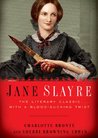 Jane Slayre: The Literary Classic with a Blood-Sucking Twist by Sherri Browning Erwin
My rating: 5 of 5 stars
I've long been a fan of monster mash-ups; you get all the fun of rereading the classic, plus the fun of the supernatural twist. This is an especially good one. I started reading this around Halloween.
I love that it includes the whole Jane Eyre story - unlike the erotica mash-up Jane Eyre Laid Bare: The Classic Novel with an Erotic Twist, which disappointingly excludes the St. John Rivers story. In Browning Erwin's telling, St. John is the Daryl Dixon of the tale, slaying vampires and werewolves with a crossbow of his own invention. Zombies have also come into play, but their fiercest slayer is Jane herself. Saving people and hunting things is the Slayre family business.
This book does include the line "Reader, I buried him," causing me to laugh out loud - but fear not, the happy ending is still intact. In short, this is the monster mash-up done right.
View all my reviews on Goodreads
I purchased this book with my own funds from Better World Books and was not obligated in any way to review it.
Next, I'm going to read Spirit Bound by Richelle Mead. It's the fifth book in the Vampire Academy series.
 |
| I think this is supposed to be Adrian and Rose, but keep in mind Rose is half Turkish and described as being olive-skinned. |
Sadly, the Frostbite movie campaign failed to find funding, so even if I enjoy Spirit Bound (doubtful, since I hate Strigoi!Dimitri), I'll never see it reach the big screen.
You know what I think could have saved the Vampire Academy movie franchise? Letting Misha Collins play Dimtri. He already answers to the name Dimitri, because it is his name. I don't even care that he's 40 and not 25. Let Dimitri Belikov be older; let his relationship with Rose seem that much more inappropriate.
No offense to Danila Kozlovsky (age 29); I still think he's gorgeous.
 |
Допускается использование материалов и фотографий в соответствии с лицензией Creative Commons Attribution/Share-Alike 3.0. При использовании обязательна ссылка на сайт. |
It's just that American audiences aren't all that familiar with Russian actors, even if I really wouldn't mind getting familiar with Danila.
Oh, well, Maybe the Vampire Academy series can do what A Series of Unfortunate Events is doing and continue on as a Netflix web series. (Squee!)
Wednesday, October 22, 2014
Wuthering Heights (Stage Production) Review

I watched the performance of Wuthering Heights by the Aquila Theatre on October 13, 2014. This adaptation of Emily Bronte’s novel was
written by Desiree Sanchez, who also directed the production. This was a
touring cast, which I caught at my alma mater of St. Mary’s College of Notre
Dame, Indiana. The Aquila Theatre’s permanent home is at New York University.
Film and video recording were prohibited at the performance,
so these photos are borrowed from Aquila Theatre’s website, for informational
purposes.
The cast consisted of six actors. There are more than six
characters in the adaptation, so this required some of the actors to play
multiple characters. I’d recently watched a performance of William Shakespeare’s
Much Ado About Nothing by the Actors From the London Stage at the University of
Notre Dame in which all the roles were played by five actors. I was familiar
with this type of production, but I can’t say it’s one of my favorites.
Nor did I understand the framework of the adaptation. As the
play opened, all six actors were on stage, and they appeared to be in some sort
of industrial setting, working in a mill. I say a mill because the program,
under the cast list, says “Edgar Linton/Mill Foreman,” “Heathcliff/Mill Worker
#5,” etc. I don’t understand what the mill is supposed to represent. The novel doesn’t
even take place in an urban setting. Perhaps if I’d gotten to my seat a little
sooner, I would have heard a preface of some sort, but it had been a long day
at work and I barely had time for theater-going.
_vertical.jpg)
Still, it’s tough for me to resist an adaptation of a Bronte
sisters novel. I love Wuthering Heights and Jane Eyre to bits.
The lighting designer was Peter Meineck. With the minimalist
set (another theater convention of which I’m not overly fond – I prefer the
elaborate production), the lighting was one of the most pleasing things about
this production. I especially liked the way that the actor’s shadows projected
on the right and left walls of the auditorium on both sides of the stage. It
was lovely to turn my head and observe how much the shadows told the stories of
the characters merely through their body language.
Here I’ve sorted my thoughts about the performances by
character. I barely need to mention James Lavender, the actor playing Old
Earnshaw, Joseph (the fire-and-brimstone-preaching servant), and the doctor, as
well as a mill worker. I’m sure he’s a fine actor, but those are the least
important roles in this adaptation.
Nelly: By far the
most sympathetic character in the adaptation, and a narrator just as she is in
the book (of the story within the story, that is), Nelly Dean was played by
Lizzy Dive. Ms. Dive is a lovely full-figured woman with a rich voice meant
just for storytelling. She was by turns maternal, particularly with Heathcliff
and then Hareton, and exasperated with Catherine. To use a netspeak turn of
phrase, Nelly is SO DONE with Catherine.
The role requires an incredible amount of REACTING on Nelly’s
part, and Dive had mastered the art. This was especially evident in the scene
in which Nelly is physically menaced by the drunken, degenerated Hindley.
Dive also took a brief turn as Frances, the wife of Hindley
and mother of Hareton. I know it’s impractical to keep another actress on the
road tour just to play the small role of Frances. However, it stretches
credulity to imagine the hale, hearty Nelly embodied in the same way as fragile
Frances.
Catherine: Kali Hughes played Cathy. According to her
biography, her acting credits include The Count of Monte Cristo; I wonder if
she played Mercedes. Also, there’s a stage version of The Count of Monte
Cristo?! We needs it, precious.
But back to the play at hand. Ms. Hughes as Cathy delivered
an impeccably harrowing, suitably wild-hearted performance. When Cathy, as her
final illness was coming on, didn’t recognize her own face in the mirror,
Hughes gave a truly blood-curdling scream. Her mannerisms and body language managed
to perfectly convey the depths of her feelings for Heathcliff, the instability
of her wild character, her insouciance, the shallowness of her feelings for
Edgar, her madness, and even her pregnancy. It was subtle performance.
I thought maybe at the end they’d lift her into the air like
they did to Marge Simpson as Blanche Dubois in the Springfield production of
Streetcar, but mercifully they didn’t.
.jpg)
Heathcliff: The
equally complex and challenging role of Heathcliff was taken on with aplomb by
Dale Mathurin. Let me tell you a thing about Dale Mathurin: he’s
stop-your-breath gorgeous. Now let me tell you a thing about why he’s so
perfect for the role of Heathcliff: In addition to the fact that he’s been
acting since he was seven years old, he’s a Briton of African descent. I know
what you’re thinking: white British, black British, Pakistani British, Indian
British, Chinese British, Polish British – they’re all just British. They’ll
all pop ‘round to the pub with their mates, have a pint, grab a takeaway curry
on their way back to their flats, and put on the kettle for a cuppa.
But the brilliance of casting a person of color in the role
of Heathcliff is that Emily Bronte repeatedly describes him as “black” and “a
Gypsy” in the novel. As much as I love Ralph Fiennes as Heathcliff, there’s
nothing about Fiennes’ lovely pale complexion that suggests the Roma people.
The Roma are what my Jewish ancestors are: an Asian ethnicity that immigrated
to Europe, except the Roma’s homeland is India. Heathcliff may be of Indian
descent, or he may be of Afro-Caribbean descent; we can’t count on the rural
English people of the novel to know or care about the difference. Either way,
he is almost certainly a person of color.
When I first read that Andrea Arnold was filming an
adaptation with Heathcliff as a black man, I was super excited to see her
movie. I didn’t end up liking it, but not because of Solomon Glave as young
Heathcliff or James Howson as adult Heathcliff. I just thought the sets were
too dark for the action to be seen, the film was too silent, and half the time
I couldn’t quite make out what was going on.
The stage production wasn’t plagued with those problems.
Dale Mathurin will rank up there among my favorite Heathcliffs. He’s a damn
sight better at it than Tom Hardy, at any rate.*
Edgar: The Masterpiece Classic movie version ruined for me any Edgar Linton who
isn’t Andrew Lincoln. Stupid Englishman-turned-zombie-killing-American; why do
you have to be so damn handsome? To be honest, though, casting Lincoln to play
Edgar Linton is an example of what TV Tropes would call AdaptationalAttractiveness.
Bronte herself named Linton in a Dickensian way; he was probably about as
attractive as his name suggests. Calder Shilling did a fine job of playing him.
Isabella: One of the things that disappointed me most about
this performance was that Isabella, a rather important character to this
adaptation, was played by Michael Ring, the actor playing Hindley. Yes,
Isabella is young, naïve, and silly, and she’s as frail as her brother, and to
some extent Bronte makes her an object of mocking. Still, I’d like to see her
humanized a little more by having her played by a woman, since having her
played by a male actor makes her look that much more ridiculous. In theory I
have nothing against gender-blind casting, but in the case of Isabella Linton
it did somewhat rub me the wrong way.

In the end, what disappointed me about this play the most
was what disappoints me the most about almost all the adaptations of WH: they
leave off the ending. For me, if we don’t get to the part where Heathcliff
finally joins Cathy in death, their spirits are said to haunt to moors, and
Cathy the younger finally gets to be free with Hareton, then the story is
seriously lacking in any sort of resolution. This one cut off just after
Catherine the elder’s death, with barely a mention of Cathy the younger’s
existence. After Heathcliff’s impassioned speech begging Cathy to haunt him,
Nelly gave a brief wrap-up, they all returned to their odd mill worker poses,
and curtain.
*At intermission, I heard some men two rows back from me
talking about a recent film adaptation starring Christian Bale as Heathcliff. I
wish! But they were simply mistaking one actor from The Dark Knight Rises for
another. Also, they couldn’t remember what happened to Isabella in the novel,
whether she died in childbirth or lived. They didn’t remember the latter
chapters of the book very well at all. I thought that was a little sad, since
the novel is best grasped as a whole, its plot being somewhat circular.
Here’s a quick rundown on them: Isabella escapes her
wretched, abusive marriage to Heathcliff, fleeing to London with their young
son, who is named, simply, Linton. However, Isabella eventually dies, and the
fragile Linton is forced to move back to Wuthering Heights with his father.
When Linton and Catherine the younger are teens, Heathcliff uses them as pawns
in his revenge game, forcing them into a marriage. Then Linton dies, and
Heathcliff treats his nominal daughter-in-law as if she were a household
servant. Thus Catherine the younger meets the love of her life: Hareton. After
Heathcliff’s death, Catherine and Hareton are free to pursue their romance –
the redemptive ending to this whole sad drama.
Friday, September 5, 2014
Currently Reading: 'Vampyres of Hollywood' by Adrienne Barbeau and Michael Scott #FridayReads

As I mentioned on a previous Book Club Friday, I'm reading Vampyres of Hollywood, a not-too-serious novel by movie actress Adrienne Barbeau and co-author Michael Scott (the Irish novelist, not the character from the U.S. The Office.)
Without giving away too much of the plot, I thought it would be fun to look at the real-life actors who appear as vampire characters in this book. The Old Hollywood vampyres, according to Barbeau and Scott, include:
Charles Brabin (1882-1957): English-born American film director who married Theda Bara in 1921. He was the original director of the 1925 version of Ben-Hur, but was replaced fairly early in the production.
 |
| Newspaper ad for While New York Sleeps, directed by Charles Brabin. Public domain image within the U.S. |
 |
| Public domain within the U.S. |
James Whale (1889-1957): English film director whose credits include Frankenstein (1931), The Invisible Man (1933), and The Bride of Frankenstein (1935). Sir Ian McKellen played him in the 1998 movie Gods and Monsters. He was one of the first gay men in Hollywood to be "out."
Mary Pickford (1892-1979): Toronto-born Canadian-American actress and behind-the-scenes business woman considered "America's Sweetheart." She was one of the founders of the United Artists company, along with her husband Fairbanks. Starred opposite her husband in The Taming of the Shrew. America's Sweetheart was a serious party girl who developed a severe alcohol problem.
 |
| Mary Pickford. Public domain image in the U.S. |
Olive Thomas (1894-1920): American (Pittsburgh area) illustrators' model, Ziegfield Follies chorus girl, and silent film actress. Her 1920 film The Flapper helped popularize the "flapper" lifestyle, and she was as notorious for partying in life as she was in the movies. She married Mary Pickford's brother Jack in 1916. She died from drinking mercury bichloride liquid, which was used at the time as a topical treatment for syphilis, which her husband had. (Remember, antibiotics didn't come into common use until around the time of World War II.) Her death was ruled accidental and not suicide, but it was quite a scandal at the time - one of the earliest Hollywood scandals.
 |
| Olive Thomas. Public domain image within the U.S. |
Orson Welles (1915-1985): Wisconsin-born actor, screenwriter, director, and producer famed for his 1938 War of the Worlds radio broadcast that many people believed was a real news report of an alien invasion, and for numerous films including Citizen Kane. He was married to Rita Hayworth for a period in the 1940s and the two had a daughter together, and he also had an affair with the gorgeous Mexican actress Dolores del Rio. He played Edward Fairfax Rochester in the 1943 version of Jane Eyre.
 |
| Welles in The Lady From Shanghai trailer. Public domain within the U.S. |
Peter Lorre (1904-1964): Jewish American (naturalized 1941) actor born in what is now Slovakia, which at the time was part of the Austro-Hungarian empire. After fighting in World War I, the young actor began working with the legendary playwright Bertolt Brecht. He was then cast as a serial killer in the film M by the German director Fritz Lang. He began making English-language films by learning his lines phonetically and is known for such movies as The Maltese Falcon and Casablanca. Toward the end of this life he also made two low-budget horror films with Roger Corman.
.png) |
| Lorre is caricatured in the Looney Tunes cartoon "Hollywood Steps Out." Public domain within the U.S. |
Pola Negri (1897-1987): Polish-born American silent film actress and ballerina. She made a number of silent films in Polish, then in German, and then she came to Hollywood and made English-language films. As the first European star in Hollywood, she's said to have paved the way for Marlene Dietrich, Greta Garbo, and their like.
.jpg) |
| Pola Negri. The U.S. Library of Congress is not aware of any restrictions on the use of this image. |
Theda Bara (1885-1955): Silent film actress, born Theodosia Goodman in Cincinnati. Her Hollywood name is an anagram of "Death Arab," because the studio thought it sounded exotic. They claimed she was the daughter of an Arab sheik and a French mother, born in the Sahara. (Close enough - her father was a Polish Jew, and her mother was of French-speaking Swiss descent, although Bara was, as I mentioned, born in Ohio.) She's remembered mainly for her risque costumes in the 1917 film Cleopatra. Most of her films are now lost (including a turn as Juliet in Romeo and Juliet), and only about 20 seconds of Cleopatra are currently extant.
 |
| Bara in Cleopatra. Public domain within the U.S. |
Tod Browning (1880-1962): American film actor, writer, and director from Louisville, Kentucky, best known for the 1931 Dracula. He literally ran away and joined the circus when he was 16 years old. After that, he became a vaudeville performer. He was directing at a vaudeville theater when he met fellow Kentuckian D.W. Griffith, the notorious director, who set Browning to performing in nickelodeon reels. When Griffith moved his base of operations to Hollywood in 1913, Browning went with him.
 |
| Lobby card for Browning's 1932 circus-themed movie Freaks. Public domain within the U.S. |
Rudolph Valentino (1895-1926): Rodolfo Alfonso Raffaello Pierre Filibert Guglielmi di Valentina d'Antonguolla was an Italian actor working in the United States, famous for his "Latin lover" image. He kind of stumbled into acting because he was poor and he took on a lot of odd jobs. The 1921 film The Four Horseman of the Apocalypse made him a star, but another film released that same year, The Sheik, cemented his image. (Surprisingly, Valentino used the publicity surrounding the role to speak out against stereotyping of Arab people, acknowledging the long tradition of arts, science, and culture in Arab history.) Adored by women, his sexuality was something of a puzzle, but he was possibly bisexual. He was supposedly dating Pola Negri when he developed appendicitis, which turned into the case of peritonitis that killed him. Another book that features Valentino as a fictional character is Loving the Undead: An Anthology of Romance (Sort Of), edited by Katherine Sanger. Valentino's ghost appears in "The Sheik and I" by Leslie Brown.
All of these people, Scott and Barbeau write, make pretty good vampyres, except the self-absorbed Valentino. Lorre is actually quite old, having had a hand in the French Revolution. Vampyres of Hollywood also mentions a vampyre named Charlie. I assume they mean Charlie Chaplin, but I'm not sure.
If you enjoy nonfiction about Old Hollywood, then you might enjoy The Girls: Sappho Goes to Hollywood. You'll learn quite a bit about Marlene Dietrich and Greta Garbo in it, and a little about Valentino, too. You can also read about Mary Pickford and Theda Bara in The American Women's Almanac by Louise Berkinow.
Wednesday, July 23, 2014
I Finally Finished Reading 'Middlemarch'

Middlemarch by George Eliot
My rating: 4 of 5 stars
I have ridden the mighty moon worm!*
Well, no, but I did finally finish Middlemarch. I've been reading this book since January. I thought I would breeze right through it, but it turned out to be 800 dense pages of characterization of virtually every person in the fictional Midlands English town of Middlemarch. It centers mainly on two marriages: the marriage of young, idealistic Dorothea Brooke to the older, bachelor scholar Edward Casaubon, and the marriage of spoiled "princess" Rosamond Vincy to a newcomer to Middlemarch, the physician-scientist Tertius Lydgate. Rosamond's brother, Fred Vincy, wants to marry the sweet-natured Mary Garth, but encounters many obstacles in the course of that courtship.
Edward Casaubon is described as looking like the philosopher John Locke.
 |
| Public domain image |
 |
| Creative Commons image |
I can't exactly say why, but I keep picturing Will Ladislaw as Ben Whishaw.
 |
| Creative Commons image by KikeValencia |

This isn't an exciting classic, like The Count of Monte Cristo or Gone With the Wind, but it is an interesting book. I read it because my copy of Jane Eyre said that if I liked that book I might also like this one. I LOVED Jane Eyre. I must point out, though, that there aren't a lot of obvious similarities. Both deal with class differences and the shifting position of women in society, though.
Middlemarch isn't nearly as romantic as Jane Eyre, nor is it as witty as anything Jane Austen ever wrote. I said before (in this post) that I thought George Eliot was a contemporary of Austen and the Bronte sisters, but this wasn't accurate. George Eliot was born (as Mary Anne Evans) in 1819, and Middlemarch was published in installments between 1871 and 1872. Jane Austen died in 1817, two years before Evans was born. Emily Bronte's short life spanned 1818-1848, and her sister Charlotte lived 1816-1855. Jane Eyre was published in 1847. Charlotte Bronte came the closest to being Evans' contemporary, but she died relatively young and published her most famous work long before Middlemarch debuted.

George Eliot is more cerebral and philosophical than her Regency-era predecessor Jane Austen, and the pleasure of reading her is a more subtle one than the emotional Romantic-era drama of the Brontes. However, I was not unsatisfied with the ending, and I'm glad I had the patience to finish all 800+ pages.
View all my reviews on Goodreads
I bought this paperback at Barnes and Noble and was not obligated to review it in any way.
*Nerdy-ass Futurama reference. Sorry.
Friday, March 14, 2014
#YABookReview 'Wuthering High' by Cara Lockwood

 Wuthering High by Cara Lockwood
My rating: 4 of 5 stars
I bought this from Better World Books because it combines two things I love: Cara Lockwood's writing and what's probably my all-time favorite book, Wuthering Heights. I've previously enjoyed Lockwood's Every Demon Has His Day and Can't Teach an Old Demon New Tricks (you can read my expanded review here on this blog), both of which were silly, fun chick lit and fairly quick, easy reads. This was similar, except the protagonist is 15 years old, placing it more in the young adult than chick lit categories (not that the two are mutually exclusive).
Teenage Miranda has made some bad choices, including one that resulted in her father's BMW colliding with a tree. As a result, Miranda's dad sends her off to a mysterious island. No, the plot doesn't exactly mirror Shakespeare's The Tempest, nor is it a modern retelling of Wuthering Heights like The Heights.
Instead, what this book has is some startling appearances of long-dead novelists, Heathcliff emerging from the pages of the novel from whence he came, a missing girl who may or may not be a modern incarnation of Catherine Earnshaw, a serial arsonist who seems strangely like Bertha Mason from Jane Eyre, a Satan-worshiping roommate, and possibly a vampire.


This book reminded me a little of Miss Peregrine's Home for Peculiar Children, a little of Eileen Favorite's The Heroines (another book in which Heathcliff comes out of the novel and into reality - read the review here on this blog), and a little of Marlene Perez's "Dead Is" series. I like all those things. When I read the first few pages, I wasn't sure I was going to like Miranda (she seems a little spoiled at first, but she's really misunderstood), but she quickly grew on me. I wasn't sure I would like a young adult book that had the MTV logo on the front cover, but it was better than expected. In fact, I think I liked this even better than Lockwood's chick lit series.
This is the first in a 4-part series by Lockwood. I haven't yet decided whether or not I'll go on the read the rest of the series.
I purchased this book with my own funds and was not asked or obligated in any way to review it. This review represents my own honest opinion.
 |
| Lulu.com |
Enter to win Midsummer Night - Pagan Spirits Book 2 - from Goodreads through March 26
Sunday, November 3, 2013
#BookReview 'When Did You See Her Last?' (All the Wrong Questions, Book 2) by Lemony Snicket

A little over a year ago, I was in Venice Beach, California, browsing Small World Books, petting the bookstore cat Conan the Librarian and wishing I wasn't traveling on such a tight budget so that I could spare the cash to buy the first book in Lemony Snicket's All the Wrong Questions series, Who Could That Be At This Hour? I never did buy a copy, but I did borrow it from my local library.
On Wednesday of last week I walked over to my library and picked up a copy of the series' second book, When Did You See Her Last? The "her" in question is the brilliant young chemist Miss Cleo Knight, missing from her family's home in the mysterious town of Stain'd-by-the-Sea (once known for its octopus ink). Our protagonist, 13-year-old Lemony Snicket, must search for her despite adults like his guardian S. Theodora Markson.
As you probably recall from A Series of Unfortunate Events, adults in Lemony Snicket's books are generally ineffective at best and downright wicked at worst. S. Theodora Markson is the ineffective type (at least, from what we know at this point). Snicket gets more reliable help from local teen journalist Moxie Mallahan and underaged taxi cab drivers Pip and Squeak, the Bellerophon brothers.
I finished this book Saturday morning. I find this series delightful, not only as a companion series to A Series of Unfortunate Events, but also in its own right. One of my favorite things about it is the way Snicket makes humorous and pithy observations in his narrative. This book contains several memorable quotes, as Snicket's books often do. Several of these I added to Goodreads myself, including:
“I'm
not a stranger," I said, and pointed to his book. "I'm
someone who reads the same authors you do.”
“Complimenting
someone in an exaggerated way is known as flattery, and flattery will
generally get you anything you want...”
“[I]t
was the color of someone buying you an ice cream cone for no reason
at all.”
“Of
course you can trust me," Jake Hix said. "We read the same
books.”
“I
don't know why wicked places generally look wicked. You'd think
they'd look nice, to fool people, but they hardly ever do.”
“Anyone
who thinks the pen is mightier than the sword has not been stabbed
with both.”
Another favorite thing? Dashiell Qwerty, the sub-librarian who always wears a studded black leather jacket and has wild, spiky hair.
Another fictional crush for me? Yes, I'm afraid so.
The literary references fly fast and furious as well. I don't even know all of them (I can't have read everything), but Pippi Longstocking is discussed at some length, Jane Eyre is mentioned, and we discover that Lemony's sister Kit enjoyed reading The Witch of Blackbird Pond. When Snicket must go to the lighthouse, it reminds him of a book he's been meaning to read. When he suffers an unfortunate tadpole bite, Snicket says, "It might be little, but it's fierce," which you and I know is a paraphrase of a famous Shakespeare quote from A Midsummer Night's Dream.
If you enjoyed A Series of Unfortunate Events and haven't picked up Who Could That Be At This Hour? yet, I encourage you to read the All the Wrong Questions series. The questions may be entirely wrong, but the writing is oh so right.

Wednesday, August 28, 2013
In Which I Yarnbomb My Blog (Amigurumi)
I haven't had much time for reading or blogging this week. On Monday afternoon and Tuesday morning, I had a ton of cleaning to do to the apartment underneath mine, getting it ready to show to a potential renter. I probably spent a total of 12 hours vacuuming, dusting, scrubbing, and sorting items to keep or donate to charity - and the guy was a no-show. I'm glad the apartment's clean, but now I'm a day behind on my writing and editing. (Still, I make time to blog.)
Late-summer chaos is contagious, apparently: I popped in to The Vintage Apple and found that the chaos has eaten the weekly Oh How Pinteresting! link-up, which will now be monthly link-up on the first Wednesday of the month, starting September 4. Which is cool with me - I still wanted to show you a thing today.
(You'll see some pre-written Halloween posts pop up on odd Wednesdays in October - just pretend like I knew Oh How Pinteresting! was going to a monthly format and I did them on purpose anyway.)
Here's the thing. Laura Keykens is a self-proclaimed nerdy girl, and she has a Pinterest board of nothing by amigurumi. Said board covers all kinds of subjects knitted in colorful yarn, and many of these subjects overlap with mynerdish obsessions interests. I like this almost as much as Isabelle Disraeli's fictional character ship-fest.
Take, for example, Alice's Adventures in Wonderland.
And Harry Potter. (Note to self: you have two Pinterest boards of nothing but Harry Potter, but you've never done a Pinterest post exclusively about The Boy Who Lived. You should do that.)
And The Hunger Games.
And The Simpsons.
And Tard the Grumpy Cat.
And Loki.
And Lady Gaga.
And even Jane Eyre. Repinning this with the misspellings intact wasn't easy for me, but I persevered.
I personally have no knitting or crocheting skills whatsoever, but I admire the crafty people who do. I don't personally own any amigurumi, either. Somehow, I don't think my husband would appreciate me carrying around a Spiderman doll all the time like I did when I was 3, or going to bed with a stuffed Lokiand calling it Tom.
Do you have a favorite amigurumi character?
Late-summer chaos is contagious, apparently: I popped in to The Vintage Apple and found that the chaos has eaten the weekly Oh How Pinteresting! link-up, which will now be monthly link-up on the first Wednesday of the month, starting September 4. Which is cool with me - I still wanted to show you a thing today.
(You'll see some pre-written Halloween posts pop up on odd Wednesdays in October - just pretend like I knew Oh How Pinteresting! was going to a monthly format and I did them on purpose anyway.)
Here's the thing. Laura Keykens is a self-proclaimed nerdy girl, and she has a Pinterest board of nothing by amigurumi. Said board covers all kinds of subjects knitted in colorful yarn, and many of these subjects overlap with my
Take, for example, Alice's Adventures in Wonderland.
And Harry Potter. (Note to self: you have two Pinterest boards of nothing but Harry Potter, but you've never done a Pinterest post exclusively about The Boy Who Lived. You should do that.)
And The Hunger Games.
And The Simpsons.
And Tard the Grumpy Cat.
And Loki.
And Lady Gaga.
And even Jane Eyre. Repinning this with the misspellings intact wasn't easy for me, but I persevered.
I personally have no knitting or crocheting skills whatsoever, but I admire the crafty people who do. I don't personally own any amigurumi, either. Somehow, I don't think my husband would appreciate me carrying around a Spiderman doll all the time like I did when I was 3, or going to bed with a stuffed Loki
Do you have a favorite amigurumi character?
Thursday, July 4, 2013
The Second #BookHaul From Better World Books @BWBooks
Look what came in the mail yesterday! There's no mail today, of course, because it's U.S. Independence Day! We're celebrating our independence from the U.K. and also the time Will Smith and Bill Pullman defeated those awful, awful aliens.
You can find the photos from my previous Better World Books haul here.

What's inside this mysterious-looking chartreuse package? As it turns out:

...Three new (well, new to me) books from Nalini Singh. I already had Slave to Sensation, Visions of Heat and (unfortunately, in hardcover) Kiss of Snow. Today I acquired Mine to Possess and Hostage to Pleasure (books 4 & 5 in the Psy-Changeling series), plus Play of Passion (which is the ninth book and comes immediately before Kiss of Snow).
The plan is to finish reading Kate Douglas's DemonFire, then finally finish off Jackie Kessler's Hell on Earth series by reading Hotter Than Hell (technically there's a fourth book in the series, but you can't get it in paperback - and I'm scared of what's going to happen to Paul), then read Visions of Heat. When that happens, then I'll need to get Book #3, Caressed by Ice. I'll feel good when I have books 1-5 all ready to go. I'll worry about 6-8 later.
What else was in that package?

I love my monster mash-ups, and now that I've read Jane Eyre (not to mention Jane Eyre Laid Bare), I have to read this vampire mash-up.

These are a few of my mash-ups. Little Vampire Women is not pictured (it's at my parents' house), nor is Android Karenina.
And yes, I did donate a paper bag filled with gently used books to Better World. Books come in, books go out. It's the circle of life.
You can find the photos from my previous Better World Books haul here.

What's inside this mysterious-looking chartreuse package? As it turns out:

...Three new (well, new to me) books from Nalini Singh. I already had Slave to Sensation, Visions of Heat and (unfortunately, in hardcover) Kiss of Snow. Today I acquired Mine to Possess and Hostage to Pleasure (books 4 & 5 in the Psy-Changeling series), plus Play of Passion (which is the ninth book and comes immediately before Kiss of Snow).
The plan is to finish reading Kate Douglas's DemonFire, then finally finish off Jackie Kessler's Hell on Earth series by reading Hotter Than Hell (technically there's a fourth book in the series, but you can't get it in paperback - and I'm scared of what's going to happen to Paul), then read Visions of Heat. When that happens, then I'll need to get Book #3, Caressed by Ice. I'll feel good when I have books 1-5 all ready to go. I'll worry about 6-8 later.
What else was in that package?

I love my monster mash-ups, and now that I've read Jane Eyre (not to mention Jane Eyre Laid Bare), I have to read this vampire mash-up.

These are a few of my mash-ups. Little Vampire Women is not pictured (it's at my parents' house), nor is Android Karenina.
And yes, I did donate a paper bag filled with gently used books to Better World. Books come in, books go out. It's the circle of life.
Wednesday, February 20, 2013
OHP! Things I Read and Want to Read
Now that Valentine's Day is over, I'm ready to start pinning green things for St. Patrick's Day, but it's pretty early. So...books. Y'know, my usual obsession.
Did anybody else read Where the Lilies Bloom in grade school? I remember it being pretty good - kinda like Katniss Everdeen's life minus the Hunger Games - which is to say, turn-of-the-century rural Appalachian. I need to reread this.
I read this circa 4th grade-ish. I don't intend to reread it, but I do think that Shane-Marian Starrett was the first fictional character pair I ever shipped, long before I knew what shipping was.
I want to reread this some time in 2013. I read it in high school and all I really remember is the loss of virginity scene, which is perfectly consensual yet physically traumatic.
I also intend to tackle Middlemarch in 2013. My annotated Jane Eyre said that if I enjoyed Jane Eyre, I would also like Middlemarch. Let's hope so. I already bought this paperback version at Barnes and Noble.
I also need to get this one. Even though I didn't love Jane Eyre Laid Bare, I'm perfectly willing to give it a chance.
First I saw this on Tumblr, posted by the artist who created it, Katie C. Turner.
Then I bought the magazine it was published in.
Debbie Stoller, the editor of Bust, titled her letter from the editor "Fifty Shades of WTF." It says what I think may be the smartest thing yet written about E. L. James and her Fifty Shades series:
"Millions of (mostly) ladies bought the titillating title, and almost as many folks mocked them for it, disdainfully pointing out that the book was badly written. But I mean, c'mon - nobody bought FSOG to stimulate what's between their ears; they bought it to stimulate what's between their legs. And I think it's that fact - that women (some of them middle aged!) spent money on something just to help them rub one out - that's rubbing people the wrong way. After all, nobody criticizes porn - a multibillion dollar that still caters mainly to men - for having crappy cinematography. We just assume that men, no matter their age or percentage of body fat, have sexual appetites that need to be fed. But when it comes to women, we seem to have confused the idea of 'being sexy' with 'being sexual' to such an extent that the idea of possibly unsexy women looking for a turn-on is as laughable as a monkey shopping at Ikea."
Now I'm looking forward to reading Carrie's Story by Molly Weatherfield (a.k.a. Pam Rosenthal). So far I've read Tristan Taormino's foreword, which says:
"Today, it seems no one can talk about a BDSM novel - hell, we can't talk about any erotic fiction - without invoking Fifty Shades of Grey. Carrie's Story was written decades before Fifty Shades, and it surpasses it on nearly every level. But one difference in particular stands out: Carrie's Story is about a submissive female heroine with a brain!"
Well, I contend that Ana Steele has a brain, but just belongs to a long romance novel tradition of very innocent, inexperienced female protagonists - but that's a story for another day. (This one.) Still, I think I will like Carrie's Story.
But nobody spoil Fifty Shades Freed for me. I haven't read it yet.
Monday, December 31, 2012
The Best Books I Read in 2012
Catch Up:
Best Books of 2011
1 - The War Trilogy by James Jones
Am I obsessed with From Here to Eternity, The Thin Red Line, and Whistle much? My blog posts from summer and fall of this year would indicate that yes. I really had no idea that James Ramon Jones was such an amazing writer - I think he's quite underrated and under-read today. (I remind you that From Here to Eternity beat out Catcher in the Rye for the 1950 National Book Award.) I've spent so much digital ink on these three brilliant books this year, so I will simply tell you, good readers, what I told my cousins when they said they couldn't understand the 1998 film version of the Thin Red Line film, written by Terrence Malick: "Read the book. First read From Here to Eternity - not the heavily-censored 1950s film, but the book - and then read The Thin Red Line. Then it all makes sense."
My perfectly PG-13 comment to the effect got removed from this post about songs inspired by books, but I still say the Flo Rida song "Whistle" is inadvertent homage to the James Jones novel of the same name.
I have not read the newest, "restored" edition of From Here to Eternity, though, so I am going to have to get the new edition and read it all over again. Don't think I won't enjoy it, especially if one of the restored sex scenes involves Isaac Nathan Bloom.
Best Books of 2011
Ok, I'm cheating a little bit. I'm counting a series as a "book." It's always hard to narrow it down to only ten, and a series was meant to read as a single unit anyway. That's my excuse, and it's my blog, so there.
The Best Books I Read in 2012:
The Best Books I Read in 2012:
10 - House of Sand and Fog by Andre Dubus III
This is a multi-generational book in my family - my grandma read it, and then I did. It's very tragic and very well-written. The narrative voice gets more chaotic as events in the characters' lives slip through their fingers.
This is a multi-generational book in my family - my grandma read it, and then I did. It's very tragic and very well-written. The narrative voice gets more chaotic as events in the characters' lives slip through their fingers.
9 - Hallucinations by Oliver Sacks
If your nonfiction tastes run to neurology, then you probably know that anything Oliver Sacks is worth reading. He's never dry and clinical, but always engaging. Most important take-away lesson from this book? Hallucinations are common, often have an organic cause and are rarely a sign of "losing one's mind."
If your nonfiction tastes run to neurology, then you probably know that anything Oliver Sacks is worth reading. He's never dry and clinical, but always engaging. Most important take-away lesson from this book? Hallucinations are common, often have an organic cause and are rarely a sign of "losing one's mind."
8 - Who Could That Be at This Hour? by Lemony Snicket
I am so glad that Lemony Snicket has started the All the Wrong Questions series. I'm not expecting any answers to the questions remaining from the Series of Unfortunate Events books, but I am expecting insouciant wordplay and copious literary references. The Maltese Falcon, Johnny Tremain, Little House on the Prairie, and "The Interlopers" by Saki are but a few of the literary works mentioned in this first of four novels in which we're introduced to Snicket as a 13-year-old apprentice to V.F.D.

In April 2013, we're going to get The Dark by Snicket, but it's an unrelated, stand-alone picture book, like The Lump of Coal or The Composer Is Dead.
I am so glad that Lemony Snicket has started the All the Wrong Questions series. I'm not expecting any answers to the questions remaining from the Series of Unfortunate Events books, but I am expecting insouciant wordplay and copious literary references. The Maltese Falcon, Johnny Tremain, Little House on the Prairie, and "The Interlopers" by Saki are but a few of the literary works mentioned in this first of four novels in which we're introduced to Snicket as a 13-year-old apprentice to V.F.D.

In April 2013, we're going to get The Dark by Snicket, but it's an unrelated, stand-alone picture book, like The Lump of Coal or The Composer Is Dead.
7 - Shadow of Night/A Discovery of Witches by Deborah Harkness
I can't believe I only read this books earlier this year - it feels like I've known this story for years and years. I didn't think I was going to like Diana Bishop at first, but what I didn't like about her was that her natural witchiness was so repressed. Once she started to come into her power, I really started to love her.
Also, if I had to marry a fictional character, it would be Matthew Clairmont. Seriously, give him to me. I anxiously await the third book, but a release date has not yet been set.
6 - The Black Count: Glory, Revolution, Betrayal and the Real Count of Monte Cristo by Tom Reiss
This story is dramatic, heartbreaking and unforgettable - and nonfiction. With a dissolute aristocratic French father and a Haitian slave mother, Alex Dumas (father of the great French novelist) spent his life torn between French Revolutionary ideals of universal equality and harsh racism. Although his famous son was only four years old when Alex died, Alex's nightmarish captivity in Italy and his heroism inspired his son's great novels.
Despite what I said in In Which the Term "13-Inch" Is Thrown About Shamelessly, I'm putting The Count of Monte Cristo on my reading list for 2013.
5 - The Hunger Games Trilogy by Suzanne Collins
The blogosphere, all pumped up for the movie release earlier this year, got me interested in this series. I was surprised by how much I actually like it; it wasn't nearly as grim as I imagined, owing to Collins' skill in getting the reader inside the head of Katniss Everdeen.
This story is dramatic, heartbreaking and unforgettable - and nonfiction. With a dissolute aristocratic French father and a Haitian slave mother, Alex Dumas (father of the great French novelist) spent his life torn between French Revolutionary ideals of universal equality and harsh racism. Although his famous son was only four years old when Alex died, Alex's nightmarish captivity in Italy and his heroism inspired his son's great novels.
Despite what I said in In Which the Term "13-Inch" Is Thrown About Shamelessly, I'm putting The Count of Monte Cristo on my reading list for 2013.
5 - The Hunger Games Trilogy by Suzanne Collins
The blogosphere, all pumped up for the movie release earlier this year, got me interested in this series. I was surprised by how much I actually like it; it wasn't nearly as grim as I imagined, owing to Collins' skill in getting the reader inside the head of Katniss Everdeen.
4 - A Study in Scarlet/The Hound of the Baskervilles/The Adventures of Sherlock Holmes by Arthur Conan Doyle
Except for a handful of short stories in grade school, I'd never read the original canon Holmes stories before. This is what I was reading when 2011 turned over to 2012. I quite enjoyed the Holmes tales, though I still have one more volume on my bookshelf unread.
3 - The Amber Spyglass by Philip Pullman
The ending to the His Dark Materials trilogy felt like Philip Pullman reached into my chest, pulled out my beating heart, and showed it to me, but it was worth it to learn what Pullman knows about love and about being a good person. (So many tears.) I don't think I can ever look at marzipan the same way again.
2 - Jane Eyre by Charlotte Bronte
I kept thinking that since Wuthering Heights is the closest thing I have to a favorite book ever, it was silly that I hadn't read Emily Bronte's sister's greatest novel. I didn't think I would like it as much - I already knew the plot after watching the Orson Welles movie on AMC years ago - but it's really quite a compelling story. Best part? Jane and Edward's verbal sparring. The dialogue is brilliant, on par with Lizzie Bennett vs. Fitzwilliam Darcy. The best, best part? Jane's stubborn independence. Go, girl.
I started a GoodReads discussion of Rochester vs. Heathcliff here. Now I need a t-shirt that says "Team Edward" on the front and "...Fairfax Rochester" on the back.
My annotated copy of Jane Eyre suggested that since I liked it, I might also like Middlemarch by George Eliot, so I'm putting that on my reading list for 2013. I imagine that someday I'll also want to read Jean Rhys' Wide Sargasso Sea. I do feel quite a bit of sympathy for Bertha Mason Rochester already.
(I also feel a kinship with "that strange woman" Grace Poole, because Grace's job is strikingly similar to the job of a modern-day mental health technician, which I have been. I didn't keep a bottle of gin nearby, though. Just 7-Eleven coffee. That's the only difference.)
Except for a handful of short stories in grade school, I'd never read the original canon Holmes stories before. This is what I was reading when 2011 turned over to 2012. I quite enjoyed the Holmes tales, though I still have one more volume on my bookshelf unread.
 |
| I read the full-length novel and the graphic novel adaptation, too
Maybe in the spring when there's more sunlight in the evenings, I won't fall asleep halfway through every dang episode of Elementary. Maybe then the lovely Lucy Liu and the lovely Jonny Lee Miller will inspire me to read more Sherlock Holmes. |
The ending to the His Dark Materials trilogy felt like Philip Pullman reached into my chest, pulled out my beating heart, and showed it to me, but it was worth it to learn what Pullman knows about love and about being a good person. (So many tears.) I don't think I can ever look at marzipan the same way again.
2 - Jane Eyre by Charlotte Bronte
I kept thinking that since Wuthering Heights is the closest thing I have to a favorite book ever, it was silly that I hadn't read Emily Bronte's sister's greatest novel. I didn't think I would like it as much - I already knew the plot after watching the Orson Welles movie on AMC years ago - but it's really quite a compelling story. Best part? Jane and Edward's verbal sparring. The dialogue is brilliant, on par with Lizzie Bennett vs. Fitzwilliam Darcy. The best, best part? Jane's stubborn independence. Go, girl.
I started a GoodReads discussion of Rochester vs. Heathcliff here. Now I need a t-shirt that says "Team Edward" on the front and "...Fairfax Rochester" on the back.
 |
| Fassbender Rochester - hawt. |
(I also feel a kinship with "that strange woman" Grace Poole, because Grace's job is strikingly similar to the job of a modern-day mental health technician, which I have been. I didn't keep a bottle of gin nearby, though. Just 7-Eleven coffee. That's the only difference.)
.png)
1 - The War Trilogy by James Jones
Am I obsessed with From Here to Eternity, The Thin Red Line, and Whistle much? My blog posts from summer and fall of this year would indicate that yes. I really had no idea that James Ramon Jones was such an amazing writer - I think he's quite underrated and under-read today. (I remind you that From Here to Eternity beat out Catcher in the Rye for the 1950 National Book Award.) I've spent so much digital ink on these three brilliant books this year, so I will simply tell you, good readers, what I told my cousins when they said they couldn't understand the 1998 film version of the Thin Red Line film, written by Terrence Malick: "Read the book. First read From Here to Eternity - not the heavily-censored 1950s film, but the book - and then read The Thin Red Line. Then it all makes sense."
My perfectly PG-13 comment to the effect got removed from this post about songs inspired by books, but I still say the Flo Rida song "Whistle" is inadvertent homage to the James Jones novel of the same name.
I have not read the newest, "restored" edition of From Here to Eternity, though, so I am going to have to get the new edition and read it all over again. Don't think I won't enjoy it, especially if one of the restored sex scenes involves Isaac Nathan Bloom.
Friday, December 21, 2012
A Few Favorite Quotes from 'Jane Eyre'
Stopping by from the #XMasGiveaway blog hop? Please visit this post for your chance to win.
"Conventionality is not morality. Self-righteousness is not religion. To attack the first is not to assail the last. To pluck the mask from the face of the Pharisee is not to lift an impious hand to the Crown of Thorns." - Charlotte Bronte (writing as Currer Bell) in the preface to the second edition of Jane Eyre, dated December 21, 1847
(St. John Rivers) "What will you do with your accomplishments? What, with the largest portion of your mind - sentiments - tastes?"
Next, on to reading Jane Eyre Laid Bare, the erotica mash-up by Charlotte Bronte and Eve Sinclair.
"Conventionality is not morality. Self-righteousness is not religion. To attack the first is not to assail the last. To pluck the mask from the face of the Pharisee is not to lift an impious hand to the Crown of Thorns." - Charlotte Bronte (writing as Currer Bell) in the preface to the second edition of Jane Eyre, dated December 21, 1847
From the novel:
"Women are supposed to be very calm generally, but women feel just as men feel; they need exercise for their faculties, and a field for their efforts just as much as their brothers do; they suffer from too rigid a restraint, too absolute a stagnation, precisely as men would suffer; and it is narrow-minded in their more privileged fellow creatures to say that they ought to confine themselves to making puddings and knitting stockings, to playing on the piano and embroidering bags." (Volume 1, Chapter 12)
 |
| http://pinterest.com/pin/285063851384855460/ |
"When you came on me in Hay Lane last night, I thought unaccountably of fairy tales, and had half a mind to demand whether you had bewitched my horse; I am not sure yet." (Volume 1, Chapter 13) This is the first of many references Rochester makes to Jane being a witch or a fairy. Jane is an orphan, raised by her mean aunt in a house with a horrible male cousin before she's sent off to a boarding school, much like Harry Potter - coincidence?
(St. John Rivers) "What will you do with your accomplishments? What, with the largest portion of your mind - sentiments - tastes?"
(Jane) "Save them till they are wanted. They will keep." (Volume 3, Chapter 4)
One final favorite Jane quote (again, she's speaking to St. John): "And I am a hard woman - impossible to put off."
Next, on to reading Jane Eyre Laid Bare, the erotica mash-up by Charlotte Bronte and Eve Sinclair.
Subscribe to:
Posts (Atom)