Pages

Showing posts with label Christianophobia. Show all posts

Thursday, August 28, 2014

'Religio Duplex:' How the Enlightenment Reinvented Egyptian Religion (Review)


Religio Duplex: How the Enlightenment Reinvented Egyptian Religion by Jan Assman, translated into English from German by Robert Savage, is described like this on Amazon.com:

"In this important new book, the distinguished Egyptologist Jan Assmann provides a masterful overview of a crucial theme in the religious history of the West - that of 'religio duplex,' or dual religion. He begins by returning to the theology of the Ancient Egyptians, who set out to present their culture as divided between the popular and the elite. By examining their beliefs, he argues, we can distinguish the two faces of ancient religions more generally: the outer face (that of the official religion) and the inner face (encompassing the mysterious nature of religious experience).

"Assmann explains that the Early Modern period witnessed the birth of the idea of dual religion with, on the one hand, the religion of reason and, on the other, that of revelation. This concept gained new significance in the Enlightenment when the dual structure of religion was transposed onto the individual. This meant that man now owed his allegiance not only to his native religion, but also to a universal 'religion of mankind.' In fact, argues Assmann, religion can now only hold a place in our globalized world in this way, as a religion that understands itself as one among many and has learned to see itself through the eyes of the other. This bold and wide-ranging book will be essential reading for historians, theologians, and anyone interested in the nature of religion and its role in the shaping of the modern world."

This is a dense, scholarly work by a German academic who's not only a noted Egyptologist but also well-versed in European history. Let's look at it chapter by chapter to see if we can make out Assmann's main arguments.

Introduction

The introduction begins with a quote by P.E. Jablonski: "Should we not say that Spinoza took his [doctrine] from the Egyptians?" Assmann's assumption is that the reader is already familiar with Spinozism (or Spinozaism). It's been many a year since my college philosophy course, so I am not. But, looking it up in Merriam-Webster online, we read, "the philosophy of Baruch Spinoza, who taught that reality is one substance with an infinite number of attributes of which only thought and extension are capable of being apprehended by the human mind."

That's not exactly an easy sentence to understand, but the Wikipedia entry on Spinozism helps place it into context a bit. Spinoza was sometimes accused in his own time (1632-1677) and afterwards of being an atheist for his suggestion that the entire world was a material one. However, the philosopher's suggestion was closer to "the universe is a subset of God," a position sometimes referred to as "panentheism."

Baruch Spinoza. Public domain image
Assmann's point in bringing up the 17th-century Dutch philosopher was the concept of "natural religion" (as represented by Spinoza) as opposed to "revealed" or "positive" religion, which is what we usually think of when we think of "religion." Natural religion demands reason; revealed religion demands faith.

We're then introduced to two scholars who came after Spinoza, Ralph Cudworth (1617-1688) and Theodor Ludwig Lau (1670-1740). Cudworth was an English philosopher, and Lau was a German lawyer and essayist.

Cudworth's The True Intellectual System of the Universe (written in English, then translated in Latin and published in that scholarly language in 1733) was intended to refute atheism. It looked at religions of the ancient world, including Egypt's, and attempted to show that each of these religions showed evidence of belief in "all-oneness," a kind of pantheism (all is God) or panentheism (all is in God). Cudworth proposed that the ancient Egyptian religion had a polytheistic "outer" religion and a pantheistic "inner" religion. This is the main idea of religio duplex, or double religion.

Lau, in his Meditationes, Theses, Dubia philosophica-theologica, actually coined the term religio duplex. His work articulates the difference between "natural" and "revealed" religion, which again boils down to religion that can be reached through reason vs. religion that can be taught by the clergy and which requires faith. At about the same time Lau's work was published, Jacob Friedrich Reimmann described the ancient Egyptian religion as being divided into the "exoteric" and "esoteric" ("open" and "hidden").

Chapter 1. Egyptian Foundations: The Dual Meaning of Signs

The first chapter looks at how the Enlightenment-era philosophers arrived at their understanding of ancient Egyptian religion. The intent of this chapter is to trace the history of a thought. Assmann concludes that the 17th and 18th century philosophers understood the Egyptian religion through the extant writings of the ancient Greeks, most notably Hecataeus of Abdera. Hecataeus was a Greek scholar invited to Egypt by the monarch Ptolemy I Soter (circa 367-283 BCE). His job was to explain the traditional Egyptian religion to the Macedonian ruler; Ptolemy I was a general under Alexander the Great before he was made king of Egypt.

Ptolemy I Soter. Public domain image
Greek writers from this period in Egyptian history did not understand the Egyptian language and could not read hieroglyphs. To these Greeks, the Egyptian priests seemed to be practicing a public religion, one that involved parades and tributes to the various animal-headed gods, but also cultivating an esoteric religion known only to the priestly elite. This was a cultural error, Assmann contends.

Chapter 2. From the Dual Meaning of Signs to Dual Religion

The second chapter goes on to show how the religio duplex idea was picked up by Moses Maimonides (1135-1204). Maimonides was writing about Judaism. He thought the pagan religions were simple, but that Judaism alone had a complexity in that it was divided between "an exoteric political theology and an esoteric philosophical theology." Maimonides wrote in Arabic and Hebrew, and while he wasn't unknown to Christian thinkers in Western Europe, his works were not widely available to Western European scholars until Johann Buxtorf the Younger (Swiss, 1599-1664) translated Maimonides' Guide for the Perplexed into Latin in 1629.

Bronze statue of Maimonides in Cordoba. Creative Commons image by David Baron
The ideas of Maimonides then influenced John Spencer (1630-1693), who - like Buxtorf - was a Hebrew scholar writing for the benefit of a Christian audience. Spencer advanced the idea of Judaism as a religion with two goals. His thesis was that Judaism was a religion that encoded its signs and symbols so that they were able to be read in two different ways.

Spencer and Cudworth were both working from Cambridge University and were peers. Both studied the ancient Egyptian religion. Yet Cudworth, Assmann asserts, was less interested in the semiotics (sign system) of ancient Egypt and more interested in the content of the ancient religion. Specifically, Cudworth's concern was the theology of Egypt's exoteric religion versus the theology of its hidden, elite religion.

An interesting sidenote in this chapter is the mention on page 49 of a historian named Isaac Casaubon who lived from 1559-1614. I simple wondered whether George Eliot named her character John Casaubon in Middlemarch after the 16th-century scholar. The fictional Mr. Casaubon is attempting to write a scholarly-religious piece about the unity of all world religions, and that seems like something Ralph Cudworth would be working on.

Chapter 3. Religio Duplex and Political Theology

Assmann begins by informing the reader that the term "political theology" was used in two senses during the Enlightenment era. The first sense is the identification of a particular religion with the state, a situation which creates the problems I read about Christianophobia. But Assmann's chapter is going to deal with the second sense, which refers to political powers using religion to further state goals, the main goal often being achieving civic peace and order.

According to the author, political theology in the second sense was criticized by both atheists and Deists. This chapter assumed familiarity with the concept of Deism. According to the World Union of Deists website, Deism can be defined thus:

"Deism is the recognition of a universal creative force greater than that demonstrated by [hu]mankind, supported by personal observation of laws and designs in nature and the universe, perpetuated and validated by the innate ability of human reason coupled with the rejection of claims made by individuals and organized religions of having received special divine revelation."

Essentially, Deism is the belief in natural religion and the rejection of revealed religion.

For the Enlightenment-era atheists, revealed religions were frauds perpetrated against the common people. For the English Deist John Toland (1670-1722), the pagan religions are merely superstitions, but Moses was excluded from the group of religious fraudsters. In Toland's writings, Moses is a philosopher who recognizes the God of nature.

John Toland. Public domain image
Following Toland's line of thought, William Warburton (1698-1779) wrote The Divine Legation of Moses. It purports to show that while paganism is a fiction invented for political purposes, there has never been a culture that successfully operated without a religion. He argues that political theology is necessary and that the Judeo-Christian philosophy is a logical and essential basis for civil order.

Sidenote: Toland writes, "...Isis has this inscription at Sais: I Am All That Was, Is, And Shall Be, Nor Has Any Mortal Discover'd What's Under My Hood. Isis therefore, whom the vulgar believ'd to have been a Queen...was the Nature of All Things, according to the Philosophers, who held the Universe to be the principal God, or the supreme being, and consequently abstruse or obscure, none seeing beyond the surface of Nature. But this they only discover'd to the initiated. To that of Sais corresponds another Inscription still remaining at Capua; To Thee, Who Alone Art All Things, O Goddess Isis."

Public domain image
He's referring to a passage written by the ancient Greek philosopher Plutarch (circa 46-120 CE). On this website it's quoted as: "In Sais the statue of Athena whom they believe to be Isis, bore the mysterious inscription: "I am all that has been, and is, and shall be, and my robe no mortal has yet uncovered." Apparently Plutarch was well-known in the 18th century, because the German poet/philosopher Friedrich von Schiller (1759-1805) wrote a poem called "The Veiled Image at Sais" in reference to the above passage.

Plutarch evidently identified the Greek goddess Athena with the Egyptian goddess Isis. You will have heard the name ISIS in the news quite a bit recently, in reference to the terrorist group the Islamic State in Iraq and Syria. An older name for Syria is The Levant, so sometimes it will be called ISIL, which is the acronym President Obama has been using. I think the President is trying not to offend Neopagans by using the name of a Great Goddess to describe an organization which is slaughtering people in northern Iraq. I think the President actually understands that we live in a multicultural world.

But I digress. I only thought it might be interesting to compare the idea of Athena and/or Isis as Supreme Being to the Gnostic conception of Sophia.

Chapter 4. Religio Duplex and Freemasonry

In this chapter, Assmann shows that an essay by Anton Kreil introduced Enlightenment-era German Freemasons to the idea of religio duplex. The Freemasons also read a novel by Jean Terrasson (1670-1750) called Sethos, which depicts its hero undergoing an initiation into the "Egyptian mysteries" upon entering a pyramid. In the temple of Isis, Sethos is offered a choice between the Draught of Oblivion which will make him forget and the Draft of Remembrance which will allow him to remember what he's learned. (Is that where the Wachowskis got the inspiration for the red and blue pills of The Matrix?) It's fictitious and only loosely based on the author's interests in history and antiquities, but some people took the depictions of the Egyptian mysteries quite seriously.

On page 107, Assmann sort of sums up the relationship between the Freemasons and the concept of an ancient Egyptian religio duplex in a paragraph that reads:

"This image of a split-level society, a society divided between superstructure and substructure, publicity and secrecy, accords with what the polyhistor Reimmann termed philosophia duplex, and it encapsulates how people pictured ancient Egyptian culture at the time. It also corresponds to the image the freemasons made of themselves as an elite that had taken cover in an underworld of secret ritual."

Mozart. Public domain in the United States
The rest of the chapter shows how Mozart's The Magic Flute can be understood on two levels. Wolfgang Amadeus Mozart (1756-1791) was an active freemason, as was his father. This, I suppose, is simply one example of how the train of thought that began with Hecataeus of Abdera trickled out of the freemason lodges and into the larger Western European culture.

Chapter 5. In the Era of Globalization: Religio Duplex as Dual Membership

As we shifted into the modern era, the concept of religio duplex began to be understood as one's particular religion (i.e. Christianity, Judaism, Buddhism, etc.) as one level and a universal human religion - an anthropological constant - as the second. Assmann claims this shift was articulated by Moses Mendelssohn (1729-1786) in his 1783 book Jerusalem. The freemasons and the other secret societies of the Enlightenment era - the Rosicrucians and the Bavarian Illuminati among them - accepted members regardless of their particular religions, and considered themselves the guardians of those few, specially evolved souls who were enlightened enough to recognize the universal human religion.

Following Chapter 5, there are two additional sections on how this train of thought can be followed into the present era, perhaps laying the groundwork for religions to co-exist in an increasingly globalized world.

This isn't a book that's likely to appeal to the casual reader interested either in the Enlightenment in Western Europe or in Egyptology. It's a specialized interest, to be sure. Philosophy majors might enjoy it, and so might people with a heavy interest in studying the history of freemasonry.

P.S.

I would have warmer feelings about Robert Savage if he'd chosen to translate "mankind" as "humankind." Come on guys, it's 2014. Enough of this exclusive language nonsense.

Monday, June 23, 2014

'Christianophobia: A Faith Under Attack' by Rupert Shortt

Rupert Shortt is a Christian from the U.K. who has written Christianophobia: A Faith Under Attack. I received a hardcover copy of this book for free through the Amazon Vine program in exchange for an honest review.


The book systematically explores the ways in which Christian identity can cause people to be killed, imprisoned arbitrarily, violently assaulted, harassed, and/or unduly deprived of property. The chapters are arranged by country.

The first country is Egypt. Violent clashes between Coptic Christians and their Muslim neighbors have included:

- After an argument between a Christian trader and a Muslim trader in 2000 in the village of El-Kosheh, 21 Christians and one Muslim were killed. The Muslim who was killed was hit with a stray bullet.
- In November 2003, a person who was a convert from Islam to Christianity died while in police custody.
- When a Coptic church in Alexandria was accused of "insulting Islam" in October 2005 after putting on a play about how to resist forcible conversion, a mob surrounded the church and four people were killed.

Egyptian flag
Many of the countries discussed in this book are Muslim-majority, but the point of the book isn't to single out Islam for blame. Shortt makes a note of Senegal, a Muslim-majority country where people of other faiths enjoy a high degree of religious freedom. It is not Shortt's belief that Islam is an inherently violent religion. He points out that in many of the countries discussed in this book, religion, politics, and nationalism become entangled in a very complicated way that makes it difficult to determine the exact extent to which religious differences in and of themselves factor into violence. Most of these countries have exceptionally poor human rights records in general.

The second country discussed in one very much in the headlines today, making this book especially relevant. Although the Christian population of Iraq had fallen to around 200,000 in 2013, Christians have lived in Iraq since the second century C.E. Since 2005, Christian clerics have repeatedly been subject to kidnappings, torture, and even beheadings by both Shia and Sunni Muslims.

In Iraq's Persian neighbor, Iran, it's increasingly difficult to be anything other than a Muslim. The only religion to be banned outright is the Baha'i faith, but people who convert to Christianity from Islam are often arrested. The story is much the same in Pakistan.

The book's fifth country is Turkey. Murders of Christians are not unheard of in Turkey. Three Christians were murdered at a publishing company in April 2007, and a Catholic bishop was murdered in June 2010. Turkey has laws against "insulting Turkishness" and Greek Orthodox Christians, Armenian Orthodox Christians, and Jews are often suspected of being "not Turkish enough," no matter how long their families have lived in Turkey. Some parties increasingly associate Turkish nationality with Islam and are suspicious of any citizens who aren't Muslims.

Nigerian flag
The first African country to appear in the book is Nigeria. Nigeria has been in the news much recently because of a large-scale kidnapping by Boko Haram, a group discussed in this book. The problem in Nigeria is that the northern part of the country is largely Muslim, while the southern part is largely Christian, and the country's most fertile land falls in the middle. On Christmas Day 2011, Boko Haram claimed responsibility for a series of bombings outside churches that killed 35 people. Another problem in Nigeria is that unmarried women who aren't Muslims are considered "prostitutes" and are subject to forced marriages and forced conversions.

Next is Indonesia, the world's most populous Muslim-majority country. A particularly gruesome crime against Christians was the 2005 beheading of three teenage cousins as the girls walked to a church-run school. Buddhists and Ahmadi Muslims are also subject to persecution.

Finally we arrived at a country where persecution happens to Christians and Muslims alike at the hands of nationalists and followers of another faith: namely, Hinduism. Hindutva, a philosophy that associates Hindu identity with Indian nationalism, considers Christianity and Islam as suspicious because of their non-Indian origins. It's the same problem as in Turkey, just with a different religion.

Ditto Myanmar (which Shortt refers to as Burma). Myanmarese identity is being increasingly linked to Buddhism. Western people typically think of Buddhism as being a rather peaceful religion, but there are verses of Buddhist scripture that can be interpreted to encourage, or at least condone, violence. This shows us that any religion can be used for either peaceful or belligerent purposes.

Flag of Myanmar
Chapter 10 is about China, where imprisonment in work camps is common for Christians who are not part of the "official" state-sanctioned churches. Chapter 11 deals with Vietnam and also with what is probably the world's most dangerous place to be a Christian - North Korea. Although North Korea is thought to have as many as 500,000 underground Christians, professing faith in any religion can mean a death sentence in North Korea. In Vietnam, ethnic minorities such as the Hmong people are especially vulnerable to religious harassment and imprisonment.

Chapter 12 deals with "The Holy Land," i.e. Israel-Palestine, where Christians are sometimes subject to attacks by ultra-Orthodox Jews. Israel-Palestine is a very complex situation, and of course there is good behavior and bad behavior on the parts of Christians, Jews, and Muslims (and others) alike. Shortt has a good deal of sympathy - and rightly so - for Arab Christians whose free expression of their faith is curtailed as well as for innocent Palestinian Muslims who suffer for the sins of the minority who espouse violence. The author has less sympathy for evangelical Christians from the U.S. who insert themselves into Israeli-Palestinian geopolitics without a sophisticated understanding of the present reality.

The 13th chapter presents brief summaries of some other problematic areas of the world, including Belarus in Europe and, in the Americas, Cuba and Chile. Shortt notes, for example, that Cuba appears to be getting more restrictive since Raul Castro took over for his brother in 2008. Still, Shortt ends his book on a hopeful note.

Not only is this book an interesting supplement to what we regularly hear on the news regarding current events in Iraq, Nigeria, and elsewhere, it's also a good reminder of why freedom of religion (and freedom to choose no religion at all) is so important in modern multicultural societies. In the U.S., we often take our freedom of religion for granted. Yet we are no different from any other peoples of the world - able to fall victim to mob mentality, the ravings of charismatic sociopaths, and us-versus-them thinking like any other imperfect human beings in the world. All the more reason to cherish and protect our precious freedoms - and that includes standing up for other people, whether we share a religion with them or not, when their religious freedoms are threatened.

This is an affiliate link:

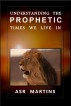
Understanding the Prophetic Times We Live In by ASR Martins. $10.26 from Smashwords.com
This book is about the end-times. The aim of this book is to bring clarity and to counter confusion in the lives of many Christians regarding the end-times, especially regarding the prophetic time we live in at this moment. Clarity will equip and enable God’s children to follow His vision for, and in this time period we are living in right now.

Friday, June 20, 2014

Book Club Friday: Current #FridayReads 6-20-14


Basically, I have a different book going in every room in the house. Let's start with the book I've been reading off and on (when not distracted by more exciting books), Middlemarch by George Eliot. 


I'm slightly more than 50% (that's just over 400 pages) through this enormous paperweight. It's interesting, but it's not exciting. I had hoped Eliot would be another Jane Austen, since they're writing about approximately the same era in British history. However, I don't find Eliot to be nearly as witty or entertaining as her contemporary. I'll stick with it just to be able to say I've read it, but it's not a can't-put-it-down like certain other thick classics I have known (i.e. Gone With the Wind, From Here to Eternity, The Count of Monte Cristo). 

Are there any Middlemarch fangirls out there? 

On my bedside table (actually on the floor next to the table) is The Casual Vacancy by J.K. Rowling. I'm about a third of the way through it. It's funny because there's a Mr. Farebrother in Middlemarch, and the character whose (MILD SPOILER) death is a motivating factor in Rowling's plot is named Barry Fairbrother. 


There's a banker named Mr. Bulstrode in Middlemarch, and I can't help but wonder if the early-19th-century Bulstrodes were secretly a wizarding family, and if their descendant is the same Millicent Bulstrode whose cat's hair Hermione Granger mistakenly used in her polyjuice potion. 

It does seem like Rowling is a George Eliot fan. Because both books deal with small English towns and groups of people being petty and venal and scheming to benefit from a gentleman's death, some people refer to The Casual Vacancy as Mugglemarch. I'm liking it, though. No one can say Rowling isn't witty. 

In the kitchen, when I get bored while waiting for my grits to thicken, I'm reading This Star Won't Go Out by Esther Earl with Lori and Wayne Earl. It's the collection of writings and artwork by Esther, who passed away at the age of 15 from thyroid cancer. In a complicated way, she's part of the inspiration for Hazel Grace Lancaster in John Green's The Fault in Our Stars. 


Esther's only ambition in life was to be a writer, and you could tell she would've been a great one if her talent had been able to mature. In some ways it's very gratifying to read how much of her personality survives in her extant work, but at the same time, her loss is a very sad one. It makes me think of all the other kids who could've been someone great and never got the chance. 

On a much lighter note, the book I've been leaving in the car and reading whenever I get a little bored away from home is J.R. Ward's Crave, the second novel in her Fallen Angels series (about a decisive contest for human souls between archangels and demons). I just can't get into this series the way I can Ward's Black Dagger Brotherhood novels. 


Book Boyfriend #311: Isaac Rothe. 

In the living room, I'm reading a book that arrived in the mail Tuesday, via Amazon's Vine program. I was in the mood for serious nonfiction, so I chose Christianophobia: A Faith Under Attack by Rupert Shortt. It documents incidents of religious-based violence in Christian communities, organized by country. The countries in which it's most dangerous to belong to a Christian church are almost all in Asia, but a few are in Africa, and only Turkey is in Europe. 


The cover shows the window of a church in Egypt and a Coptic Christian girl looking out fearfully.

So far, the author has done a good job of being fair to the people of other religious faiths who share space with Christian neighbors. This is not, for example, a book about what's wrong with Islam. The author acknowledges that most Muslims, like most Christians, are anti-violence, and that some Christians have committed acts of religious-based violence. 

Lastly (I think), in my Nook I'm about halfway through Play Him Again, a murder mystery set in 1920s Los Angeles, by Jeffrey Stone. 


What's fun about this book is how it weaves in historical figures of the period, such as Charlie Chaplin, Mary Pickford, and Alla Nazimova. (You may remember Alla Nazimova from the nonfiction The Girls: Sappho Goes to Hollywood.)

How many things are you reading?