If you're any kind of a Disney fan, I highly recommend you go see
Maleficent, starring Elle Fanning and Angelina Jolie. I took my 8- and 10-year-old nieces on Wednesday, and they loved it.
 |
| Disney's Sleeping Beauty Castle, Anaheim, CA. Public domain image |
I loved it, too. Although Maleficent is the villainous fairy who tries to kill the princess with a spell in the Disney cartoon
Sleeping Beauty, she's the heroine of this live-action version (also from Disney). Sleeping Beauty/Aurora herself is...also a heroine! This movie doesn't pit them against each other, it makes them friends.
The villain is Aurora's awful father Stephon. Human Stephon and fairy Maleficent met as children. He showed goodwill at their first meeting when he threw away his iron ring - fairies can't bear the touch of iron. As they grew into teens, they fell in love, but Stephon didn't have an honest or loyal bone in his entire body. Maleficent grew nicely into her role as protector of the moors, while Stephon went off to court and secretly aspired to be king. She was innocent, open, and honest, while he was worldly, greedy, and duplicitous.
The presiding king tried to conquer the moors; Maleficent and her fairies repelled them. The king was wounded and promised that whoever killed Maleficent would be his successor. Slimy Stephon paid his "true love" a visit on the pretense of warning her, but instead drugged her and brutally cut off her wings. He brought the wings to the king as "proof" she was dead.
Stephon, subsequently made king, married and had a daughter, but slowly descended into madness. Maleficent got her bit of revenge by cursing the newborn Aurora to fall into a deep sleep on her 16th birthday when she touched a spinning wheel. (We know this part from the cartoon.) We can't really blame Maleficent for this, because STEPHON CUT OFF HER MAGNIFICENT FRICKING WINGS.
 |
| "Sleeping Beauty" by Louis Sussman. Public domain photo by Mutter Erde |
Stephon sent baby Aurora off to a cottage in the woods to be raised by three fairies (one of them was played by Imelda Staunton, best known to U.S. audiences as Dolores Umbridge in the Harry Potter movies). These fairies are well-meaning but rather dim-witted. Maleficent looks out for Aurora, and gradually the two women become friends. Inevitably, Aurora finds out about the curse and forsakes the moors for her father's castle. Of course, the curse comes true, although Maleficent regrets it and tried unsuccessfully to lift it. Aurora falls into her enchanted sleep.
Maleficent comes to the rescue, though. Aurora's prince friend is ineffective at lifting the curse, but because Maleficent friendship-love for Aurora is true, Maleficent kisses her friend and breaks the spell.
Then the
really happy ending: fairy and wings are reunited, Stephon gets his comeuppance, and the violent old patriarchy is replaced with a peaceful matriarchy under Queen Aurora.
This movie is visually beautiful and well-written. Angelina Jolie's acting in the title role is perfection.
According to
Wikipedia, the earliest published account of Sleeping Beauty is Charles Perrault's 1697 version. That article (linked above) doesn't say much about the European folklore that may have inspired it, except that the sleeping princess motif may have been inspired by "tribulations of saintly female martyrs in early Christian hagiography conventions" and the Germanic folk tale of
Brynhild. Also called Brunnehilde, Brynhild was placed by Odin in a magical circle of fire, where she slept. The hero Siegfried rescued her and awakened her by removing her Valkyrie armor.
"Hagiography" is simply a fancy Greek loan word that means "holy writing." For an example of a female martyr story, see
this post on the feast day of St. Lucia.
 |
| "Wotan's Farewell to Brunhilde" by Emilie Kip Baker. Public domain within the U.S. |
So, why a spindle or spinning wheel, of all things, as the center of the curse? If we read
SparkNotes' Themes, Motifs, and Symbols page for Sleeping Beauty (the Disney film), we see that the spinning wheel might represent "the unstoppable revolutions of the years," signifying how time inevitably changes things. Clearly one of things time is changing is Aurora - on her 16th birthday, she's transforming from a girl into a woman. This is certainly another example of the
Dangerous 16th Birthday trope.
I've read elsewhere - and unfortunately I can't remember where - that the spindle on which Aurora pricks her finger may be a stand-in for another type of "prick." In other words, the thing the king and queen wish to keep her away from is her own awakening sexuality.
If you'll recall from
the Mother Night post, the Germanic mother-goddess known variously as Frigga, Frigg, and Freya has a spinning wheel, which was known as the Wheel of Fate. Fate or Fortune seems to be an underlying theme of the Sleeping Beauty legend. Wikipedia will tell you that in some versions, the princess doesn't fall under a curse at all, but falls into an enchanted sleep simply because it's her fate to do so. The three fairies who raise her represent the Fates, who in Germanic mythology are called the Norns.
 |
| Public domain image of the three Norns. 1895 |
The Norns are also collectively called the Weird Sisters (cf.
Macbeth, and also
Harry Potter and the Goblet of Fire), the Women Who Write (because they wrote the Book of Destiny), and the Three Mysterious Beings. Their names were Fate, Being, and Necessity; or Become, Becoming, and Shall-Be; or Urth (Mother Earth), Verthandi, and Skuld. Skuld lends her name to "skullduggery," the doings of witches. As depicted above, they lived in a cave containing the root of the world-tree Yggdrasil and the source of the Fountain of Life. (If you're a fan of Marvel movies, you'll be somewhat familiar with Yggdrasil. The image of the tree first shows up in
Captain America, I believe.)
It's probably not a coincidence that when a bitter, vengeful Maleficent decides to make herself queen of the moors, her throne is located in a grotto with a waterfall, and a tree grows out of it.
The Fates are also the Triple Goddess: maiden, mother, and crone. This is clearly depicted in
Maleficent. The eldest of the three, played by Staunton, wears pink and represents the crone. (Imelda Staunton isn't actually very grandmotherly, in my opinion. She's younger than 60 and rather young-looking for a Caucasian woman of her age. She has good skin.) The fairy in blue who wishes happiness on Aurora is the mother figure, and the green nature-fairy with wild blonde hair is the childlike maiden.
The ancient Greeks pictured the fates as weavers, weaving the thread of life and cutting it at the time of death. What do you make with a spinning wheel? Thread. You spin thread from flax. The Greeks also envisioned the Fates as standing over the cradle of newborns, determining the child's destiny, according to Barbara G. Walker's
The Woman's Encyclopedia of Myths and Secrets.
Clearly, the fairy tale of Sleeping Beauty has some roots in very old Indo-European mythology, some of which was common to the ancient Greeks and the Vikings. How cool that we're still adapting and telling this ancient bit of goddess-mythology. How cool that Angelina Jolie makes such a cool goddess figure.
This is an affiliate link:
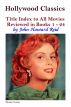 Hollywood Classics Title Index to All Movies Reviewed in Books 1 - 24 by John Howard Reid. $0.99 from Smashwords.com
Another essential book for a film buff's library, this one is packed with information and reviews. Some of the entries are quite extensive. JHR provides all the information you need, including complete cast and production staff. I find JHR's information invaluable. I like to read not only who acted in a movie, but who made it, both top-billed and lesser mortals. -- Ross Adams in DRESS CIRCLE mag.

