Pages

Showing posts with label Kali. Show all posts

Saturday, March 1, 2014

The Fifth Element

This post is a follow-up to yesterday's Vampire Academy book review. It has to do with the elemental magic practiced by Richelle Mead's Moroi - vampires who are living, mortal beings and self-appointed guardians of the earth. I may make occasional reference to the 1997 Luc Besson movie titled The Fifth Element, starring Bruce Willis, Milla Jovovich, and Gary Oldman (which, I'll have you know, I think is a very good movie).

We can learn much of interest about the Classical four elements by referring to Barbara G. Walker's wonderful resource The Woman's Encyclopedia of Myths and Secrets.


The Four Elements

Walker's encyclopedia entry on "elements" informs us of the following:

- Naming the four elements as water, fire, earth, and air was common to many ancient civilizations, including the Chinese, Greeks, Romans, Egyptians, Hindus, Aztecs, and some other North American indigenous tribes. These four elements were commonly thought to make up everything that exists.

- Ancient Hindus believed the goddess Kali created the four elements. By inscribing symbols to represent them on her necklace of skulls, Kali brought the Sanskrit alphabet into being.

Public domain image by Ambereen21
- Kali is sometimes portrayed as holding one of four objects in each of her four hands: a bowl of blood symbolizing water, a lightning bolt-shaped scepter symbolizing fire, a lotus wheel representing earth, and a sword representing air.

- Kali's four symbols, once adapted by Europeans, evolved into the cup, wand, wheel (pentacle), and sword used on the Tarot deck. These, in turn, became the hearts, clubs, diamonds, and spades of the modern playing card deck.

- Water and earth were feminine, and air and fire were masculine. This is why hearts and diamonds are red (feminine) and clubs and spades are black (masculine) - analogous to the concepts of yin and yang. In Hindu philosophy, the feminine elements were creative/benevolent  and the masculine elements destructive/cruel. However, to the ancient Greeks, the feminine elements were passive and the male elements were active.

- The combination of water and fire - male and female - represented sexual union. Together they made blood, which was red like fire yet tasted like ocean water.

- The "four humors" used by Western medicine are each related to one of the four elements. Blood was air, phlegm was water, yellow bile was fire, and black bile was earth. A predominance of blood in the body led to the sanguine temperament (cheerful), phlegm the phlegmatic (calm, cool, composed, imperturbable), yellow bile the choleric (irritable), and black bile the melancholic (tending toward depression).

Personification of the four temperaments. Title page of 'The Seven Planets' by Adriaen Collaert, 1581. Public domain image. 
 - In Christian iconography, the four Gospel writers (or Four Evangelists) are represented as a bull (ox), lion, serpent (according to other sources, an eagle), and a man or angel. These symbols represent earth, fire, water, and air as well as the Gospels of Luke, Mark, John, and Matthew.

The Four Evangelists depicted in the Book of Kells. Public domain image. 
The Moroi in the Vampire Academy series each specialize in one type of elemental magic in their teen years, similar to reaching puberty. Christian Ozera, for example, has fire magic, and Victor and Natalie Dashkov both specialize in earth magic. Lissa, however, has no specialization. She has some control over all four elements, but her true specialization is the rare fifth element, spirit.

The Fifth Element

According to Walker, the ancient Greeks characterized the fifth element as "ether," which means "heavenly." The gods and goddesses were thought to be made of ether - so I wasn't completely wrong in my movie review when I characterized Lissa as having an "ethereal" quality.

In the Luc Besson movie, the fifth element is both embodied in a person - Leeloo - and also representative of love itself.

Leeloo cosplay, complete with Multipass. Creative Commons image by Christopher Michel
Walker's encyclopedia entry for quintessence describes the substance variously as the blue blood of the gods (also known as ichor), specifically as the menstrual blood of the Goddess, or as the sacred wine or ambrosia consumed by the gods. Walker claims that in Homeric poetry, ichor is described as being made by the honeybees of Aphrodite. "Blue blood" is said to be the reason both the Hindu deity Krishna and the Gnostic creator-god known as the Demiurge were depicted as blue-skinned, and why ancient Celts painted themselves blue in religious ceremonies and in battle. Celts killed in battle hoped to be resurrected like the immortal gods.

Walker goes on to write that in medieval alchemy, quinta essentia or quintessence referred to a blue elixir associated with both bodily resurrection and spiritual illumination. She also writes that quintessence is used to reference the fifth trump suit or Major Arcana of the Tarot deck.

For further evidence, I turned to The Book of Alchemy: Learn the Secrets of the Alchemists to Transform Mind, Body, and Soul by Francis Melville. It says, "Of all the philosophical principles, none is as mysterious and intangible as the quintessence, the fifth essence or element, which is concealed within the four philosophical elements and equates with the secret fire, the spark of divinity within all things."

If Lissa Dragomir's quintessence is the spark of the divine, it certainly explains what our narrator Rose feels when she experiences Lissa's healing: a sense of all the good, wonderful, happy things in the world, a beautiful bliss.

Melville further writes, "The four elements conceal within them a fifth element, known as the quinta essentia, the quintessence, or Azoth. This has the connotation of being the absolute essence of a thing and, as such, many alchemical magisteries (products or medicines) are called quintessences, particularly those that have been distilled, because distillation releases the soul and spirit from matter. Some alchemists call the spirit of wine (distilled brandy) a quintessence, and, indeed, it fulfills the criteria described by Isaac Newton:

"'Quintessence is a thing that is spiritual, penetrating, tinging, and incorruptible, which emerges anew from the four elements when they are bound to each other.'

"Paracelsus considers it to be the extract of the elements, their incorruptible, eternal substratum. Manfred Junius calls it 'The origin and goal of all things.'


"It is often said that the quintessence is not a product of the elements, but one of the three philosophical principles. In fact, it is all three: the trinity is everything. The quintessence is the soul and spirit within all things. It is also the salt that allows it to emerge through the four elements. This reveals it to be nothing less than the secret fire, the spark of eternal light from the first combustion of creation. It is the divinity in all things, the inner sun in which all things find their true identity. Alchemists give it many names: Universal Spirit, Never-failing Source...key of the philosophers, nursery of the world, heavenly substance, Mother of the Waters and, even, Mercurius [identified with the Egyptian wisdom god Thoth, the Greek god Hermes, and the Roman god Mercury].

"The quintessence can be symbolized by the pentagram, the figure that most perfectly divides the circle. It represents the microcosm, the individual containing the whole universe within itself."

If Lissa's spirit is the "extract of the elements," that explains why she and the other spirit-users (Saint Vladimir and Sonya Karp) have weak control over all of the four other elements. By alchemy is very esoteric and every one of its symbols and terms means different things to different alchemists, and now the exact nature and meaning of the fifth element may be murkier than ever.

I'll have to read the rest of the Vampire Academy series to found out if Richelle Mead sheds any more light on it.

Shadow-Kissed Anna

That said, it may be worth noting that St. Vladimir's Dhampir guardian, according to Mead, was called Anna. Walker tells us in her entry on St. Anne (the mother of the Virgin Mary) that Anne/Anna is a name associated with the "grandmother goddess." Analogous names include the Canaanite goddess Anat, the Roman goddess Anna Parenna (Grandmother Time), the Celtic goddess Ana or Anu who made up one third of The Morrigan, Morg-Ana ("invincible Queen Death") in Arthurian legend, and even Angurboda ("hag of the iron wood") the mistress of Loki and the mother of Hel. The pentacle (a pentagram inside a circle, according to modern Wiccan usage) was the symbol common to St. Anne and Morgana, and is the ancient Egyptian symbol for the Underworld.

Shadow-kissed Anna, Ms. Karp, and Lissa make up a kind of trinity. Anna is a legendary figure from long ago, a sort of ancestor or grandmother. She was a guiding light who kept St. Vladimir from giving in to madness. Ms. Karp is like the mother-figure of the trinity, although the madness swallowed her and she became Strigoi. Lissa is the maiden figure whose spirit-power is still largely untested. "Shadow-kissed" means brought back from the land of the dead, so naturally, Anna has an association with the Underworld.

As we know from a long line of myth and literature, there is always a heavy cost to be paid for bringing anyone back to life from the Underworld - a cost that will no doubt have to be paid by Lissa and Rose, since Rose herself is shadow-kissed.

Our crime thriller Eminent Domain is a Kindle Bargain, only $3.99 for a limited time

Tuesday, June 4, 2013

Goddesses in Eve Ensler's Memoir 'In the Body Of the World'

I finished reading In the Body of the World, the 2013 memoir by dramatist/activist Eve Ensler, on Monday night. Because I wrote about it in some detail on Book Club Friday last week, I don't feel the need to share my review here, although I did review it on Amazon and Goodreads.

Instead, I thought I 'd write about the goddess chapter in this book, in which Ensler - an atheist with an ethnic Jewish father and a WASP mother - calls upon the aid of two goddess-figures as she battles the cancer inside her. The chapter is called "Tara, Kali, and Sue." Although the chapters aren't numbered (they aren't in my ARC - maybe they are in the final print edition), it occurs approximately in the center of the book.

Yet before she starts chemotherapy, Ensler takes a pink shawl, lays it out reverently, and makes an altar to Tara and Kali. Tara is for protection. She calls Tara "the mother of all Buddhas" and says she fights off fear and demons.

Tara

My introduction to Tara came through a book called Bodhisattva of Compassion: The Mystical Tradition of Kuan Yin by John Blofeld (Shambhala Publications - Boston - 1977). This book is the same age as me, and I think I picked it up at a yard sale. I wrote about Kuan Yin in The Smell of Gas, but it's difficult to say whether the book was intended to be research or just part of my usual habit of collecting feminist and feminine-spiritual books.

Blofeld writes, "...Tara, a beautiful deity able to manifest herself in twenty-one different forms for the sake of succoring sentient beings...emanating from the compassionate Bodhisattva, she is immensely popular in Tibet and Mongolia where her devotees credit her with two main functions: rescuing beings from present woes and assisting them to rid themselves of the delusions binding them to samsara....

"....Whether visualized as a sweet-faced matron or as a winsome sixteen-year-old maiden, she has two principal embodiments known as the Green Tara and the White. They are much alike except that, from her seat upon a moon disc supported by a giant lotus, the Green Tara extends one foot as though about to rise from meditation, whereas the White Tara sits in meditation posture and further differentiated by having a 'wisdom eye' in the centre of her forehead as well as eyes in the palms of each hand."


Blofeld goes on to say that Tara is merged with Kuan Yin in the popular Chinese imagination, and that she is beloved figure among Tibetan, Nepali and Mongolian Buddhists. Unfortunately, I don't know much else about Tara, but the idea of her seems to be strongly linked to the embodiment of the Buddha's compassion. 


Kali

Kali is for what Kali is always for: destruction. Death. Burning. Kali's destructive path of fire is ultimately constructive: she burns away what must be burned away so that life can continue. Here, she represents the lifesaving destructiveness of the chemo itself, the poison that will burn away the rapidly dividing killing cells.


Kali is also depicted with the third eye/wisdom eye in the center of her forehead. Tara is compassion, and Kali is destruction, but both embody wisdom - wisdom is essential in all things, whether saving a life from excruciating suffering or bringing cleansing through death.

Ensler's prayer reads:

"Burn it away, Kali, burn it away. Make it new. Take me to the core of holy destruction and death and let me survive your excruciating heat. Let me throw what isn't useful into your flame. Dissolve it there are make me new, make me whole. Burn off all the cells that are compulsively dividing and subdividing. Burn off all the parts of me that create separation and division. Burn off the stories. Burn off my contempt and my self-pity. Burn off all the ways I get ahead of myself and try to get ahead of others. And Tara, open my heart. Make me one with all sufferers."

Sue

The Sue of the chapter title refers to Ensler's therapist, who tells, her, "The chemo is not for you. It is for the cancer, for all the past crimes, it's for your father, it's for the rapists, it's for the perpetrators. You're going to poison them now and they are never coming back. Chemo will purge the badness that was projected onto you but was never yours....Your job is to welcome the chemo as an empathetic warrior, who is coming in to rescue your innocence by killing off the perpetrator who got inside you...fighting on your behalf and on behalf of all women's bodies, restoring wholeness, innocence, peace."

Calling on Tara, Kali and Sue works for Ensler. The chemo works. Her cancer retreats, and she lives to eat and work again. She lives to visit the Congo and see the City of Joy and the wild gorillas. In a Hawthornesque fashion, the book ends with a word repeated three times:

Rising. Rising. Rising

Actually, the closing line of "Rising" strikes several literary chords - not only Hawthorne's "Be true! Be true! Be true!" but also Maya Angelou's "And Still I Rise" and even the ending of Virginia Woolf's closing of Orlando, with Orlando rising up and crying out, "It is the goose!...the wild goose!," the elusive beauty that can never quite be caught the way the poet struggles to capture individual moments on the page, but the past is always elusive and the poet is always caught in the present.

The title, In the Body of the World, may call to mind the admonition among Christians, "Be in the world but not of the world" - in reverse. Ensler is asking us through this book to be in our bodies and of the world, valuing ourselves, valuing other people and valuing the planet as a whole. Is that opposed to Christian doctrine? Not at all. Christians remind each other not to value worldly, material things more than they value the eternal things, but that doesn't mean to neglect other people or let the planet come to harm. Having a hope for an eternal life isn't an excuse to cause or allow misery in this one.

When Ensler asks us to be of the world, she wants us to think about how our actions in the U.S., Canada, the U.K. or some of the other very privileged parts of the world can affect people in the less-privileged parts of the world - not because of some misguided "white savior complex" but in the very real sense that we're all made of the same fragile stuff. Whether there is heaven, reincarnation, enlightenment or not, we all have a very finite time in these human skins.

Yet we are rising. There's hope. No matter what our religion or lack thereof, at times we need to call on the wisdom of other human beings. Sometimes, too, we need to call on something greater than ourselves and our limited human powers. Sometimes even atheists have need of the infinite power and compassion of the Goddess, whether one imagines the Goddess as something part of ourselves or as separate from ourselves.


This is an affiliate link:

How to Meditate for Beginners: Tips and Trick Your Mind for Meditation by AssussA. $2.99 from Smashwords.com
Meditation aims to focus and quiet your mind, eventually reaching a higher level of consciousness and inner calm. It may come as a surprise to know that you can meditate anywhere and at any time, allowing you to access a feeling of tranquility and peace no matter what is happening to her around.

Thursday, January 31, 2013

Imbolc Eve, the goddess Kali and Kara Stanton

The sabbat of Imbolc is approaching - or, in some parts of the world, already here. We're getting ready to celebrate the approach of spring and, in the Irish-Celtic tradition, pay honor to the fire goddess Brigid (or Bride, pronounced "breed"). Even though that grumpy groundhog almost always sees his shadow and forecasts six more weeks of winter's chill (in the temperate parts of the Northern Hemisphere, anyway), Imbolc always fills me with hope that spring is just around the corner.

Actually, this winter's hardly been harsh at all. I went for a walk the other night and it was 50 degrees (F) outside, temperatures I'd normally expect in late March at the earliest. I can't even really complain about the winter of 2012-2013, and the winter of 2011-2012 was similarly mild.

But though this time of year is traditionally reserved for Brigid, I am feeling the spiritual vibrations of another goddess today: India's Kali.

http://pinterest.com/pin/46936021088634658/
Not too long ago, I finished a breezy, humorous novel by Sonia Singh called Goddess for Hire. The Indian-American heroine of that novel finds out at the age of 30 that she's an incarnation of the goddess Kali.


She gets a powerful sword and sets out to vanquish evil. Another pop-cultural incarnation of the warrior woman who slays her enemies in a quest for justice? Kara Stanton.


Stanton seems to divide Person of Interest fans: we love her or hate her. Personally, I love her, the ex-Marine, CIA-trained assassin who shoots to kill without blinking an eye or smudging her lip liner. She's not evil, per se, but she is amoral. She'll do anything to survive. She reminds me of Scarlett O'Hara when she goes to dig up the neighbor's field because she's starving, exhausted, staring up at the sky and shouting, "As God is my witness, I will never be hungry again!" Kara's just determined that nobody's going to fuck with her anymore.

This the promo for the episode that airs tonight. I'm scared. I'm not really worried about Reese - they're not going to kill off one of the series regulars mid-season. However, I do think there's a good chance Stanton, Mark Snow or both of them are going to die tonight. I will really miss Stanton if she finally gets killed for real.

That's assuming she can be killed. I kind of think she's another incarnation of Kali, a death goddess. That's my hope: that Stanton lives to BAMF it up another day, whether it's as part of a redemptive arc (i.e. she decides to start working for Reese and Finch on a contract basis, like another POI chick I love, Zoe Morgan) or as the villain.


If Stanton does die, I may (against my better judgment) have to start watching Annie Parisse's other show, Fox's The Following. It just premiered on Monday last week, and I've only seen the first episode, which didn't even have Parisse in it. It's about a serial killer English professor and his murderous disciples (kinda like Kali's Thuggees) who kill based on tortured extrapolations on the works of Edgar Allan Poe. I'm disinclined to like the series because a) it gives me the creeps and b) it links one of the greatest figures of 19th-century American literature with gruesome killings and mutilations. Here you can read Laura Miller's Salon.com article about specific ways in which The Following disses the creator of "The Raven."

(I'm rooting for the Baltimore Ravens in the Superbowl, by the way, because the San Francisco 49ers were not named after a poem.)

So please, Kara Stanton, don't leave me. I'll still have Joss Carter and Zoe Morgan, plus that psycho Root (played amazingly by the talented and oh-so-lovely Amy Acker, whom I cannot wait to see in Much Ado About Nothing). But they've already killed off the dutiful Alicia Corwin, and can you ever really have enough strong female characters? Of course not.

Note to self: write The Following parody in which crazed Jane Austen fans go around yarnbombing things, but with embroidery instead of knitting.


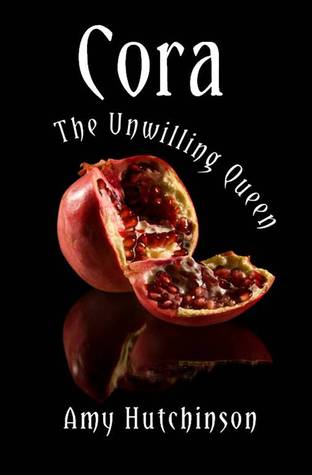
The other goddess I'll be thinking about today is Kore/Persephone. The copy of Cora: The Unwilling Queen that I won from GoodReads arrived in the mail today, directly from the home of its author, Amy Hutchinson. I know I need new books like I need more holes in the head, but I still can't help but squee! when they arrive.

Hungry for more pomegranate-laden books about Persephone? Check out this batch and also this one.