Erin O'Riordan writes smart, whimsical erotica. Her erotic romance novel trilogy, Pagan Spirits, is now available. With her husband, she also writes crime novels. Visit her home page at ko-fi.com.
Happy Women's History Month 2014! In March 2011, I wrote "Great Books For Women's History Month" for David Weisman's book blog Breaking in Before Breaking Down. It's still a great list, so please don't be out off by the fact that it's labeled 2011.
Today is an exciting day for my fellow author/blogger Shah Wharton; today she reveals the cover of her first novel, Finding Esta! Shah will be my guest next WIP Wednesday, but in the meantime, you can see her book cover here. Go show my girl Shah some love.
This week I've been working on adding a few more sex scenes to the third novel in the Pagan Spirits series, St. James' Day. But I haven't done a ton of writing this week. What are YOU working on?
Obviously, I've been reading - lots of From Here to Eternity, and still have 300 pages to go. Then I started Deborah Harkness' Shadow of Night, the sequel to A Discovery of Witches, because I have it from the library for a limited time. Yep, I'm cheating on Robert E. Lee Prewitt with Matthew Clairmont. But it doesn't mean I don't love you, Prew, despite all your faults.
I can't wait to see the From Here to Eternity movie, after I finish the book. I'm stupidly excited that the Internet told me Montgomery Clift was bisexual. I really don't care about people's sexual orientation - just be yourself - yet tell me that somebody famous and hot is bi, and all of the sudden I'm like, "Victory!"
'Sup with that?
Monty Clift, you will be my second future baby daddy once time travel is perfected. After George Gershwin. We'll go in chronological order.
I'm also stupidly excited that someone found this blog by searching "famous Jewish lesbians." I'm happy to be the curator of Jewish lesbian knowledge, although I can't really tell you that much. A little bit about The Dyke and Dybbuk, yes. I can tell you a little more about bisexual Jewish women: Peaches, for example, and Susan Sontag and Rachel Kramer Bussel. I feel compelled to post about Gertrude Stein now.
Or Phranc. Phranc comes up in She's A Rebel by Gillian G. Gaar:
"As virtually the only self-proclaimed 'all-American Jewish lesbian folksinger,' Phranc, with her snappy flattop hairstyle, was a category unto herself, but she was quick to point out it was a category with universal appeal. 'My songs speak to everybody,' she says. 'I have some songs that deal with the issue of lesbians, and there's an identification of me being a lesbian, but my sexuality is not the biggest part of me-it's part of me like my haircut and my shoes; it's not the biggest part of me and it's not the smallest part. But when I was growing up, there were so few examples of people that were out as lesbians, I felt like I was the only one! I'm not the only one. Young people need to know that they're not the only one. They should have the right to grow up and be whoever they are. That's the point I'm making.'
"Born Susie Gottlieb and raised in Los Angeles, Phranc began playing music at age five, progressing from piano to violin to guitar by age ten..."
As I'm writing this, I'm watching For Colored Girls, the film based on Ntozake Shange's play-in-poetry For Colored Girls Who Have Considered Suicide When the Rainbow is Enuf. I've never read Shange, but her words are gorgeous. The movie was adapted and produced by Tyler Perry; the previews at the beginning of the DVD included I Can Do Bad All By Myself, a Tyler Perry project that stars Taraji P. Henson.
It's Thursday, and I am counting down the last hour and a half or so until the Person of Interest season finale (less time, by the time I finish writing). I haven't gotten to interact with my blog or social media as much as I would have liked over the past few days - my hubby and I rehabbed my parents' bathroom while they were out of town, and then I spent two days helping him with an exterior painting job. I've been painting porch pickets - hence the lackluster WIP Wednesday yesterday.
Pride and Prejudice and Person of Interest
Earlier today, I learned that Donna Summer passed away at the young age of 63 after a battle with cancer. I'm not a huge disco fan, but there was one summer when I drove an old Chevy Cavalier with a cassette player and wore out a cassette of disco favorites. One of them was "Bad Girls," but I think my all-time favorite Donna Summer song is "Love to Love You Baby."
In She's a Rebel, Gillian G. Gaar calls Summer "the undisputed Queen of Disco" and details how the Boston-born pop star was inspired by gospel singer Mahalia Jackson. After the decline of disco, Summer went through a born-again Christian/gospel music phase, but then returned to the pop charts with "She Works Hard for the Money."
My Facebook friend and fellow author/blogger Donald Peebles (he's on Blogger here) wrote, "My BFF DjMonalisa Indasoul and I used to talk about the infamous Kaminsky Park incident where many White males crushed and broke numerous disco albums at Kaminsky Park, Chicago as part of their "DISCO SUCKS" campaign. Disco was a musical form in which many White American males could not really capitalize on and dominate whereas African-American women, gay people, and newly independent White women navigated freely. This backlash more or less ended disco as well as the war on the gay liberation movement."
Disco - uniting African-Americans, the gay community and women in a way that white males couldn't appreciate or understand and felt threatened by. Whether you like the music or not, you've got to respect that it was a cultural force to be reckoned with from the mid-'70s into the early '80s.
Later this afternoon, Mom and I went to a matinee showing of Dark Shadows, starring Johnny Depp, written by Seth Grahame-Smith and directed by Tim Burton. I should state that I've never seen an episode of the 1970s TV show of the same name, the inspiration for the current film. Thus, I have no idea how the film compares to the original. (I can, however, read about the original on pages 146-151 of Vampire Lovers: Screen's Seductive Creatures of the Night by Gavin Baddeley.)
I liked Depp's performance as Barnabas Collins, a vampire chained in a coffin in the 1770s, only to emerge in the 1970s. He's absolutely charming. The problem with the film's plot and characterization is that the women are too easily charmed by him - to the degree that one love interest kills herself because she can't have him and the other goes completely psychotic when her love is unrequited.
The psycho with the unrequited crush on the pretty vampire is a witch, and I didn't appreciate the witch-bashing. The worst part, though, was the climactic battle scene in which Collins and the witch, Angie, battle it out in the Collins mansion. Although she's threatened his family, she isn't trying to kill him, so when Collins slaps Angie around, it just reeks of relationship violence. I like Johnny Depp; he's my beloved gypsy Roux from Chocolat. I don't want to see him as a character who slaps his ex around.
I didn't like his hasty disposal of the Helena Bonham Carter character, Dr. Hoffman, either. Her "crimes" of getting drunk and wanting to be immortal were hardly worth the death sentence. She's not Bellatrix LeStrange here, and she doesn't deserve the contempt the other characters treat her with.
Et tu, Seth Grahame-Smith? You, the same guy who made Elizabeth Bennett into a deadly ninja warrior in Pride and Prejudice and Zombies? If Mr. Darcy would have raised his hand to Lizzy in anger, she would have snapped him in half like a twig. She did kick him into a marble mantelpiece, and all he did was propose to her (albeit in a rather backhanded way).
The best part, actually, was a farcical sex scene in which Collins and Angie destroy an office in a fashion that puts Bella and Edward's bed-wrecking to shame. That, my friends, is what should have happened between Diana Bishop and Matthew Clairmont in A Discovery of Witches.
The same theater was also showing The Lucky One (based on the Nicholas Sparks novel I recently read- and loved. That ending - oy! I literally threw the book down and said, "Now THAT is how you end a novel! Well done, Mr. Sparks!") and The Hunger Games. I have a feeling I would have been better off seeing either one.
Oh, and earlier today, while I did a bit of online research, I watched The Thin Red Line. I admit I've never read a James Jones novel. Once, when I was 16 or so, I checked From Here to Eternity out of the library. Because the profanity and sexuality of the book were considered somewhat controversial when it was published, I thought I might enjoy it. I don't think I made it past page 10. Line (the title comes from a Kipling poem) is a sort of sequel to Eternity.
It's a brilliant film, although I don't particularly care for Sean Penn. Jim Caviezel is playing Private Witt, a Southerner who's not particularly intellectually gifted, but who is nonetheless amazingly perceptive, kind and noble. His observations in voice-over are lovely. Now I'm forced to wonder how much of Witt comes from James Jones and how much comes from the screenwriters. Might have to go to the library and peek inside the book.
Witt, your soul is pure. You're as pretty on the inside as you are on the outside. Which is a lot.
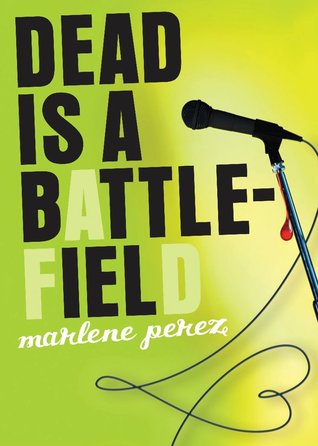
This book marks the beginning of the Jessica Walsh era - Jessica takes over as heroine of the Dead Is series from Daisy Giordano. Psychic Daisy and her sisters are the Walsh's next door neighbors, and Daisy's boyfriend Ryan is the best friend of Jessica's older brother Sean. Jessica doesn't have psychic powers, but she does have a strange new tattoo that just appears without the use of needles. She learns she's a virago, a supernatural warrior-woman destined to guard her hometown of Nightshade, California.
I wondered if I would like this series as much with Jessica in charge as I did with Daisy. I did, pretty much. The ending was a little rushed, but I imagine some of the confusion will be further cleared up in the next volume, Dead Is a Killer Tune.
While battling an outbreak of a strange infection and an even stranger ant farm, Jessica develops a crush on the new lead singer of local band Side Effects May Vary: her fellow Nightshade High student Dominic Gray. But Dominic seems to have a split personality when it comes to Jessica; sometimes he seems into her, and sometimes he's all over Selena Silvertongue. What's up with Dominic? Will Jessica survive the danger - and Flo's virago workouts - long enough to find out?
Dead Is a Killer Tune is due out September 4, 2012.
When I read Beauty Queens by Libba Bray, the Maroon 5 song "She Will Be Loved" ("Beauty queen of only 18...") kept getting stuck in my head. I couldn't read this book without repeatedly singing "Love is a Battlefied" by Pat Benatar.
Fortunately, I like this song. It reminds me of when I was a little girl in the '80s. In She's a Rebel, Gillian G. Gaar wrote, "Female performers rarely experienced the attacks that groups like N.W.A., 2 Live Crew, or Judas Priest did, though their work was scrutinized by organizations like the PMRC, who, in analyzing sexism on MTV, gave Pat Benatar's 'Love Is a Battlefield' video a negative rating, citing: 'one performer fights with her ornery parents then leaves home to become a hooker.'"
I purchased Dead Is a Battlefield at my brick-and-mortar Barnes and Noble and was not compensated for this review in any way.
I first heard the sad news here from Rhetta Akamatsu: legendary pop/rhythm and blues singer Etta James passed away earlier today after suffering from leukemia.
Some day I really, really need to read T'Ain't Nobody's Business If I Do: Blues Women Past and Present by Rhetta Akamatsu. Etta James is the subject of Chapter 13. Nineteen other women are featured in the book, starting with Mamie Smith, Ma Rainey and Bessie Smith and finishing with Koko Taylor.
My all-time favorite rock book is She's A Rebel: The History of Women in Rock & Roll by Gillian G. Gaar. (I own the original 1992 edition and the expanded 2002 edition - the true book nerd must buy the expanded version of a book she already owns.) Gaar places James in the "Roots" chapter. Gaar writes:
"Etta James was another performer with roots in the R&B scene who eventually found success on the pop charts. Born Jamesetta Hawkins in 1938 in Los Angeles, James sang in the church choir as a child. She later moved to San Francisco with her mother and in her teens formed a vocal trio with her sisters Abbye and Jean Mitchell. The trio auditioned for Johnny Otis...and Otis brought them to L.A., where he had the girls record a song they had written, 'Roll With Me Henry.'"
The song was released in 1955, and in 1960 she moved to Chess Records, where she recorded her first Top 40 hit, "All I Could Do Was Cry." Considered racy by '50s standards, "Roll With Me Henry" was re-recorded as "Dance With Me Henry" by another performer, Georgia Gibbs.
Going on tour was James' first encounter with the brutally-enforced segregation of the American South, Gaar writes. She was once threatened with a shotgun for refusing to use a bug-infested "Colored" bathroom. She only escaped by apologizing to the man who pulled the gun on her.
Not that it was in James' nature to submit. She told Rolling Stone in 1997, "I've had people say to me, 'Can't you be more feminine? I would go, 'Feminine? Why do I have to be feminine?' Does that mean I have to put a little apron on and bake some cookies or something?" James also said she was a feminist before she knew what the word meant.
Gutsy, rebellious, unabashedly sexual, unique and undoubtedly talented, Etta James will be missed by music-lovers and by those who look up to strong women.
Some of you will watch Cadillac Records in her honor. You may recall that James was miffed that Beyonce, who portrayed her in the film, performed her signature song "At Last" at the inaugural ball for President Barack Obama when James herself was available to do so. She seemed to have forgiven Lady B, though. (According to the Rolling Stone interview, James was a fan of Mary J. Blige's style, and not-so-much of Toni Braxton's breathy voice.) So I don't think James would be offended if you do.
Just remember what I said in "5 Dudes," though - Adrien Brody enacts ethnic stereotypes in his role as Leonard Chess. Don't think that I endorse said stereotypes.
I do, however, heartily endorse interracial snogging in films.
Images: Roland Godefroy (Creative Commons); public domain; Louis Ramirez (Creative Commons)