Erin O'Riordan writes smart, whimsical erotica. Her erotic romance novel trilogy, Pagan Spirits, is now available. With her husband, she also writes crime novels. Visit her home page at ko-fi.com.
(Mom, since you haven't read the book yet, do not read my review. It may contain spoilers and unduly influence your opinion.)
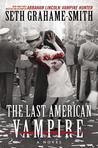
The Last American Vampire by Seth Grahame-Smith
My rating: 2 of 5 stars
(Heads up: I'm going to use "they" as a singular, gender-neutral pronoun.) I enjoyed Abraham Lincoln: Vampire Hunter, but this sequel much less so. I don't understand the plot. What is A. Grander VIII's motivation for doing all the awful things they do? I can't enthusiastically endorse a book in which the villain's actions are so nonsensical.
Seth Grahame-Smith's consistent insensitivity to the female half of the species continues to baffle and irk me. It's not only his refusal to join us in the 21st century and, in the voices of his narrators, use the inclusive word "humankind" rather than the outdated, gender-biased "mankind." On the "Facts" page that proceeds the title page in this first edition, in the voice of his narrator - not, mind you, a character from an earlier century - Grahame-Smith uses "mankind" twice in three paragraphs.
It's also a return on Grahame-Smith's part to the "I used to love her, but I had to kill her" theme I so detested in his screenplay of the Tim Burton/Johnny Depp/Helena Bonham Carter travesty Dark Shadows. "But she was a witch!" and "But she was an evil vampire!" may be acceptable excuses for violence against fictional women, but such scenes are not the least bit entertaining in a world where real violence against real women is a disturbing constant.
I really enjoyed Pride and Prejudice and Zombies, but Seth Grahame-Smith disappoints me as often as he impresses me. I did like the footnote in which Emily Dickinson's reclusiveness is explained by her being a lesbian or bisexual/pansexual vampire. Alas, the women in Grahame-Smith's fiction since Elizabeth Bennet have all been footnotes, plot devices to be used at the service of the male characters' plotlines and then violently disposed of when no longer necessary. If Grahame-Smith's next book is titled Emily Dickinson: Pansexual Vampire, I'll probably read it. Otherwise, I think I'll be done with his casually sexist, anachronistic ass. I read for fun, not to be made to feel as if my entire gender is disposable.
Judging from his photo on the inside back cover, Seth Grahame-Smith is a fairly good-looking guy. He will not, however, be one of my Hanukkah Hotties, because he is a not-very-nice Jewish boy.
I checked this book out from my local library and was not obligated to read or review it any way.
If you've read this blog for a while now, you may recall that near the top of my all-time favorite classic novels list is Emily Bronte's Wuthering Heights. I read or watch it or its many spinoffs and adaptations at least once every couple of years.
In October 2014, I saw it as a stage play. With Halloween being right around the corner from that night, I decided to give the vampire version a chance.
The thing that gave me tremendous pleasure about reading this novel was re-discovering all the brilliant bits that made me fall in love with Wuthering Heights in the first place. I have my favorite lines, and it's always a small thrill whenever they come up in a new version. There are also some deft bits of humor woven in.
Overall, I didn't enjoy this mash-up as much I liked Jane Slayre: The Literary Classic with a Blood-Sucking Twist, which I also recently read. In general, I'm fan of monster mash-ups, beginning with Pride and Prejudice and Zombies. Wuthering Bites was a fun read, but the vampire elements could have been incorporated in a more thorough way. Some of them, especially toward the end, felt very tacked-on. In a really good mash-up, we don't see the seams.
For example, for the vast majority of this version, we don't know what Heathcliff is. We know he's most likely the son of a Roma vampire slayer and that he has some power to control the vampires around Wuthering Heights. They listen to him when he tells them certain people are off-limits as food sources. But why does he have this power? We also know he's not a vampire himself. At almost the very end, we learn Heathcliff is a dhampir - half vampire, half human. Why this had to be a surprise kept until the very end, I just can't figure out. It seems like being a dhampir would go a long way to explain and perhaps even excuse some of Heathcliff's more disturbing behavior. Didn't Bronte intend for us to feel sympathy for Heathcliff, after the way Hindley treated him? He's more sympathetic if, through no fault of his own, he's caught between two opposing worlds.
The elder Catherine's fate is treated in a similarly mysterious way. Her ultimately-fatal illness, explained in the original book as being self-induced out of sheer cussedness, is explained in this mash-up by a vampire bite - not enough to turn her into a vampire, but enough to eventually kill her. We're told throughout the second half of the novel that Catherine's grave always looks fresh, and at the very end we find out it's because Catherine isn't quite dead and roams the moors in a zombie-like vampiric state. (Sounds like a job for Andrew Lincoln as a combination of Edgar Linton and Rick Grimes, no?) It would have been interesting for the other characters to come across her in this state, rather than just having Mr. Lockwood learn about her at the last possible moment.
One addition I did rather enjoy was the younger Catherine's ambition to become a vampire slayer. In the end, not only is she redeemed by her love for Hareton, but also by her new-found freedom to pursue her dream. I love a heroine with an ambition, even if her ambition is beheading bloodsucking fiends.
I love Wuthering Heights. I love vampires. This should have been the perfect book for me, but I thought it fell somewhat flat.
I purchased this book with my own funds and was not obligated in any way to review it. According to the sticker on the back, I bought it for $15 at Borders. It was published in 2010, so this was apparently one of the last things I ever bought at Borders.
This is an affiliate link:
The First Bite Is the Deepest by Elisa Catrina. $2.99 from Smashwords.com
“Funny and clever and emotionally hard-hitting” "A perfectly creepy read." Elisa Catrina's debut novel begins as a quirky send-up of vampire romance, but quickly turns sinister. High schooler Stella Ortiz starts dating the mysterious new guy, but her friends are convinced he's bad news: Sebastian misses tons of school, he day-drinks something that smells like pennies, and oh yeah, he's a vampire.
Welcome to Pagan Spirits book blog, my little corner of the book blogiverse!
What was the most special book you've ever gifted or received?
I wish I had one great book that I received for a Christmas or Hanukkah present that was really meaningful to me personally. I don't, as far as I can remember. One year, my parents gave me Pride and Prejudice and Zombies and Sense and Sensibility and Sea Monsters, and I love those. They're fun books, but I wouldn't really describe them as "special." In fact, my original paperbacks got water-damaged and I ended up having to replace them.
One year I really, really wanted a new novel that was a sequel to The Scarlet Letter, and I got that, but it wasn't very good (or at least I didn't think so at the time). I can't remember the name of the book now, or the author's name, although I think it was a male author. This was probably in the late 1990s, shortly after I read The Scarlet Letter as a high school assignment. Wikipedia is pretty clueless about the Scarlet Letter sequels, so if anyone's a rabid Hawthorne fan and they want to get on that, please do so.
(Update: I mean Hester by Christopher Bigsby, which is a prequel. It says in my diary that I got it on December 25, 1994.)
Come to think of it, the real reason I never got a "special" book for the holidays as a kid was probably that if I wanted a book bad enough, my parents would get it for me right when I wanted it. They taught me that books are never a waste of money, so when I want one badly enough, I just go get it.
I love to give books as gifts. This year my Percy Jackson-obsessed older niece is getting two books about Greek and Roman myths for Christmas. (Niece #2 is currently obsessed with Captain Underpants, but I hear that Santa Claus will be bringing her the books in that series that she doesn't have yet.) Last year I gave my grandma The Mermaid Chair by Sue Monk Kidd. (Then after she read it, she got my mom to read it, too - that and Shanghai Girls by Lisa See are our three-generation books.)
The only one who won't accept a book as a gift is my hubby, Mr. Elingtin. He does not read - I read to him. (It's not that he can't read - it's just that he gets bored very easily. He's very visual and needs the free space in his head to imagine.)
What's the greatest book YOU ever got as a gift? Comment for a chance to win!
What you can win here: The Black Count: Glory, Revolution, Betrayal and the Real Count of Monte Cristo by Tom Reiss (paperback). If Alexandre Dumas' classic The Count of Monte Cristo is one of your favorites, you'll love the true story of Dumas' father, a general in the Napoleonic army. Held captive by the Kingdom of Naples, the real-life Edmond Dantes suffered many trials before he was able to return to his wife and children.
Number of winners: One lucky winner
Open to (INT, US or US/CAN): U.S. only (sorry!)
How to enter: Leave a blog post comment, and make sure I can get in touch with you if you win. If I can find your e-mail address by clicking on your name, then all you have to do is comment. If not, leave your e-mail address in a "name AT Webhost DOT com" format within the comment. Being a follower of this blog is not necessary to win, but I would really appreciate it!
Let's look at the same passage, first in Jane Austen's original Pride and Prejudice, then in two of the mash-ups based on it. This is Jane's take on a pivotal scene between Elizabeth Bennet and Mr. Darcy:
"...While settling this point, she was suddenly roused by the sound of the door bell; and her spirits were a little fluttered by the idea of its being Colonel Fitzwilliam himself, who had once before called late in the evening, and might now come to enquire particularly after her. But this idea was soon banished, and her spirits were very differently affected, when, to her utter amazement, she saw Mr. Darcy walk into the room. In a hurried manner he immediately began an enquiry after her health, imputing his visit to a wish of hearing that she were better. She answered him with cold civility. He sat down for a few moments, and then getting up walked about the room. Elizabeth was surprised, but said not a word. After a silence of several minutes, he came towards her in an agitated manner, and thus began:--
"'In vain have I struggled. It will not do. My feelings will not be repressed. You must allow me to tell you how ardently I admire and love you.'
"Elizabeth's astonishment was beyond expression. She stared, coloured, doubted, and was silent. This he considered sufficient encouragement, and the avowal of all that he felt and had long felt for her immediately followed. He spoke well, but there were feelings besides those of the heart to be detailed, and he was not more eloquent on the subject of tenderness than of pride. His sense of her inferiority, of its being a degradation, of the family obstacles which judgment had always opposed to inclination, were dwelt on with a warmth which seemed due to the consequence he was wounding, but was very unlikely to recommend his suit.
"In spite of her deeply-rooted dislike, she could not be insensible to the compliment of such a man's affection, and though her intentions did not vary for an instant, she was at first very sorry for the pain he was to receive; till, roused to resentment by his subsequent language, she lost all compassion in anger. She tried, however, to compose herself to answer him with patience, when he should have done. He concluded with representing to her the strength of that attachment which, in spite of all his endeavors, he had found impossible to conquer; and with expressing his hope that it would now be rewarded by her acceptance of his hand. As he said this, she could easily see that he had no doubt of a favourable answer. He spoke of apprehension and anxiety, but his countenance expressed real security. Such a circumstance could only exasperate farther; and when he ceased, the colour rose into her cheeks, and she said,--
"'In such cases as this, it is, I believe, the established mode to express a sense of obligation for the sentiments avowed, however unequally they may be returned. It is natural that obligation should be felt, and if I could feel gratitude, I would now thank you. But I cannot--I have never desired your good opinion, and you have certainly bestowed it most unwillingly. I am sorry to have occasioned pain to any one. It has been most unconsciously done, however, and I hope will be of short duration. The feelings which you tell me have long prevented the acknowledgement of your regard can have little difficulty in overcoming it after this explanation.'
"Mr. Darcy, who was leaning on the mantel-piece with his eyes fixed on her face, seemed to catch her words with no less resentment than surprise..."
Then, in 2009, Quirk Books came out with Pride and Prejudice and Zombies, with improvements by Seth Grahame-Smith. Grahame-Smith's Elizabeth is a martial artist:
"...While settling this point, she was suddenly roused by the sound of the door bell; and her spirits were a little fluttered by the idea of its being Colonel Fitzwilliam himself, who had once before called late in the evening, and might now come to enquire particularly after her. But this idea was soon banished, and her spirits were very differently affected, when, to her utter amazement, she saw Mr. Darcy walk into the room. In a hurried manner he immediately began an enquiry after her health, imputing his visit to a wish of hearing that she were better. She answered him with cold civility, scarcely able to believe her luck at his happening by so soon, and waiting for the opportunity to excuse herself and retrieve her Katana. He sat down for a few moments, and then getting up walked about the room. Elizabeth was surprised, but said not a word. After a silence of several minutes, he came towards her in an agitated manner, and thus began:
"'In vain have I struggled. It will not do. My feelings will not be repressed. You must allow me to tell you how ardently I admire and love you.'
"Elizabeth's astonishment was beyond expression. She stared, coloured, doubted, and was silent. This he considered sufficient encouragement, and the avowal of all that he felt and had long felt for her immediately followed. He spoke well, but there were feelings besides those of the heart to be detailed, and he was not more eloquent on the subject of tenderness than of pride. His sense of her inferiority, of its being a degradation, of the family obstacles which judgment had always opposed to inclination, were dwelt on with a warmth which seemed due to the consequence he was wounding, but was very unlikely to recommend his suit.
"In spite of her deeply-rooted bloodlust, she could not be insensible to the compliment of such a man's affection, and though her intention of killing him did not vary for an instant, she was at first very sorry for the pain he was to receive; till, roused to resentment by his subsequent language, she lost all compassion in anger. She tried, however, to compose herself to answer him with patience, when he should have done. He concluded with representing to her the strength of that attachment which, in spite of all his endeavors, he had found impossible to conquer; and with expressing his hope that it would now be rewarded by her acceptance of his hand. As he said this, she could easily see that he had no doubt of a favourable answer. He spoke of apprehension and anxiety, but his countenance expressed real security. Such a circumstance could only exasperate farther; and when he ceased, the colour rose into her cheeks, and she said,--
"'In such cases as this, it is, I believe, the established mode to express a sense of obligation for the sentiments avowed, however unequally they may be returned. It is natural that obligation should be felt, and if I could feel gratitude, I would now thank you. But I cannot--I have never desired your good opinion, and you have certainly bestowed it most unwillingly. I am sorry to have occasioned you pain, but only sorry because it has been most unconsciously done. Before you walked through that door, I had resolved to strike you down, sir. My honor--nay, the honor of my family, demands no lesser satisfaction.'
"Elizabeth presently lifted her dress above her ankles and struck a basic crane pose, which she thought well-suited for the cramped quarters. Mr. Darcy, who was leaning on the mantel-piece with his eyes fixed on her face, seemed to catch her words with no less resentment than surprise..."
As I alluded to in a previous post, the latest mash-up is Pride and Prejudice: Hidden Lusts. It's published by Cleis Press and improved by Mitzi Szereto, "With heartfelt appreciation to Miss Jane Austen for her kind patronage (with some additional encouragement courtesy of Mr. Colin Firth).":
"...Elizabeth was suddenly roused by the sound of the door bell; and her spirits were a little anxious that it might be Colonel Fitzwilliam. Perhaps by having compromised herself in his company, he had concluded that she was a woman of reckless morals and had come to take from her what he felt was his due. After the events of the afternoon, that he should behave in so ungentlemanly a manner would not have surprised her at all. As she readied herself to fend off his advances, to her utter amazement Mr. Darcy walked into the room.
"In a hurried manner he immediately began an enquiry after her health, imputing his visit to a wish of hearing that she were better. When Elizabeth acknowledged that she was, Darcy sat down for a few moments and then, getting up, walked about the room. His demeanor was most agitated as he came toward her and said,'In vain I have struggled. It will not do. My feelings will not be repressed. You must allow me to tell you how ardently I admire and love you.'
"Elizabeth's astonishment was beyond expression, and for some time she could not speak. Her silence Darcy seemed to take as encouragement, and he went on to speak eloquently of his warmth and ardor for her, though there were feelings besides those of the heart to be detailed as well. He chronicled his sense of her inferiority and that of her family, concluding his speech by representing to her the strength of that attachment which, in spite of all his endeavors, he had found impossible to conquer. In expressing to her his hope that it would be rewarded by her acceptance of his hand, he reached toward the flap of his breeches and began to unbutton it.
"Till now Elizabeth had been in such a state of disbelief at his declaration, followed by anger at his review of her circumstances, that she had not taken note of his condition. Before she could put forth a reply, Darcy released his manhood from the confines of his breeches, displaying it fully to her. As she watched, he proceeded to stroke it, his fingers moving with practiced fondness along the sleek surface, traveling from tip to base, and then back again. His member was of considerable length and girth, making it a worthy rival to that which belonged to the chorister, if indeed, not its superior, and Elizabeth very much suspected that it far surpassed even Wickham's impressive specimen. The nest of curls at the place from which it sprang were darker than those on Darcy's head and looked nearly as silken, and for a moment she imagined herself passing some very pleasant moments twining them around her fingers.
"Since Elizabeth had never before been offered a proposal of marriage, she was uncertain if this manner of courtship was at all customary. Her friend Charlotte had never spoken of Mr. Collins' application to herself; therefore she had little basis for comparison, though she could most assuredly comprehend the practical nature of a gentleman's wish to make known his every asset to a young lady on whom he had set his sights. Darcy squeezed and pulled at the length of himself with his fingers, as if compelling it to grow still larger in what appeared to be a heartfelt attempt to impress her, paying particular attention to the roll of flesh near the tip, drawing it repeatedly down to reveal to her what lay beneath. Elizabeth detected a tiny bead of moisture that had gathered there like a drop of dew on a rose petal, and she fought a curious desire to lick it away with her tongue. The image of her doing so set off such a powerful reaction in the place of her womanhood that she was required to bite down on her lip as distraction lest she took a hand to herself--or worse still, her tongue to Darcy.
"In spite of her deeply rooted dislike, Elizabeth could not be insensible to the compliment of such a man's affection, nor to the appeal of what promised to be a most excellent representative of manly pleasure-giving, though her intentions did not vary for an instant. 'In such cases as this, it is, I believe, the established mode to express a sense of obligation for the sentiments avowed, however unequally they may be returned,' she began. 'It is natural that obligation should be felt, and if I could feel gratitude, I would now thank you. But I cannot--I have never desired your good opinion, and you have certainly bestowed it most unwillingly. I am sorry to have occasioned pain to anyone.'"
I'm reading this last version right now and very much enjoying it! In some places, I miss Miss Austen's somewhat archaic prose. I also keep expecting Lady Catherine de Bourgh's ninjas. Can somebody write a mash-up of the mash-ups with both the lust and the zombies?


 The First Bite Is the Deepest