Pages

Saturday, April 17, 2010

Excerpt from 'Beltane' from Eternal Press


Allie took Melissa’s hand and went with her. They sat on the ground, a little too close to the fire for Allie’s comfort. Sweat dripped off her body as she watched Zen swaying along with the other women, dancing around the maypole in time to the music of a circle of drummers. Melissa sat close by Allie, narrating the dance for her.

“The Goddess draws near to her lover,” Melissa said. Her voice sounded far-off,
dreamy. Allie watched the pink and red ribbons intertwine around the top of the pole.

“She lets him inside her, just a bit, to tease the head of his cock with the lips of herpussy.” Zen and the other women twisted and spun, moving their hips suggestively.

Ribbon covered more and more of the maypole.

Allie saw the men on the other side of the maypole. Orlando stood among them,
watching Zen dance.

“The Goddess drives the Horned One deeper inside her,” Melissa continued. “He reels from the touch of the smooth walls of the Great Mother’s pussy. The beautiful Goddess holds her hips still, holding her breath, content to feel the solid length of her Consort inside her.” The dance concluded amidst loud cheers from the crowd. The ribbons covered the pole. “He’s inside of her up to the hilt now. Their union is complete, and now their mating can begin.”

Allie sat there for a moment, taking in Melissa’s words. The words, the dance, the meat in her belly, and the wine were all having their effect on her. She was alert, but drowsy, content, and more than a little aroused. She wondered where her May King was. All around her, she saw nothing but women.

Before she knew what was going on, the women held Allie by the hands, taking her away. They lifted her onto a picnic table. She was aware of them unbuttoning her dress and helping her out of her bra and panties. She was naked, but she wasn’t embarrassed. They left the black lace-up sandals on her feet.

Kameko now came toward her, carrying a silver bowl that Allie recognized. It was filled with dark blood, the blood of the deer they had eaten. The women dipped their fingers in the blood and touched it to Allie’s skin. It was cold from being in the refrigerator, the coolness felt good against her sweaty skin. The blood had a slightly musty, earthy smell. Any other time, it would have made Allie sick. But tonight, she understood the blood had its purpose. The women used it as paint, drawing sacred spirals on Allie’s face and around her breasts. Allie’s nipples hardened in response. They painted designs on her belly and thighs as well. Lastly, they placed the crown of oak leaves on her head, fixing it in place with hair pins.

When they had finished, they helped her off the table. The women clapped and cheered for their Queen.

“Go out into the wheat field,” Melissa whispered in Allie’s ear. “You’ll meet your King there. Be the Goddess for us. Bless the fields with your fertility; ensure that our crops will grow tall and strong, so that we will eat them and be healthy.” She kissed Allie’s lips as a blessing to close her invocation.

Allie did as she was told. She was thrilled and terrified at the same time. As she wandered out into the wheat, she heard the sounds of other couples, locked in acts of passion. Around the maypole, the crowd still roared with laughter, cheering and clapping. She left them all behind, wandering far out into the wheat. Her heart seemed to beat in time to the rhythm of the now-distant drum circle.

He found her before she saw him. She felt his hand, reaching out for her. She looked up and saw the May King’s crown of antlers in the dim light of the full moon.

“My Queen,” the Horned One whispered. He wrapped his arms around her. She let her body fall against his. He was naked except for the crown. He’d been painted with the blood, just as she had. There were dark spirals on his face and chest, and arrows painted on his arms and thighs. His body was hard and strong. His touch brought her a sense of peace. She didn’t think of him as a mortal man, a stranger. To Allie, the Horned One was the living embodiment of the Goddess’s Consort.

“My King,” she whispered back, closing her eyes.

He kissed her, gently, not daring to part his lips. She took his chaste kisses and turned them into something wilder. Bodies pressed together, smelling of sweat and farm soil and the exotic perfume of the deer’s blood, they joined in the rhythm of the world around them, kissing fiercely.
*************************************************************************************
Beltane is available as an e-book from Eternal Press, or in paperback.

Take the "Which Beltane Character Are You?" quiz on facebook

Watch the Pagan Spirits novel series trailer on YouTube
*************************************************************************************
Other fun stuff:

Download Brendan Gerad O'Brien's World War II thriller free, now through May 22nd, when you use the coupon code BE86M.

Another free e-book: Marta Acosta, the author of Happy Hour at Casa Dracula, offers her young adult novel The Shadow Girl of Birch Grove free at scribd!

Tuesday, April 6, 2010

5 out of 5 stars for Donna Grant's Cross-Genre Romance


I recently finished Dangerous Highlander by Donna Grant, the first novel in her Dark Sword series. The book was published in paperback by St. Martin's Press in 2010.

I don't usually give five stars to romance novels (though I am a big fan of them), but this one earned my respect early on. By chapter three I was completely hooked on this series. The three MacLeod brothers--eldest Fallon, middle brother Lucan, and youngest Quinn--are simply irresistible.

It's not just that they're gorgeous Scottish Highlanders, either. Thanks to the workings of ancient Druid magic, originally used to fend off the Romans, the three brothers share an ancient god trapped inside them. A madwoman seeks to capture them because of this, and because of their secret, their clan was slaughtered. For three hundred years, the immortal brothers lived alone in the ruins of their castle with only their vengeful god for company. When an innocent young nun-in-training, Cara, ventures near their forbidden hold, she senses there's something magical about the place, but she never expects to fall in love with one of the brothers. This book was the perfect blend of romance and sword and sorcery, with moments of action but also a great heart, great chemistry, and an unforgettable band of brothers.

I took Donna Grant's Dark Sword quiz on FaceBook, and the quiz suggested "my" brother is Fallon. Okay, so Fallon does slightly resemble my husband, but so far I think I like Quinn a little better. I won't really know until I get my hands on the next book in the series, Forbidden Highlander. I plan to do that on my next trip to the bookstore.

Sunday, April 4, 2010

Easter: Why the Egg?


Why is the egg the symbol of Easter?

Hens will only lay eggs when they've received at least 12 hours of light a day. Before electric lights, this meant hens only laid eggs in the six months of the year when the earth gets the most sunlight, from the spring equinox to the fall equinox. Fresh eggs were a natural sign of spring in the time when they were only available during the warm months of the year. Like seeds, the egg is also a symbol of the beginning of life.

According to some historians, the egg was adopted as the symbol of Easter because Christians traditionally abstained from eating eggs during Lent. On Easter, they could break their egg-fast and eat them again. Eggs, according to St. Augustine, are also a symbol of hope, because the egg, like hope, is something that has not yet come to fruition.

Another connection Christians make with the egg is the phoenix. This mythical bird builds a funeral pyre for itself and dies. From its ashes, an egg emerges, and the phoenix is reborn. Because of its death and resurrection, the phoenix became a symbol for Jesus.

Many cultures consider the egg a symbol of rebirth and reincarnation. In Asia, eggs dyed red are given at births and funerals. In some parts of Africa, and also in the Appalachian Mountains in the United States, eggs are buried near cemeteries to encourage the souls of the dead to be reborn.

The Easter egg hunt became popular in the United States only during the Civil War, when Abraham Lincoln brought the practice to the White House lawn. The practice of hunting hidden eggs in spring predates Lincoln by thousands of years, though. It originated in Asia, where the hunt for the icon of reincarnation symbolized the individual's personal responsibility for his or her own karma. It's emblematic of the hunt for new life for the soul.

In ancient Europe, the custom was to place eggs under the barn to increase the fertility of the animals...or under human beds to increase our own fertility. Planting eggs in a field or garden was also thought to make the plants more fruitful.

Eggs, in many ancient mythologies, played an important role in the creation of the world. In Hindu and Phoenician mythology, the world is formed from an egg which emerges from the primordial waters and splits in two. One half becomes the earth, and the other half becomes the sky. The Finnish creation story tells of the world forming from eggs laid in the lap of the water-mother. Hawaiians also have a legend about the big island of Hawaii forming from an egg laid on the water. It's unknown if there is any historical connection between these early creation stories and the Easter egg, though.

Eggs play a role in the Jewish Passover meal, the seder. They represent mourning for the destruction of the Temple. The Jewish celebration of the ancestors' escape from Egypt may have borrowed the symbol of the egg from Egyptian mythology.

Some European superstitions concern an egg laid by a hen on Good Friday (the Friday before Easter, commemorating the day Jesus died). It is said that such an egg is a powerful amulet against sudden death, or that it protects orchards from blight. The yolk of an egg laid on Good Friday, if kept for a hundred years, is said to turn into a diamond.

Other traditions say it's the Easter rabbit that lays the eggs. This custom supposedly arrived in the United States with Pennsylvania Dutch settlers. German children prepared a nest for the "Oschter Haws" (Easter hare) on Easter eve and found it filled with colored eggs the next morning. The association of Jesus with the Easter bunny may have come about because the rabbit emerges from its burrow in the ground like Jesus emerging from his tomb.

Some say the rabbit is also a form of the ancient Germanic goddess of the spring (sometimes called Eostre or Ostara, but this name may not be historically accurate), whose is a shape-shifter and can take on the form of any animals. Like the Greek goddess Artemis, the Roman Diana, or the Eastern European veela, she's the Lady of Wild Things, the huntress-goddess who serves as an intermediary between human beings and their game.

In Other News
: Between now (April 3) and midnight, April 9, 2010, please help me out by stopping by http://www.coffeefuelederotica.blogspot.com/ [Link defunct - sorry.]. My entry is short story #3. Vote by leaving a comment. (You must leave a name; anonymous votes do not count.) Your help is appreciated!

Friday, April 2, 2010

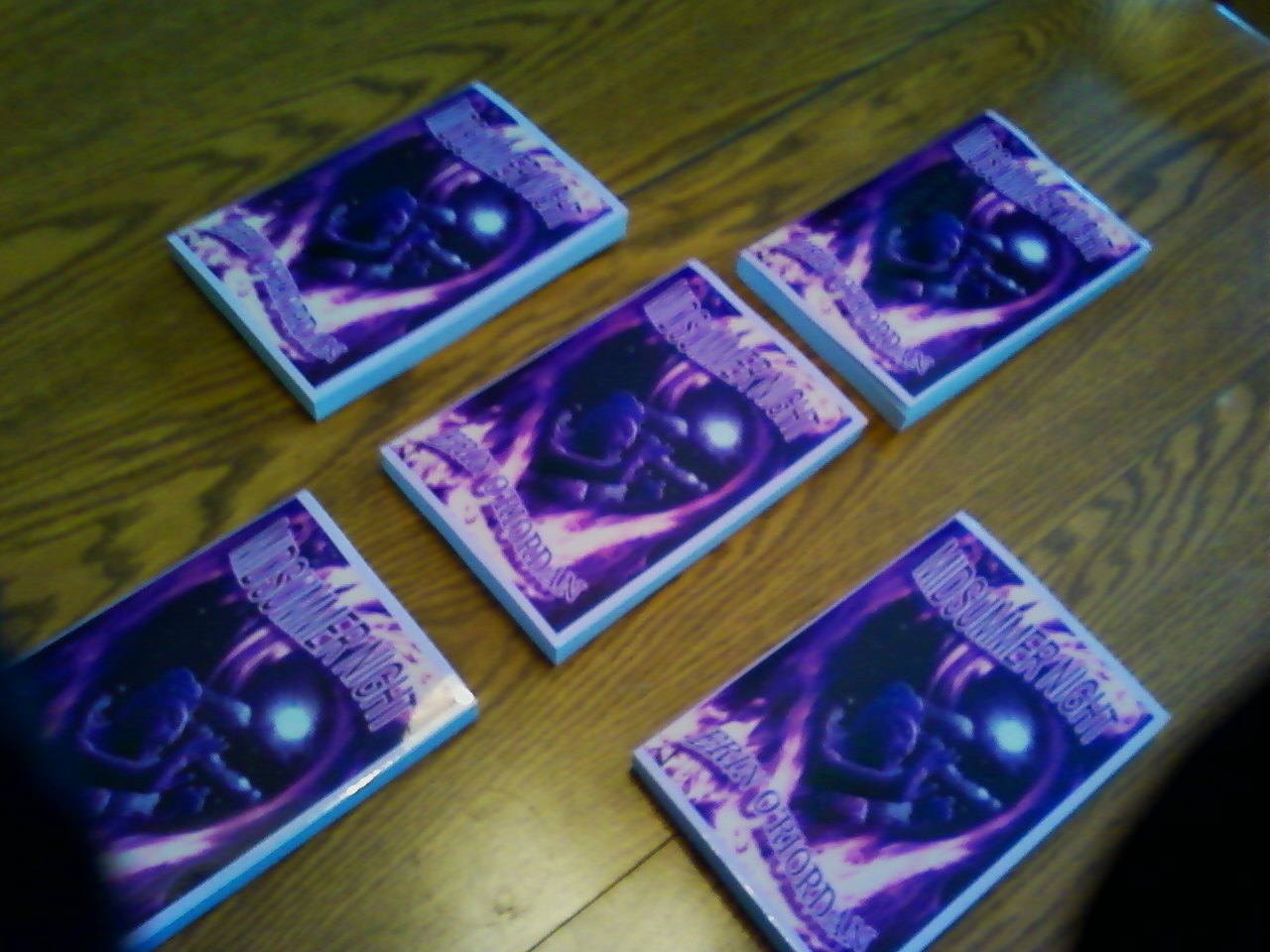
New Lower Price on 'Midsummer Night' Paperback


Have you wanted to buy yourself a paperback copy of my novel Midsummer Night, but been put off by the price at $17.99? I was, too. The first book in the series retails for $9.99, so it didn't seem right that the second book is so expensive. So...I wrote to the publisher, and she got Amazon to lower the price to $12.50. That's more like it!

You can find the paperback version at http://www.amazon.com/Midsummer-Night-Erin-ORiordan/dp/1449928692/ref=ntt_at_ep_dpi_4.

For even more savings, buy the e-book version. You can find it for Kindle at http://www.amazon.com/gp/product/b002z6yueo/ref=dp_proddesc_1?ie=UTF8&n=283155. Don't have a Kindle? No problem. Neither do I, so I downloaded Amazon's free Kindle for PC application. It took about 2 minutes, and now I can read all the e-books available for Kindle. Check them out; the prices are really reasonable. There are even FREE books available for Kindle!

Midsummer Night: Priestess-in-training and part-time witch Zen Van Zandt loves biology grad student Ramesh Sudhra. Only two things stand in the way of their happiness: his traditional Indian-American family doesn't welcome Zen, and Zen-s training requires a yearlong vow of celibacy. Between Ramesh's stern mother's disapproval, Zen's vow of celibacy, and her assistant's romantic troubles with a wild new witch, Zen wonders if she and Ramesh will ever see their wedding day.

Tuesday, March 23, 2010

Again With the Vampires! This Time, It's 'The Vampire Diaries: The Awakening'

I’m usually good about reading a book before it’s turned into a movie or TV show. I read Harry Potter and the Sorcerer’s Stone before the first movie came out, Chamber of Secrets shortly before it came out on film, and the rest of the books long before they made it to the big screen. I was a fan of Sookie Stackhouse and had read all but the latest two of Charlaine Harris’s books about her before tuning in to the True Blood TV series. I read Twilight before it was a movie, then read New Moon, Eclipse, and Breaking Dawn in a mad reading binge before I’d seen a single preview of the New Moon film.


When it comes to The Vampire Diaries, though, I dove into watching the TV series while barely aware of L. J. Smith’s books. I knew nothing about Elena Gilbert or the Salvatore brothers before I tuned to for the premiere.

I’ve finally gotten around to reading the first book in the series, The Awakening. One of my FaceBook friends warned me the books were nothing like the series. I was rather skeptical about that; how different could it really be?, I wondered. My skepticism was misplaced. The book is very different.

On TV, Elena has striking dark hair and brown eyes, as does her historical, vampire counterpart, Katherine. In the book, Elena and Katherine are blondes with lapis lazuli-blue eyes. The setting of the show is Mystic Falls in New England; the book is set in Fell’s Church, in the South*. TV Elena has a teenage brother; book Elena has a four-year-old sister. TV Aunt Judith doesn’t have a boyfriend; book Judith is engaged to a guy named Bob. Bonnie is different: African-American on TV, she’s a small, white girl with curly red hair in the book. The character of Meredith didn’t even make it onto the screen.

The biggest difference, though, has to be in Stefan and Damon Salvatore. On TV, they were born and raised in Mystic Falls and became vampires in the Civil War era. Perhaps this was simply a bit of True Blood rivalry, though. In the books, the Salvatores are from Italy and much, much older. The acquired their supernatural powers during the Renaissance.

I don’t particularly like Elena Gilbert. She’s a silly, shallow, self-centered creature, the sort of stereotypically pretty, popular teenage girl who makes real teenage girls blush with shame. The TV version of Elena is the same way, but the book takes the stereotype a wee bit further by making her a Southern girl. Elena Gilbert is actually the vacuous ice princess Scarlett O’Hara (who was actually quite intelligent, but played dumb to attract boys) was pretending to be. Compared to Elena, Scarlett is a Jimmy Carter-esque humanitarian. Much ado has been made about Bella Swan’s helpless, self-destructive behavior in Stephenie Meyer’s Twilight series, but Elena could wear that crown just as easily.

Nor is L. J. Smith’s writing style a particularly literary one. She can be forgiven for this, perhaps, because she’s writing for a young adult audience. The easy-breezy, fashion-mag tone of the book is ill-suited to its dark subject material. It’s like Elena mistakenly fell off the cover of Teen Vogue and into a pulp horror novel. For readers with more sophisticated tastes, this will hardly do.

http://www.fanpop.com/clubs/nina-dobrev/images/20009160/title/nina-teen-vogue-magazine-scans-april-2011-photo
Still, there’s something intriguing about the storyline that keeps me from wanting to give up on this entire series. Sure, Elena is dumb, and Damon on paper is as detestable as he is on TV. The beating heart of this vampire series, ironically, is Stefan. Like Edward Cullen, he’s a vampire “vegetarian,” preferring to hunt animals rather than people. Unlike Edward, he makes an occasional slip. He has all of Edward’s Byronic, tortured mojo without Edward’s unfortunate, stalker-ish tendencies. He’s the bad boy, but the question here is not whether the girl with a heart of gold can save him, but whether he can save the girl with the heart of nothing.

*In fact, they're both set in Virginia, an error I'd realize when I read the second book in the series. Also, in the TV series, Judith's name is changed to Jenna.

Friday, March 19, 2010

St. Marcus Day: Stephenie Meyer's Myth Vs. Reality


In the film The Twilight Saga: New Moon, Bella arrives in Volterra, Italy just in time to save Edward from revealing himself as a vampire to a throng of mortals at the St. Marcus Day festival on March 19th. Attendees of the festival, clad in red, hooded robes, march in procession bearing a statue of St. Marcus to the church in the center of town. In the Twilight world, “St. Marcus” is celebrated by mortals for having rid the town of vampires, when he was, in fact, a vampire himself. Volterra is the home of the Volturri, the lawgivers of the vampire world. Marcus is one of them. Some Twilight fans wear red on March 19th to mark this holiday.

New Moon author Stephenie Meyer borrowed the fictional St. Marcus Day from the real European celebration of St. Mark’s Day. She changed the date: St. Mark’s Day is April 25th. Because the date coincides with observances of Easter (a moveable feast; the date varies, but it generally occurs in March or April) and a number of other Eurasian spring festivals, it is thought that St. Mark’s Day is a Christianized version of a much older, Pagan observance. Edain McCoy writes, “As was done with many Pagan festivals in Europe, the early church attempted to refocus the symbolism of Ostara [the spring festival for Germanic Pagans] onto the Feast Day of St. Mark. Instead of being a festival of rebirth, the St. Mark’s imagery was concentrated on death and martyrdom, through which Christian rebirth is attained.”

St. Mark is traditionally considered to be the author of the Gospel of Mark in the Christian Bible. He’s believed to be the companion of St. Paul, the great early Christian evangelist, that the Book of Acts of the Apostles refers to as “John Mark.” A disciple of Paul, Mark is thought to have used Paul’s preaching as the basis for the Gospel. He is also remembered as the founder of the Coptic Church. Coptic tradition holds that Mark appears in the Gospels as the young man who carried water to the house where the Last Supper of Jesus and his Apostles took place, as the young man who ran away naked when Jesus was arrested, and to have poured the water Jesus turned into wine at the wedding at Cana.

Mark is said to have been martyred on April 25th in the year 68 in Alexandria, Egypt. A group of local people resented his trying to turn them away from their traditional gods. They placed a rope around his neck and dragged him through the streets until he was dead. His major shrines are in Egypt and Italy. His Italian shrine is the Basilica de San Marco in Venice, which is traditionally said to be the place where Mark’s remains are buried. So, he really does have a connection to Italy, though not specifically to the town of Volterra.

Perhaps because of his martyrdom, many curious traditions grew up over the centuries about the celebration of St. Mark’s feast day. In seventeenth through nineteenth century England, especially in the north and the west, folklore held that the wraiths of those who would die the following year made a procession, in the order they would die, through the churchyard and into church at midnight on St. Mark’s Eve. Some said the procession would be of coffins, or of headless or rotting corpses. Others said the procession would be of identifiable, ghost-like wraiths, and that one could sit and watch the procession as it went by and thus know who was going to die.

To see these wraiths, folklore claimed, one had to be fasting. Another legend held that one had to be present at the churchyard on St. Mark’s Eve for three years in a row, and only in third year would one see the wraiths. Sometimes, these living watchers saw their own wraiths, and died not long after. Another superstition regarding St. Mark’s Eve is that on this night, witches who had sold their souls to the devil (or written their names in the devil’s book) and wished to keep their unearthly powers had to walk three times around the church backwards, peek through the keyhole, and recite certain words, or their powers would be lost.

Another traditional St. Mark’s Eve activity was stirring the ashes of the hearth. If the ashes formed the shape of a shoe, someone who lived in the household would die during the year.

St. Mark’s Eve was one of three nights of the year associated with the dead. The others are St. John’s Eve and All Hallow’s Eve. According to some legends, on these three nights those who have died can return to the earth as spirits. This belief about All Hallow’s Eve (Halloween) is a Christian appropriation of the Celtic harvest festival of Samhain, the point when the veil between the living and the dead was at its thinnest, and also the halfway point between autumn and winter. Similarly, St. Mark’s Eve marks the halfway point between spring and summer and is associated with the Pagan festival of Ostara. St. John’s Eve, traditionally celebrated on June 23rd, is associated with the Pagan feast of Midsummer, or the summer solstice.

Not all of the legends associated with St. Mark’s Eve are associated with death, though.

The night was also one when young women would try to divine whom their future mates would be. There were a number of ways to accomplish this: by picking twelve leaves of sage at midnight, by walking nine times around a haystack while reciting, “Here’s the sheath, now where’s the knife?” or by baking a dumb-cake, eating a piece of the cake, then walking backwards to bed without saying a word (hence the word “dumb”). If a woman did any of these things, but especially if she prayed to St. Mark while doing them, she would see the shadow of, or catch a fleeting glimpse of, the man she would someday marry. However, if she went to bed without seeing such a shadow and dreamed of a newly-dug grave, that meant she would die unmarried.

These are largely English customs, though. In Italy, if St. Mark’s Day is celebrated at all, it is with feasting, drinking, and/or offering bread to the less fortunate. The custom of wearing red and having a procession seems to be Stephenie Meyer’s invention.

References

“English Folklore: St. Mark’s Eve.” http://www.answers.com/topic/st-mark-s-eve-1

“Mark the Evangelist.” http://en.wikipedia.org/wiki/Mark_the_Evangelist

McCoy, Edain. Ostara: Customs, Spells & Rituals for the Rites of Spring. St. Paul: Llewellyn, 2002.

“St. John’s Eve.” http://en.wikipedia.org/wiki/St_John's_Eve

“St. John’s Eve, St. Mark’s Eve.” http://www.infoplease.com/dictionary/brewers/st-johns-eve-st-marks-eve.html

“St. Marcus Day: Fact From Fiction.” http://twilightnovelnovice.com/2009/03/19/st-marcus-day-fact-from-fiction/

“St. Mark’s Eve.“ http://www.childrensnursery.org.uk/british-customs/popular-customs%20-%200299.htm

“The Eve of St. Mark.” http://en.wikisource.org/wiki/The_Eve_of_St._Mark

“Twilight and New Moon fans be sure to wear your red on Thursday for Robert Pattinson and Edward Cullen.” http://www.examiner.com/x-4908-Twilight-Examiner~y2009m3d17-Twilight-and-New-Moon-fans-be-sure-to-wear-your-read-on-Thursday-for-Rob-Pattinson-and-Edward-Cullen

“Volterra, Italy.” http://twilightsaga.wikia.com/wiki/Volterra,_Italy

Thursday, March 11, 2010

Upcoming Events

Sunday, March 14, 2010: Unofficial release date for March 2010 Poetic Monthly Magazine. My column this month is a review of Heather Derr-Smith's Bosnian war poetry in her book Each End of the World.

Monday, March 15: Deadline for submissions to Oysters and Chocolate, Erotic's anthology

Tuesday, March 16: "Womb Pride" article, about an ununsual Twilight fan-made object, goes live at Oysters and Chocolate, Erotic

Erin O'Riordan interview at Whipped Cream goes live

Wednesday, March 17: Happy St. Patrick's Day! Visit Whipped Cream's Yahoo group for a live chat with Erin O'Riordan. Comment for a chance to win a signed copy of Midsummer Night!

Friday, March 19: Live chat with Erin O'Riordan at 9 p.m. on Gather

March 19 is St. Marcus Day, according to Stephanie Meyer's Twilight universe. Look for a special St. Marcus Day post here on Pagan Spirits.